
Author
Suzanne is an Owner/Designer
Author
Suzanne is an Owner/Designer
You bought the sofa, you have enough seating, the lighting works, and the room still feels off. Here's how I diagnose and finish that last 20 percent, plus a DIY checklist if you want to try it yourself first.
You bought the sofa, you have enough seating, the lighting works, and the room still feels off. Here's how I diagnose and finish that last 20 percent, plus a DIY checklist if you want to try it yourself first.

A lot of people have great bones already. A sofa they genuinely love, seating that fits how the family actually sits, enough light to read by. And the room still feels unsettled. Like you're a guest in it.
So you start guessing. Is it the paint? Is it the sofa color? Is it that the walls are bare? Diagnosing it yourself is hard, partly because every style guide contradicts the last one. One says paint it moody. The next says leave it white and let the light do the work.
Here's the short answer: the furniture is usually the easy 80 percent. The last 20 percent is rug size, layered lighting, art at the right height, window treatments, and fixing two or three scale problems you've stopped noticing. That's the part that makes a room read finished, and it's almost never about buying a new sofa.

Signs Your Room Is Almost There
You can usually feel it before you can name it. A few tells I look for first:
Your eye has nowhere to land. You walk in and nothing pulls your attention, so it bounces around the room and never settles.
The furniture is islanding. Pieces are pushed to the walls with a lonely rug floating in the middle, not quite touching anything.
Everything is the same height. Sofa back, chair back, console, all hovering around 32 inches, with a big blank zone above.
You only turn on the ceiling light. If one switch controls the entire mood of the room, the mood will be flat.
The windows are naked or wearing something too short. Bare glass at night turns into a black mirror, which is a surprisingly big part of why a room feels unfinished after dark.
There's nothing personal at eye level. No art, no photos, nothing with a story. The room could belong to anyone.
If you nodded at three or more of those, you don't have a furniture problem. You have a finishing problem, and that's genuinely good news because it's cheaper to fix.
The Pieces That Are Usually Missing
The rug is too small
A rug that only touches the coffee table shrinks the room and disconnects the furniture. As general guidance, I want at least the front legs of every seating piece on the rug, and ideally all four legs in a larger room. Leaving roughly 10 to 18 inches of bare floor around the perimeter tends to look right, though the room's shape decides.
Going up one size is usually the highest-impact thing you can do for the money.
There's only one light source
A room needs three layers to feel alive: overhead or ambient, task light for reading and working, and low accent light that flatters faces at night. One ceiling fixture gives you one layer and a lot of shadows under people's eyes.
If you want the spacing logic behind where fixtures actually belong, I walked through it in this guide to lighting placement.
The walls are empty, or covered in small things
Blank walls read unfinished. Eight tiny frames scattered around read anxious. Big, quiet, and few beats small, busy, and many almost every time.
Most people hang art too high. Center of the piece at roughly 57 to 60 inches from the floor is the common gallery guideline, and over furniture you want the bottom edge close enough to the sofa back that the two read as one group. The full method is in my guide to hanging artwork, and if you want a grouping instead of one big piece, start with the gallery wall walkthrough.
The windows are unaddressed
Curtains do more than block light. They add softness, height, and color, and they cover the black-mirror effect at night. Mounted too low and too narrow, though, they make windows look squat. Here's how I hang curtains so the room gains height instead of losing it.
Nothing has been styled
Styling is not clutter. It's a few objects with different heights and textures placed where your eye naturally goes. A tray, a stack of books, one tall thing, one round thing, something living.
How to Spot Scale and Height Problems
This is the part people can't see in their own homes, because you stop registering a room you walk through fifty times a day.
Try this. Stand in the doorway and take a photo with your phone. Then look at the photo in black and white. Color stops distracting you and you'll immediately see the shapes: the flat horizon line of furniture, the gap over the sofa, the little rug island, the lamp that's too short for the table it's on.
A quick diagnostic:
What you notice | Usual cause | First move |
|---|---|---|
Room feels choppy and small | Rug too small, furniture pushed to walls | Bigger rug, float the seating |
Feels cold or harsh at night | One overhead light, cool bulbs | Two lamps, 2700K bulbs, a dimmer |
Walls feel bare and echoey | Art too small or hung too high | One oversized piece at eye level |
Windows look short and squat | Rod mounted at the trim, panels too short | Rod high and wide, floor-length panels |
Everything is the same height | No vertical elements | Tall lamp, plant, leaning art, tall vase |
Nice pieces that still feel flat | No texture variety | Mix wool, linen, wood, ceramic, metal |
A plug-in dimmer is about the cheapest mood fix in the house, and a slim picture light makes ordinary art look considered.
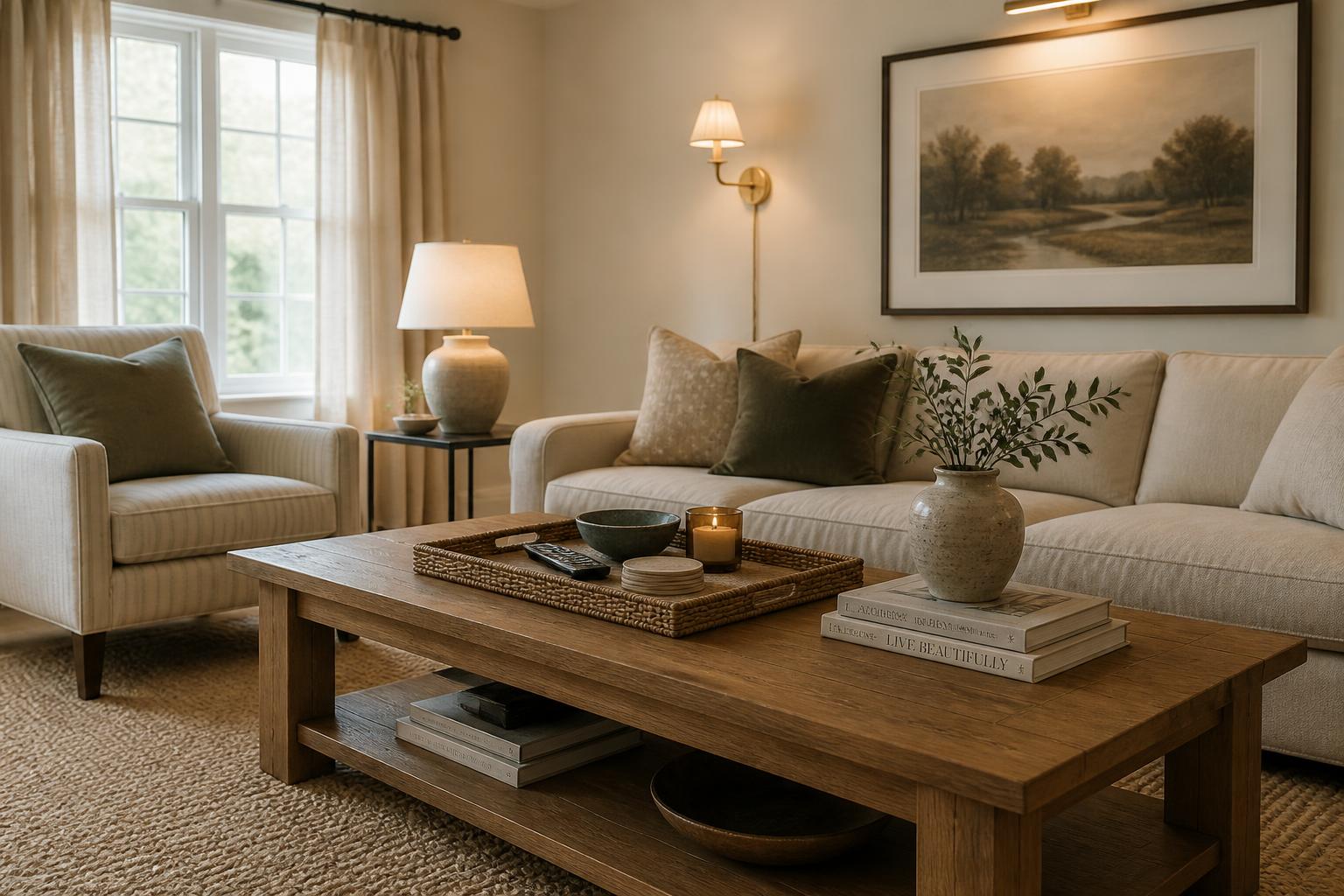
It Depends on Your Space
Small room: Fewer, larger pieces. One oversized art piece instead of a grouping, one big rug instead of two small ones, curtains mounted close to the ceiling. Resist the urge to add more little things. Small rooms get crowded by quantity, not by size.
Large or open-plan room: You probably need to define zones rather than fill them. A second rug, a console behind the sofa, a floor lamp marking the edge of the seating area. Empty corners in a big room are where finishing usually stalls.
Renters: Lean art on a mantel or shelf, use tension rods or a no-drill curtain rod bracket, add plug-in sconces, and put your money into the rug and lamps since those move with you. Skip anything that requires patching.
Owners: This is where paint, hardwired lighting, and window treatment upgrades earn their keep. Fix the ceiling fixture you've hated for four years.
Low light: Warm bulbs, more lamps than you think, light-reflecting textures, and curtains that stack fully off the glass so you keep every bit of daylight. Avoid heavy dark drapery on a dim north-facing window.
Bright light: You can handle deeper colors and heavier texture. Add a sheer layer if glare is a problem, and check that your rug and art aren't in direct afternoon sun all summer.
Kids and pets: Washable or low-pile wool rugs, performance fabric, hang art above grabbing height, and use a tray so the surface clutter has a home. Finished does not mean fragile.
Tight budget: Rug size, bulbs, and one big piece of art. In that order. Those three usually get you most of the way.
If your room needs a plan like this rather than another shopping trip, that's exactly the work I do. Tell me what's not working and I'll tell you what I'd change first.
Shop This Room
As an Amazon Associate, I earn from qualifying purchases. It doesn't change what I recommend.
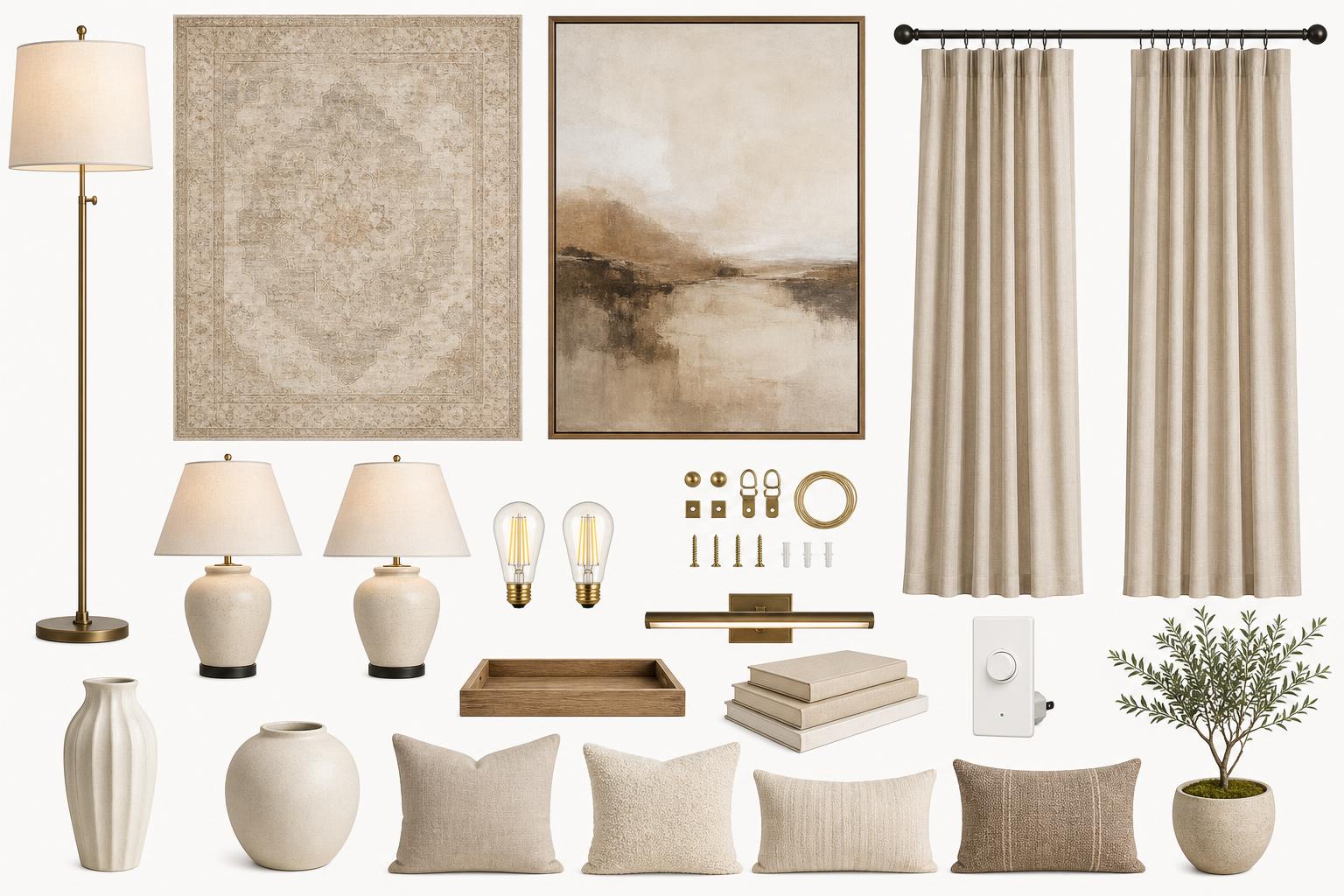
the rug that's actually big enough goes under the full seating group so the sofa and chairs sit on it, not beside it. Undersized rugs are the single most common thing I fix.
the corner lamp that changes the whole evening lives behind or beside the sofa and takes the pressure off your ceiling fixture.
a pair of table lamps that match each other but not everything else sit on end tables or a console to build the second and third light layers.
the warm bulbs that fix the hospital feeling swap into every lamp in the room. Same fixtures, completely different room.
the curtain rod that's longer than you think you need mounts high and wide so the panels stack off the glass and the window looks taller.
linen panels that actually reach the floor hang at the windows. Floor length always. Measure before you order.
one piece of art big enough to matter goes over the sofa or the mantel, where most people hang something far too small.
the hanging kit that keeps it straight saves you from the eleven extra holes.
the tray that makes clutter look intentional sits on the coffee table or ottoman and corrals remotes, coasters, and the candle.
pillow inserts with some actual body go inside the covers you already own. Sad flat pillows make a nice sofa look tired.
What Finishing Actually Involves
When I take on a room that's almost there, I'm not starting over. I'm doing the diagnosis you can't do from inside your own house.
That means measuring the room and the existing pieces, mapping the layout on paper before anything moves, identifying the specific scale problems, and then building a short, specific list: rug size and material, lighting plan, art size and hanging heights, window treatment specs, and a styling plan for the surfaces you already have.
You get a plan you can act on in stages instead of a vague feeling that something is wrong. Scope and current pricing for finishing work live on the services page.
And if the stall point is that you genuinely don't know what you like, start with the Style Discovery quiz. Use the code FRIENDS and it's free, a $49 value. Knowing your direction makes every one of these decisions faster.
The DIY Checklist
Not ready to hire anyone. Fair. Work in this order.
Photograph the room from the doorway. Convert to black and white. Write down the three things that bother you.
Measure your rug. If the front legs of your seating aren't on it, size up before you buy anything else.
Count your light sources. Add lamps until you have three separate ones you can turn on at night.
Swap every bulb to 2700K and add a dimmer where you can.
Hang one large piece of art at the right height. One good piece beats five small ones.
Fix the windows. Rod high and wide, panels touching the floor.
Style one surface with a tray, books, and something tall.
Stop. Live in it a week before adding anything else.
That sequence handles most of the gap between almost and done.

FAQ
Why does my living room feel unfinished even though I have all the furniture?
Usually because the soft layers are missing: an appropriately sized rug, lamp light, art, and window treatments. Furniture fills a room, but those finishing layers are what make it feel considered and comfortable.
What size rug should I get for my living room?
Aim for the front legs of every seating piece to sit on the rug at minimum, and all four legs if the room allows. An 8x10 works for many standard living rooms and a 9x12 for larger ones, but measure your actual seating footprint and let that decide rather than the label.
How high should I hang art above a sofa?
Center the piece around 57 to 60 inches from the floor, and keep the bottom edge roughly 6 to 10 inches above the sofa back so the two read as one group. The art should span about two-thirds of the sofa width.
Is it worth hiring a designer if my room is already mostly done?
Often yes, because the remaining decisions are the ones most people guess at and get wrong twice. A finishing plan is far less expensive than replacing a rug or a set of curtains that turned out to be the wrong size.
How much does it cost to finish a room?
It depends entirely on what's already working and what needs to change. Rug, lighting, and art tend to be the biggest line items, and current pricing for design help is listed on the services page.
Your room is closer than you think. If you want someone to name the last few things and put them in order, let's talk.
A lot of people have great bones already. A sofa they genuinely love, seating that fits how the family actually sits, enough light to read by. And the room still feels unsettled. Like you're a guest in it.
So you start guessing. Is it the paint? Is it the sofa color? Is it that the walls are bare? Diagnosing it yourself is hard, partly because every style guide contradicts the last one. One says paint it moody. The next says leave it white and let the light do the work.
Here's the short answer: the furniture is usually the easy 80 percent. The last 20 percent is rug size, layered lighting, art at the right height, window treatments, and fixing two or three scale problems you've stopped noticing. That's the part that makes a room read finished, and it's almost never about buying a new sofa.
Signs Your Room Is Almost There
You can usually feel it before you can name it. A few tells I look for first:
Your eye has nowhere to land. You walk in and nothing pulls your attention, so it bounces around the room and never settles.
The furniture is islanding. Pieces are pushed to the walls with a lonely rug floating in the middle, not quite touching anything.
Everything is the same height. Sofa back, chair back, console, all hovering around 32 inches, with a big blank zone above.
You only turn on the ceiling light. If one switch controls the entire mood of the room, the mood will be flat.
The windows are naked or wearing something too short. Bare glass at night turns into a black mirror, which is a surprisingly big part of why a room feels unfinished after dark.
There's nothing personal at eye level. No art, no photos, nothing with a story. The room could belong to anyone.
If you nodded at three or more of those, you don't have a furniture problem. You have a finishing problem, and that's genuinely good news because it's cheaper to fix.
The Pieces That Are Usually Missing
The rug is too small
A rug that only touches the coffee table shrinks the room and disconnects the furniture. As general guidance, I want at least the front legs of every seating piece on the rug, and ideally all four legs in a larger room. Leaving roughly 10 to 18 inches of bare floor around the perimeter tends to look right, though the room's shape decides.
Going up one size is usually the highest-impact thing you can do for the money.
There's only one light source
A room needs three layers to feel alive: overhead or ambient, task light for reading and working, and low accent light that flatters faces at night. One ceiling fixture gives you one layer and a lot of shadows under people's eyes.
If you want the spacing logic behind where fixtures actually belong, I walked through it in this guide to lighting placement.
The walls are empty, or covered in small things
Blank walls read unfinished. Eight tiny frames scattered around read anxious. Big, quiet, and few beats small, busy, and many almost every time.
Most people hang art too high. Center of the piece at roughly 57 to 60 inches from the floor is the common gallery guideline, and over furniture you want the bottom edge close enough to the sofa back that the two read as one group. The full method is in my guide to hanging artwork, and if you want a grouping instead of one big piece, start with the gallery wall walkthrough.
The windows are unaddressed
Curtains do more than block light. They add softness, height, and color, and they cover the black-mirror effect at night. Mounted too low and too narrow, though, they make windows look squat. Here's how I hang curtains so the room gains height instead of losing it.
Nothing has been styled
Styling is not clutter. It's a few objects with different heights and textures placed where your eye naturally goes. A tray, a stack of books, one tall thing, one round thing, something living.
How to Spot Scale and Height Problems
This is the part people can't see in their own homes, because you stop registering a room you walk through fifty times a day.
Try this. Stand in the doorway and take a photo with your phone. Then look at the photo in black and white. Color stops distracting you and you'll immediately see the shapes: the flat horizon line of furniture, the gap over the sofa, the little rug island, the lamp that's too short for the table it's on.
A quick diagnostic:
What you notice | Usual cause | First move |
|---|---|---|
Room feels choppy and small | Rug too small, furniture pushed to walls | Bigger rug, float the seating |
Feels cold or harsh at night | One overhead light, cool bulbs | Two lamps, 2700K bulbs, a dimmer |
Walls feel bare and echoey | Art too small or hung too high | One oversized piece at eye level |
Windows look short and squat | Rod mounted at the trim, panels too short | Rod high and wide, floor-length panels |
Everything is the same height | No vertical elements | Tall lamp, plant, leaning art, tall vase |
Nice pieces that still feel flat | No texture variety | Mix wool, linen, wood, ceramic, metal |
A plug-in dimmer is about the cheapest mood fix in the house, and a slim picture light makes ordinary art look considered.
It Depends on Your Space
Small room: Fewer, larger pieces. One oversized art piece instead of a grouping, one big rug instead of two small ones, curtains mounted close to the ceiling. Resist the urge to add more little things. Small rooms get crowded by quantity, not by size.
Large or open-plan room: You probably need to define zones rather than fill them. A second rug, a console behind the sofa, a floor lamp marking the edge of the seating area. Empty corners in a big room are where finishing usually stalls.
Renters: Lean art on a mantel or shelf, use tension rods or a no-drill curtain rod bracket, add plug-in sconces, and put your money into the rug and lamps since those move with you. Skip anything that requires patching.
Owners: This is where paint, hardwired lighting, and window treatment upgrades earn their keep. Fix the ceiling fixture you've hated for four years.
Low light: Warm bulbs, more lamps than you think, light-reflecting textures, and curtains that stack fully off the glass so you keep every bit of daylight. Avoid heavy dark drapery on a dim north-facing window.
Bright light: You can handle deeper colors and heavier texture. Add a sheer layer if glare is a problem, and check that your rug and art aren't in direct afternoon sun all summer.
Kids and pets: Washable or low-pile wool rugs, performance fabric, hang art above grabbing height, and use a tray so the surface clutter has a home. Finished does not mean fragile.
Tight budget: Rug size, bulbs, and one big piece of art. In that order. Those three usually get you most of the way.
If your room needs a plan like this rather than another shopping trip, that's exactly the work I do. Tell me what's not working and I'll tell you what I'd change first.
Shop This Room
As an Amazon Associate, I earn from qualifying purchases. It doesn't change what I recommend.
the rug that's actually big enough goes under the full seating group so the sofa and chairs sit on it, not beside it. Undersized rugs are the single most common thing I fix.
the corner lamp that changes the whole evening lives behind or beside the sofa and takes the pressure off your ceiling fixture.
a pair of table lamps that match each other but not everything else sit on end tables or a console to build the second and third light layers.
the warm bulbs that fix the hospital feeling swap into every lamp in the room. Same fixtures, completely different room.
the curtain rod that's longer than you think you need mounts high and wide so the panels stack off the glass and the window looks taller.
linen panels that actually reach the floor hang at the windows. Floor length always. Measure before you order.
one piece of art big enough to matter goes over the sofa or the mantel, where most people hang something far too small.
the hanging kit that keeps it straight saves you from the eleven extra holes.
the tray that makes clutter look intentional sits on the coffee table or ottoman and corrals remotes, coasters, and the candle.
pillow inserts with some actual body go inside the covers you already own. Sad flat pillows make a nice sofa look tired.
What Finishing Actually Involves
When I take on a room that's almost there, I'm not starting over. I'm doing the diagnosis you can't do from inside your own house.
That means measuring the room and the existing pieces, mapping the layout on paper before anything moves, identifying the specific scale problems, and then building a short, specific list: rug size and material, lighting plan, art size and hanging heights, window treatment specs, and a styling plan for the surfaces you already have.
You get a plan you can act on in stages instead of a vague feeling that something is wrong. Scope and current pricing for finishing work live on the services page.
And if the stall point is that you genuinely don't know what you like, start with the Style Discovery quiz. Use the code FRIENDS and it's free, a $49 value. Knowing your direction makes every one of these decisions faster.
The DIY Checklist
Not ready to hire anyone. Fair. Work in this order.
Photograph the room from the doorway. Convert to black and white. Write down the three things that bother you.
Measure your rug. If the front legs of your seating aren't on it, size up before you buy anything else.
Count your light sources. Add lamps until you have three separate ones you can turn on at night.
Swap every bulb to 2700K and add a dimmer where you can.
Hang one large piece of art at the right height. One good piece beats five small ones.
Fix the windows. Rod high and wide, panels touching the floor.
Style one surface with a tray, books, and something tall.
Stop. Live in it a week before adding anything else.
That sequence handles most of the gap between almost and done.
FAQ
Why does my living room feel unfinished even though I have all the furniture?
Usually because the soft layers are missing: an appropriately sized rug, lamp light, art, and window treatments. Furniture fills a room, but those finishing layers are what make it feel considered and comfortable.
What size rug should I get for my living room?
Aim for the front legs of every seating piece to sit on the rug at minimum, and all four legs if the room allows. An 8x10 works for many standard living rooms and a 9x12 for larger ones, but measure your actual seating footprint and let that decide rather than the label.
How high should I hang art above a sofa?
Center the piece around 57 to 60 inches from the floor, and keep the bottom edge roughly 6 to 10 inches above the sofa back so the two read as one group. The art should span about two-thirds of the sofa width.
Is it worth hiring a designer if my room is already mostly done?
Often yes, because the remaining decisions are the ones most people guess at and get wrong twice. A finishing plan is far less expensive than replacing a rug or a set of curtains that turned out to be the wrong size.
How much does it cost to finish a room?
It depends entirely on what's already working and what needs to change. Rug, lighting, and art tend to be the biggest line items, and current pricing for design help is listed on the services page.
Your room is closer than you think. If you want someone to name the last few things and put them in order, let's talk.
Other Blogs
Other Similar Blogs
Your go-to destination for insightful articles, tips, and inspiration on all things landscaping and outdoor living
Other Blogs
Other Similar Blogs
Your go-to destination for insightful articles, tips, and inspiration on all things landscaping and outdoor living
Other Blogs
Other Similar Blogs
Your go-to destination for insightful articles, tips, and inspiration on all things landscaping and outdoor living


Join our newsletter list
Sign up to get the most recent blog articles in your email every week.