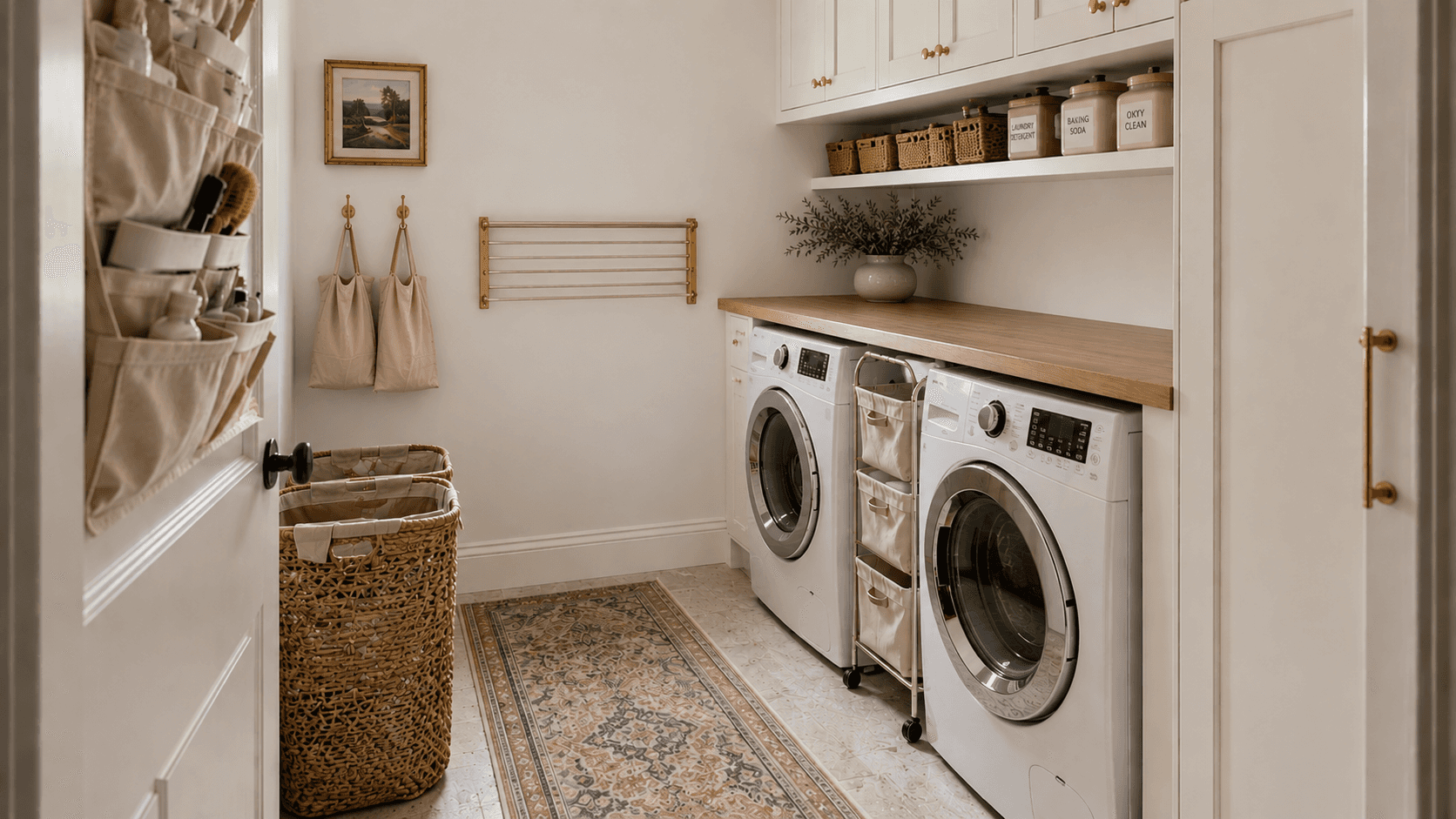
Author
Suzanne is an Owner/Designer
Author
Suzanne is an Owner/Designer
A layout-first guide to making a small laundry room actually work, starting with measurements and workflow zones instead of pretty bins.
A layout-first guide to making a small laundry room actually work, starting with measurements and workflow zones instead of pretty bins.
Laundry Room Organization for Small Spaces: A Complete Layout and Storage Guide
*This blog contains affiliate links.
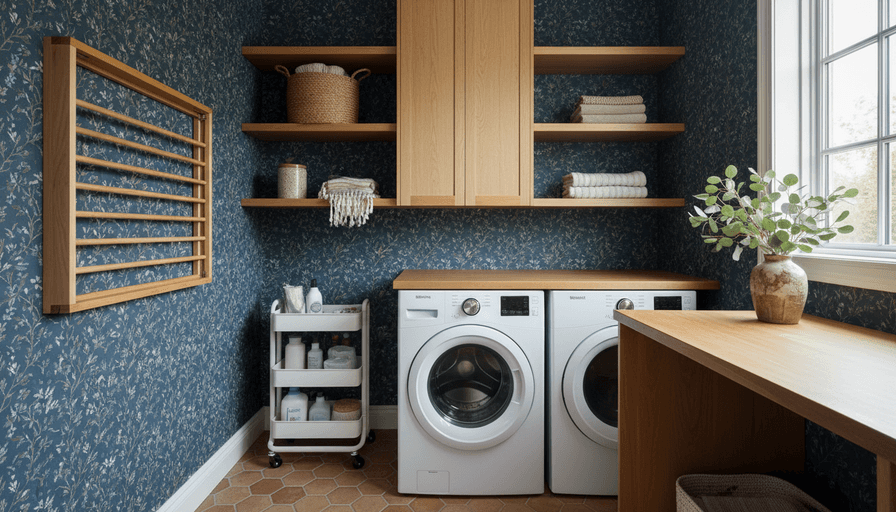
You know, but like, does it ever end? I have looked into laundry service because woo, it is a mountain. Unfortunately I am not at a point where that is a luxury I can afford, so in its place I have created some laundry systems that work.
Actually my favorite room from my home renovation was putting my laundry room adjacent to both my bathroom as well as my kids'. Jack and Jill style. Now this isn't for everyone, but for my optimized-efficiency brain it makes things so much faster to put clothes into the washer and enormously faster when folding and putting away. Outside of you having to complete a renovation, lets talk through some ways you can make it work for you.
Because heres the thing. Most laundry room "makeovers" start with matching containers and cute labels. And those are fine. But if you haven't thought about where your body actually moves in that room, no amount of organization products will fix the bottleneck.
So were starting with measurements. Then workflow. Then products. In that order.
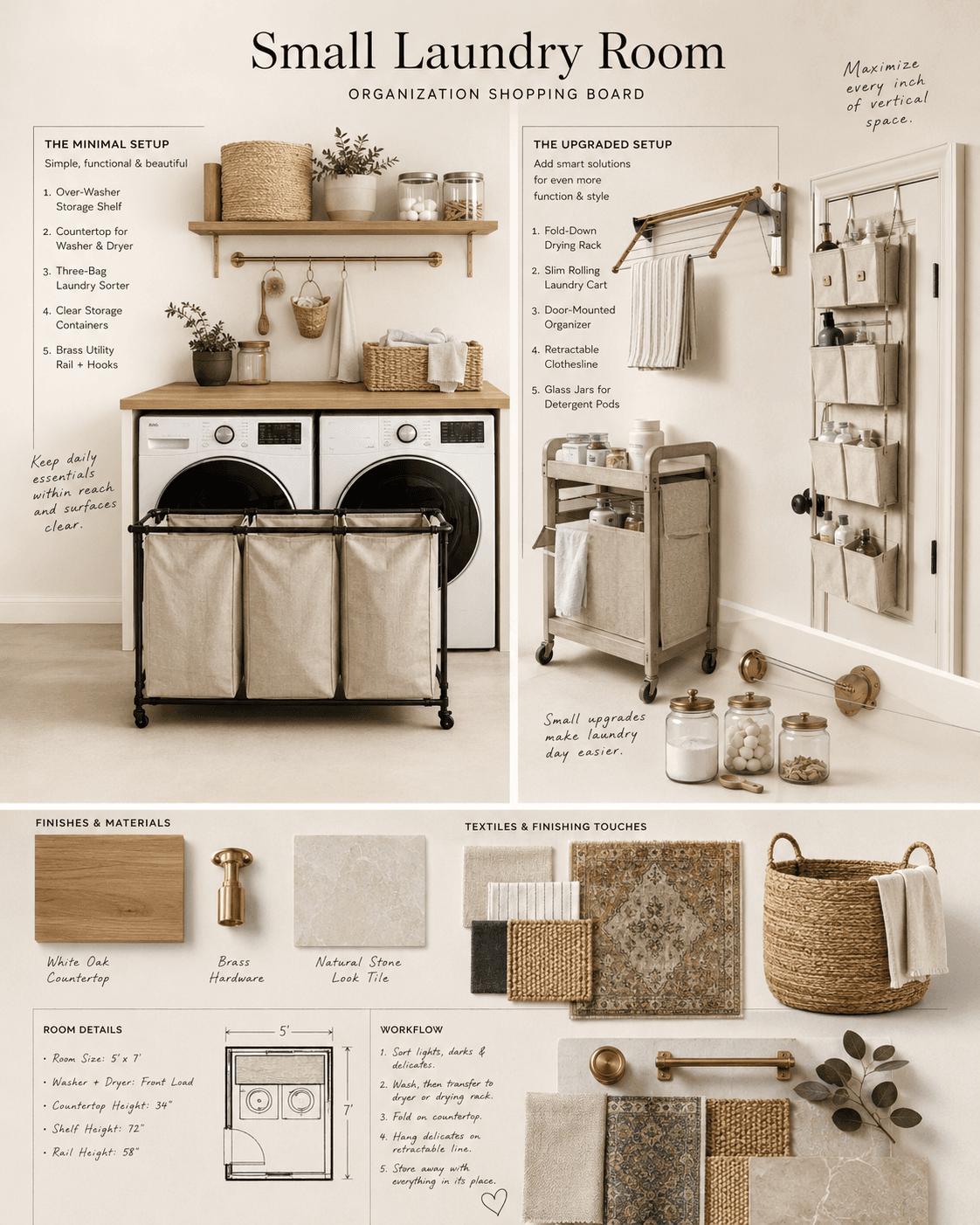
Shop This Room
Before we get into the layout strategy, here are the pieces that come up throughout this post. Everything is sized for small laundry rooms (most under 30 inches wide or designed to mount on walls).
Over-washer storage shelf for vertical storage above your machines
Wall-mounted fold-down drying rack that disappears when you dont need it
Slim rolling cart laundry for that weird gap between machines
3-bag laundry sorter so sorting happens before washing, not during
Countertop over washer dryer for a folding surface that actually fits
Door mounted organizer rack because that door back is free real estate
Clear labeled storage containers laundry for pods, dryer sheets, stain sticks
Retractable clothesline indoor for delicates that cant go in the dryer
Start With the Measurements (Seriously)
I know this isn't the fun part. But I have seen so many "organization hauls" where someone buys a gorgeous shelf unit and it blocks the dryer vent. Or a hamper that doesn't fit when the door swings open. So.
The numbers that matter:
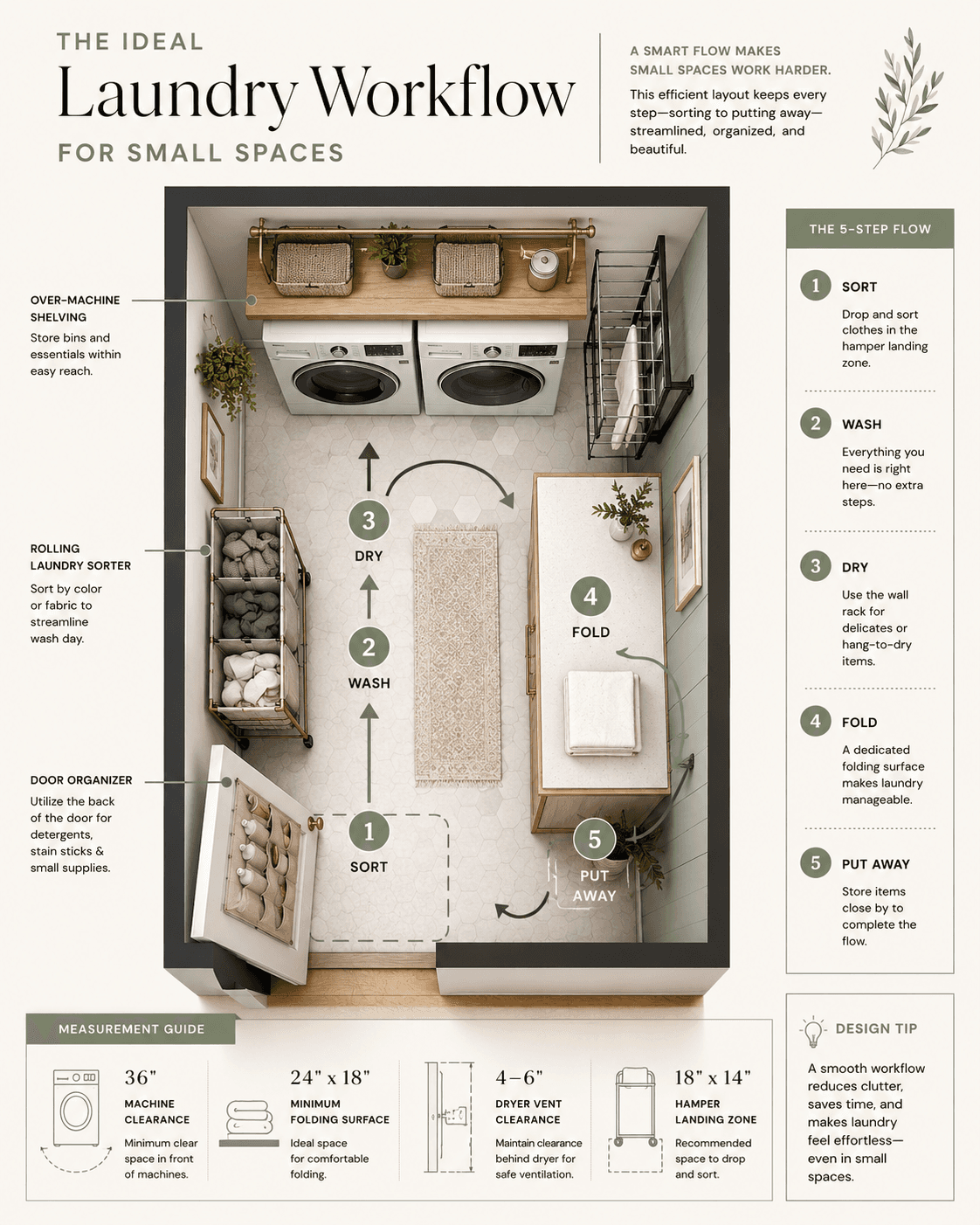
Standard washer/dryer footprint: roughly 27 inches wide x 30-33 inches deep each. If you have a stackable unit, you're looking at about 27 x 30 in floor area and around 75-77 inches tall.
Clearance behind machines: you need 4-6 inches behind the dryer for the vent hose. This is non-negotiable and its the reason your room always feels tighter than you measured.
Door swing: measure your door open at 90 degrees. Mark where it ends. Everything you place in the room has to clear that arc.
Folding surface: you want at minimum 24 x 18 inches of flat surface to fold a bath towel in half. If you dont have counter space, this becomes the constraint that drives everything else.
Hamper landing zone: a loaded hamper needs about 18 x 14 inches on the floor. Two hampers side by side, 36 inches of wall. Most of you dont have that, which is why a rolling sorter with bags that tucks into a closet or hallway is the better move.
Measure your room with the machines in place. Not before. Not from the listing photos. With the machines shoved back and the vent connected. That is your actual room.
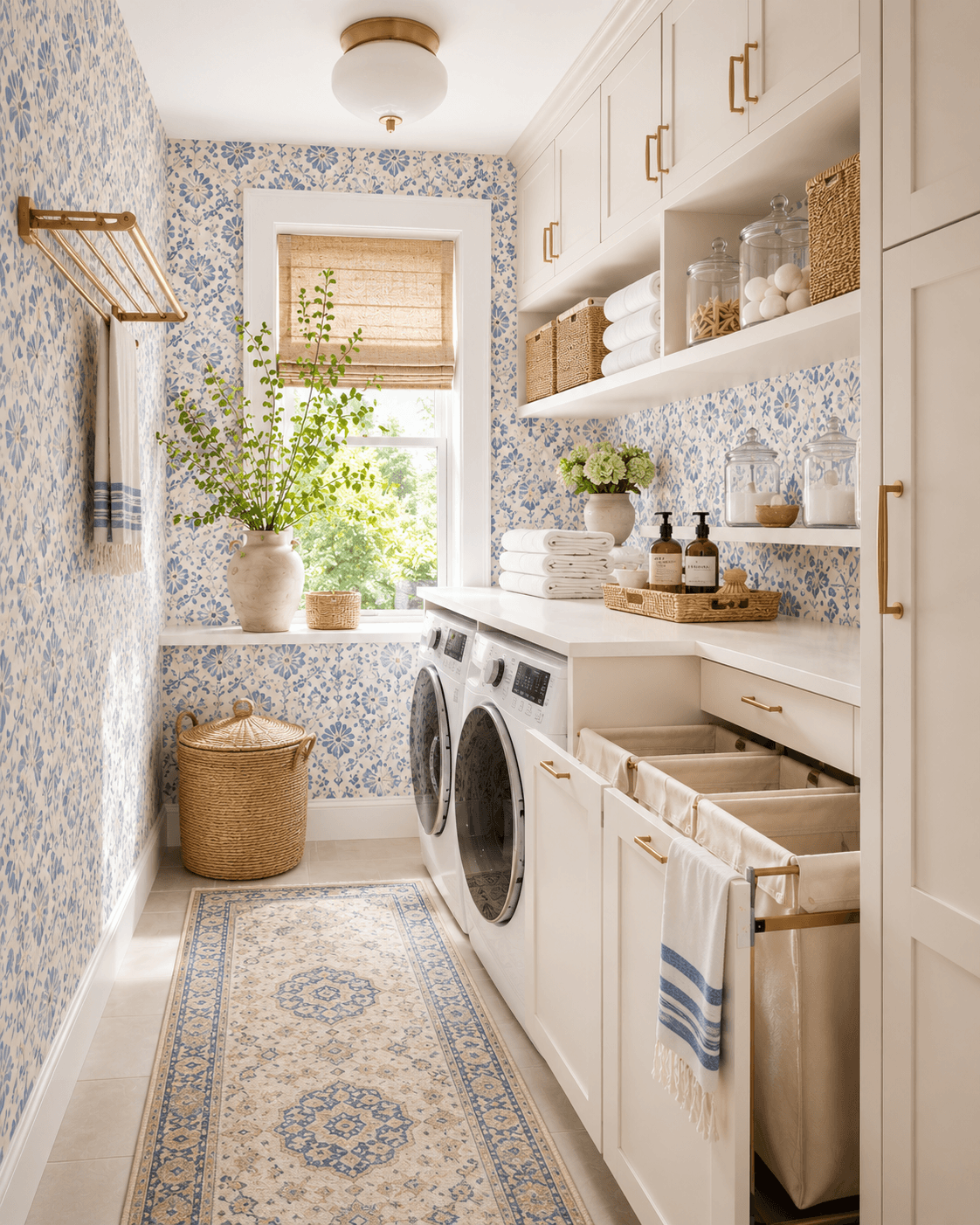
The Hot Zones
I think about laundry rooms the same way I used to think about workstations. There are hot zones, places where your hands and body are doing the most repetitive work, and everything else should serve those zones.
Hot Zone 1: The machine openings. You stand here the most. This is where you load, unload, add detergent, pull out lint. You need about 36 inches of clear floor in front of your machines to open doors comfortably, especially front-loaders. If you have top-loaders, you need overhead clearance (no shelf lower than 48 inches above the machine top unless you can never fully open the lid, which always makes me nervous).
Hot Zone 2: The folding surface. This is the single most skipped zone in small laundry rooms and its the reason clean clothes end up in a basket on the couch for four days. You need a surface. It can be a countertop that sits over your washer and dryer, a wall-mounted drop-leaf table, or even a sturdy board that slides out from a shelf. It just has to exist.
Hot Zone 3: The hamper landing. Where do dirty clothes arrive? If the answer is "they get carried in from wherever," then this zone needs a home. A wheeled sorter that parks outside the room and rolls in on laundry day is one of the simplest things you can do.
Your Laundry Workflow, Mapped to the Room
This is the part where everything clicks. Or doesn't.
Laundry has five steps: sort, wash, dry, fold, put away. Each one should happen in a specific physical spot. When any step doesn't have a spot, thats where the pileup starts.
Sort → outside the room or at the entrance. Sorting shouldn't happen in front of the washer. You should arrive at the machine with a pre-sorted load. A 3-bag sorter (lights, darks, delicates) in a hallway, bathroom, or bedroom closet handles this. If you absolutely have to sort in the laundry room, keep the sorter next to the door, not between you and the machines.
Wash → at the washer. Obvious. Keep detergent, stain treatment, and pods within arm's reach of the washer opening. Not on a shelf across the room. A small shelf riser right next to or above the washer is perfect here.
Dry → at the dryer + a wall-mounted rack. Most stuff goes in the dryer. Delicates and anything you don't want to shrink goes on a fold-down wall rack or a retractable clothesline that you can string across the room above head height. I have one that spans 42 inches across the room at 6 feet up. It holds maybe 8-10 items and I forget its there when its retracted.
Fold → on your folding surface. We talked about this. The counter, the drop-leaf, the board. Whatever it is, this is its only job.
Put away → out the door. This step is the one that breaks. Clothes get folded and then just sit. The fix isnt a product, its proximity. If your laundry room is near the bedrooms (like my Jack and Jill setup), folded stacks go directly into rooms. If its in a basement, a set of labeled sorting baskets by family member means each person grabs their own basket and carries it upstairs. One trip per person. Done.
Going Vertical: The Storage Strategy That Actually Fits
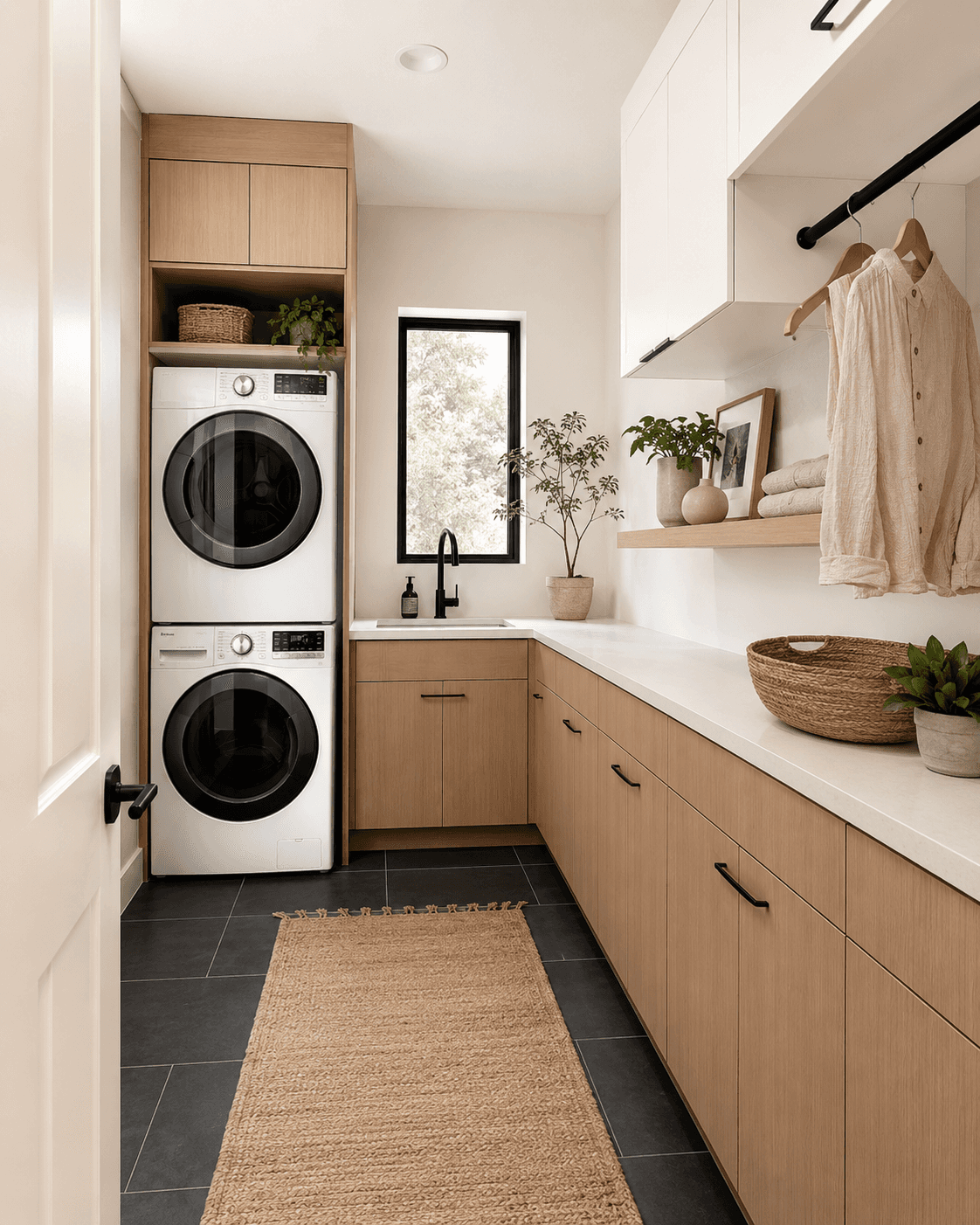
Small laundry rooms have one abundant resource: wall height. And most of us ignore everything above 5 feet.
Tier 1: Over the machines. An over-washer shelving unit gives you 2-3 shelves without taking any floor area. Use the lowest shelf for daily items (detergent, dryer sheets, stain pen). Use the upper shelves for things you grab weekly or less (extra supplies, specialty detergents, the mesh bags you always forget about).
Tier 2: The walls beside the machines. A wall-mounted utility rail with hooks lets you hang a dustpan, a lint brush, that one spray bottle you use for pretreating. These take up maybe 2 inches of depth. They keep your counter and shelf surfaces clear.
Tier 3: The door. If your laundry room has a door that swings into a hallway (not into the room), the back of that door holds an over-door organizer beautifully. Dryer sheets, clothespins, stain sticks, sewing kit. All the small stuff that otherwise clutters a shelf.
Tier 4: The ceiling area. A retractable clothesline or a ceiling-mounted drying rack uses airspace above your head. Its genuinely one of the most underused zones in any room.
The rule I follow: if its used daily, it lives between your waist and your shoulders. If its used weekly, it can go higher. If its used monthly, top shelf or behind the door.
What Not to Store in the Laundry Room
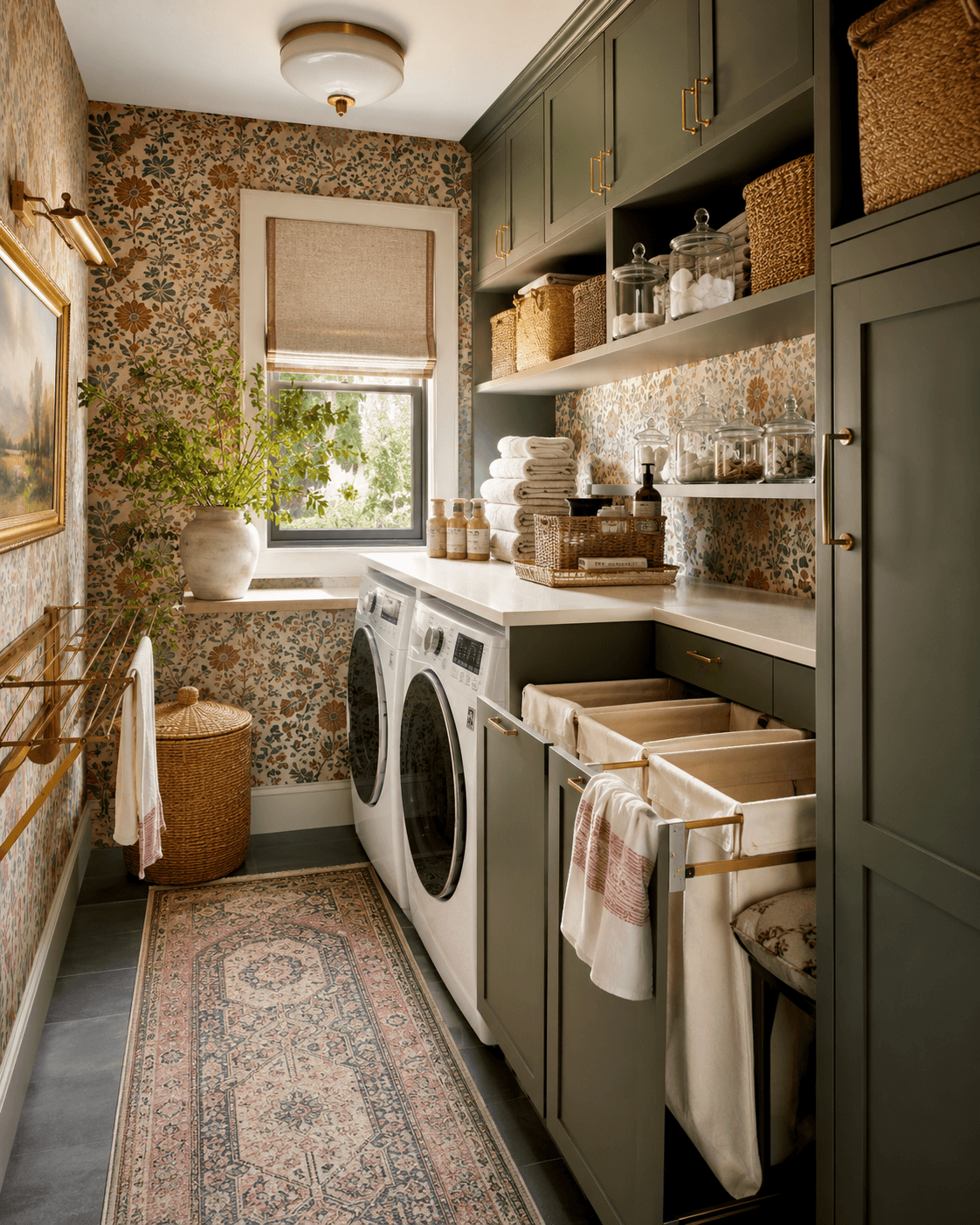
This trips up a lot of folks. The laundry room feels like a utility catch-all, but its actually one of the worst rooms for storing certain things because of humidity and heat cycling.
Don't store these here:
Medicines or vitamins. Humidity degrades them faster than you think.
Important papers or documents. I once found a stack of warranty cards behind someones dryer that had basically composted.
Electronics or batteries. Heat cycling and moisture. Bad combo.
Extra towels or linens you don't use weekly. They absorb moisture and develop that stale smell.
Pet food. Humidity makes kibble go stale and can attract pests.
Anything in cardboard boxes long-term. Cardboard absorbs moisture, weakens, and eventually grows mold in a room that cycles between hot and humid.
Your laundry room stores laundry supplies, cleaning supplies, and thats about it. Resist the urge to make it the everything-overflow room.
This is exactly what I do for clients. Want me to design your room like this?
I help with full room layouts, starting with how you actually move through the room and working backward to the products that fit. Not the other way around. Book a Room Systems Plan if you want a layout plan for your laundry room (or any room thats fighting you).
And if you're not sure what your style is yet, Style Discovery is a good place to start. It takes about 5 minutes and its kind of fun. I say kind of because you'll probably disagree with at least one of the results, and honestly, that tracks.
The Minimal Setup (Under $100)
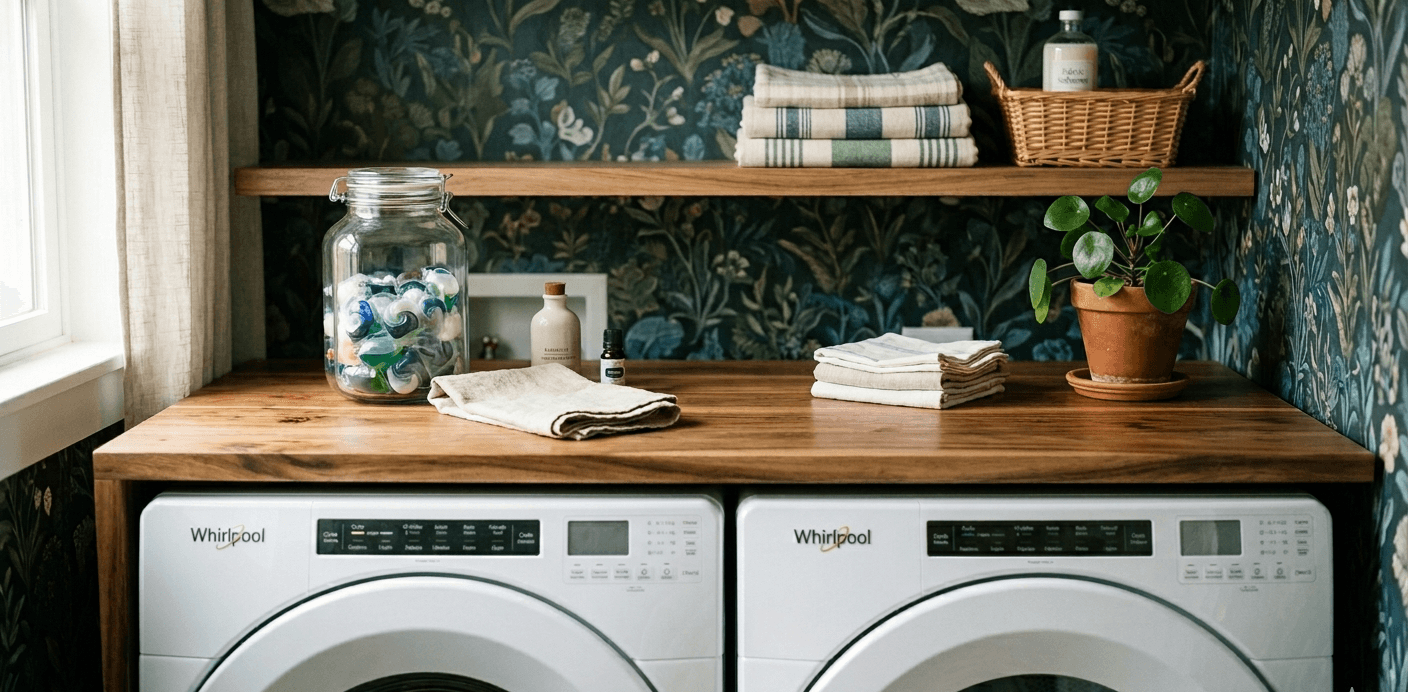
If you're renting, tight on budget, or just want to stop the chaos without a full overhaul, here are the non-negotiables.
A folding surface. Even a simple bamboo shelf board placed over the machines gives you somewhere to fold.
A 3-bag sorter. This kind of wheeled sorter lives outside the laundry room and rolls in when needed.
One wall-mounted drying rack. The fold-down type collapses flat when not in use.
A small container for daily supplies. A caddy or turntable for detergent and pods keeps everything in one spot next to the washer.
Thats it. Four things. The room will function differently within a week.
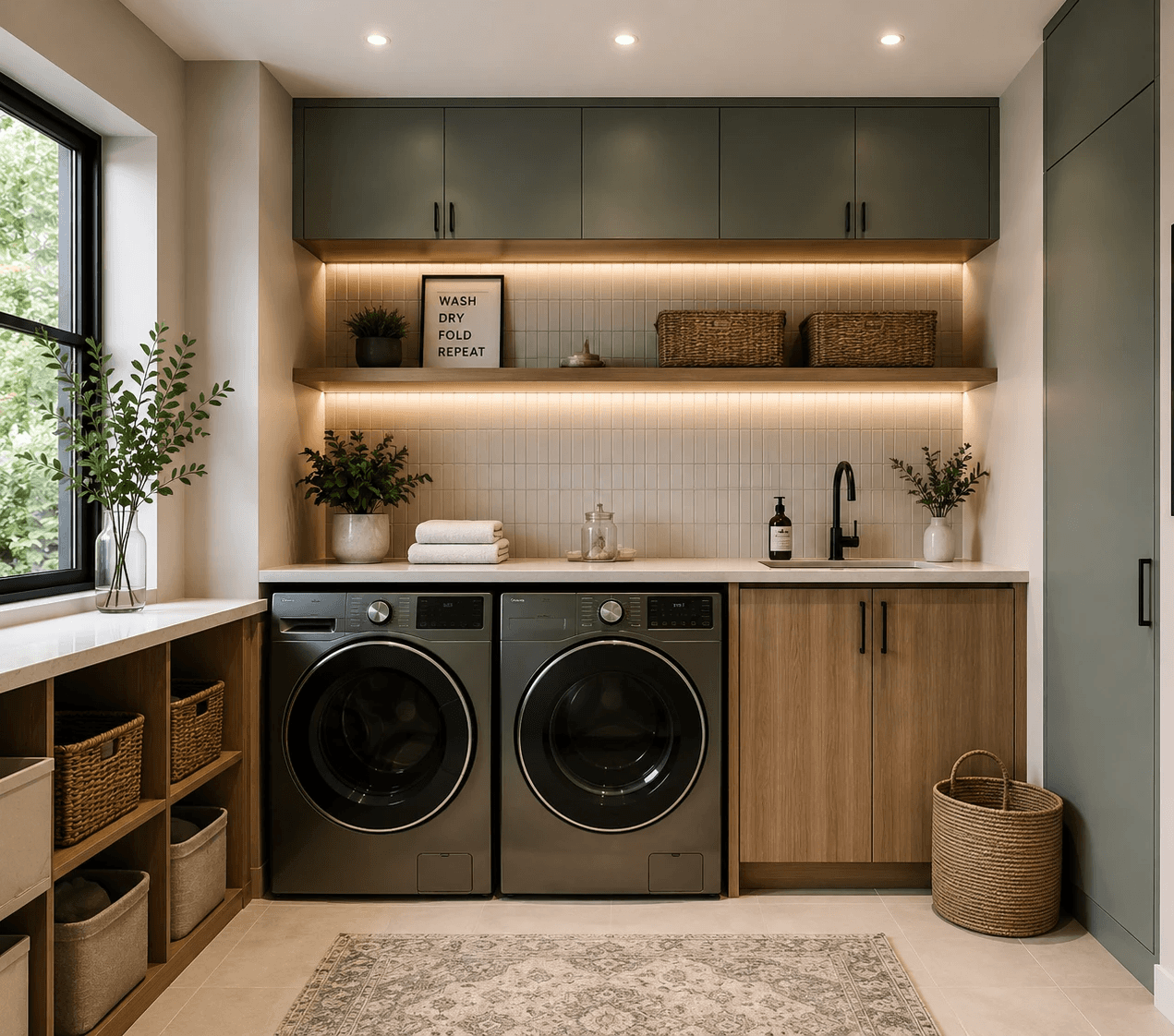
The Upgraded Setup (Under $300)
If you own the room and want to go further:
Everything from the minimal setup, plus:
An over-machine shelving unit. A freestanding 2-3 tier shelf that doesnt require wall mounting.
A slim rolling cart. Fits in the gap between machines (usually 6-10 inches). Holds detergent, dryer balls, stain remover.
Wall-mounted utility rail and hooks. A rail system for hanging tools, spray bottles, and that ironing board you never know where to put.
A retractable clothesline. Mounts on opposite walls and gives you drying room without taking floor area.
Door-back organizer. Over-the-door rack for all the small supplies.
Labeled containers. Clear, uniform jars or bins on your shelves so everything looks and feels intentional.
The difference between these two setups isn't really about money. Its about how many of the five workflow steps you want to physically build into the room versus just mentally keep track of.
One Last Thing
I think about laundry rooms more than is probably healthy. And the thing I keep coming back to is that they fail for the same reason kitchens sometimes fail. Not because they're small, but because the workflow wasn't designed. It was just inherited.
You opened the door, the machines were there, and everything else just accumulated around them.
The good news is its one of the fastest rooms to fix. A Saturday afternoon, a tape measure, and some intention. Thats the whole project.
And if you want help thinking it through, thats what I'm here for. Let's Make it Happen
If you're looking for help with your foyer set up you can find that here, help with your fridge organization you can find that here, or help with windows that are especially tricky find that here?
Laundry Room Organization for Small Spaces: A Complete Layout and Storage Guide
*This blog contains affiliate links.
You know, but like, does it ever end? I have looked into laundry service because woo, it is a mountain. Unfortunately I am not at a point where that is a luxury I can afford, so in its place I have created some laundry systems that work.
Actually my favorite room from my home renovation was putting my laundry room adjacent to both my bathroom as well as my kids'. Jack and Jill style. Now this isn't for everyone, but for my optimized-efficiency brain it makes things so much faster to put clothes into the washer and enormously faster when folding and putting away. Outside of you having to complete a renovation, lets talk through some ways you can make it work for you.
Because heres the thing. Most laundry room "makeovers" start with matching containers and cute labels. And those are fine. But if you haven't thought about where your body actually moves in that room, no amount of organization products will fix the bottleneck.
So were starting with measurements. Then workflow. Then products. In that order.
Shop This Room
Before we get into the layout strategy, here are the pieces that come up throughout this post. Everything is sized for small laundry rooms (most under 30 inches wide or designed to mount on walls).
Over-washer storage shelf for vertical storage above your machines
Wall-mounted fold-down drying rack that disappears when you dont need it
Slim rolling cart laundry for that weird gap between machines
3-bag laundry sorter so sorting happens before washing, not during
Countertop over washer dryer for a folding surface that actually fits
Door mounted organizer rack because that door back is free real estate
Clear labeled storage containers laundry for pods, dryer sheets, stain sticks
Retractable clothesline indoor for delicates that cant go in the dryer
Start With the Measurements (Seriously)
I know this isn't the fun part. But I have seen so many "organization hauls" where someone buys a gorgeous shelf unit and it blocks the dryer vent. Or a hamper that doesn't fit when the door swings open. So.
The numbers that matter:
Standard washer/dryer footprint: roughly 27 inches wide x 30-33 inches deep each. If you have a stackable unit, you're looking at about 27 x 30 in floor area and around 75-77 inches tall.
Clearance behind machines: you need 4-6 inches behind the dryer for the vent hose. This is non-negotiable and its the reason your room always feels tighter than you measured.
Door swing: measure your door open at 90 degrees. Mark where it ends. Everything you place in the room has to clear that arc.
Folding surface: you want at minimum 24 x 18 inches of flat surface to fold a bath towel in half. If you dont have counter space, this becomes the constraint that drives everything else.
Hamper landing zone: a loaded hamper needs about 18 x 14 inches on the floor. Two hampers side by side, 36 inches of wall. Most of you dont have that, which is why a rolling sorter with bags that tucks into a closet or hallway is the better move.
Measure your room with the machines in place. Not before. Not from the listing photos. With the machines shoved back and the vent connected. That is your actual room.
The Hot Zones
I think about laundry rooms the same way I used to think about workstations. There are hot zones, places where your hands and body are doing the most repetitive work, and everything else should serve those zones.
Hot Zone 1: The machine openings. You stand here the most. This is where you load, unload, add detergent, pull out lint. You need about 36 inches of clear floor in front of your machines to open doors comfortably, especially front-loaders. If you have top-loaders, you need overhead clearance (no shelf lower than 48 inches above the machine top unless you can never fully open the lid, which always makes me nervous).
Hot Zone 2: The folding surface. This is the single most skipped zone in small laundry rooms and its the reason clean clothes end up in a basket on the couch for four days. You need a surface. It can be a countertop that sits over your washer and dryer, a wall-mounted drop-leaf table, or even a sturdy board that slides out from a shelf. It just has to exist.
Hot Zone 3: The hamper landing. Where do dirty clothes arrive? If the answer is "they get carried in from wherever," then this zone needs a home. A wheeled sorter that parks outside the room and rolls in on laundry day is one of the simplest things you can do.
Your Laundry Workflow, Mapped to the Room
This is the part where everything clicks. Or doesn't.
Laundry has five steps: sort, wash, dry, fold, put away. Each one should happen in a specific physical spot. When any step doesn't have a spot, thats where the pileup starts.
Sort → outside the room or at the entrance. Sorting shouldn't happen in front of the washer. You should arrive at the machine with a pre-sorted load. A 3-bag sorter (lights, darks, delicates) in a hallway, bathroom, or bedroom closet handles this. If you absolutely have to sort in the laundry room, keep the sorter next to the door, not between you and the machines.
Wash → at the washer. Obvious. Keep detergent, stain treatment, and pods within arm's reach of the washer opening. Not on a shelf across the room. A small shelf riser right next to or above the washer is perfect here.
Dry → at the dryer + a wall-mounted rack. Most stuff goes in the dryer. Delicates and anything you don't want to shrink goes on a fold-down wall rack or a retractable clothesline that you can string across the room above head height. I have one that spans 42 inches across the room at 6 feet up. It holds maybe 8-10 items and I forget its there when its retracted.
Fold → on your folding surface. We talked about this. The counter, the drop-leaf, the board. Whatever it is, this is its only job.
Put away → out the door. This step is the one that breaks. Clothes get folded and then just sit. The fix isnt a product, its proximity. If your laundry room is near the bedrooms (like my Jack and Jill setup), folded stacks go directly into rooms. If its in a basement, a set of labeled sorting baskets by family member means each person grabs their own basket and carries it upstairs. One trip per person. Done.
Going Vertical: The Storage Strategy That Actually Fits
Small laundry rooms have one abundant resource: wall height. And most of us ignore everything above 5 feet.
Tier 1: Over the machines. An over-washer shelving unit gives you 2-3 shelves without taking any floor area. Use the lowest shelf for daily items (detergent, dryer sheets, stain pen). Use the upper shelves for things you grab weekly or less (extra supplies, specialty detergents, the mesh bags you always forget about).
Tier 2: The walls beside the machines. A wall-mounted utility rail with hooks lets you hang a dustpan, a lint brush, that one spray bottle you use for pretreating. These take up maybe 2 inches of depth. They keep your counter and shelf surfaces clear.
Tier 3: The door. If your laundry room has a door that swings into a hallway (not into the room), the back of that door holds an over-door organizer beautifully. Dryer sheets, clothespins, stain sticks, sewing kit. All the small stuff that otherwise clutters a shelf.
Tier 4: The ceiling area. A retractable clothesline or a ceiling-mounted drying rack uses airspace above your head. Its genuinely one of the most underused zones in any room.
The rule I follow: if its used daily, it lives between your waist and your shoulders. If its used weekly, it can go higher. If its used monthly, top shelf or behind the door.
What Not to Store in the Laundry Room
This trips up a lot of folks. The laundry room feels like a utility catch-all, but its actually one of the worst rooms for storing certain things because of humidity and heat cycling.
Don't store these here:
Medicines or vitamins. Humidity degrades them faster than you think.
Important papers or documents. I once found a stack of warranty cards behind someones dryer that had basically composted.
Electronics or batteries. Heat cycling and moisture. Bad combo.
Extra towels or linens you don't use weekly. They absorb moisture and develop that stale smell.
Pet food. Humidity makes kibble go stale and can attract pests.
Anything in cardboard boxes long-term. Cardboard absorbs moisture, weakens, and eventually grows mold in a room that cycles between hot and humid.
Your laundry room stores laundry supplies, cleaning supplies, and thats about it. Resist the urge to make it the everything-overflow room.
This is exactly what I do for clients. Want me to design your room like this?
I help with full room layouts, starting with how you actually move through the room and working backward to the products that fit. Not the other way around. Book a Room Systems Plan if you want a layout plan for your laundry room (or any room thats fighting you).
And if you're not sure what your style is yet, Style Discovery is a good place to start. It takes about 5 minutes and its kind of fun. I say kind of because you'll probably disagree with at least one of the results, and honestly, that tracks.
The Minimal Setup (Under $100)
If you're renting, tight on budget, or just want to stop the chaos without a full overhaul, here are the non-negotiables.
A folding surface. Even a simple bamboo shelf board placed over the machines gives you somewhere to fold.
A 3-bag sorter. This kind of wheeled sorter lives outside the laundry room and rolls in when needed.
One wall-mounted drying rack. The fold-down type collapses flat when not in use.
A small container for daily supplies. A caddy or turntable for detergent and pods keeps everything in one spot next to the washer.
Thats it. Four things. The room will function differently within a week.
The Upgraded Setup (Under $300)
If you own the room and want to go further:
Everything from the minimal setup, plus:
An over-machine shelving unit. A freestanding 2-3 tier shelf that doesnt require wall mounting.
A slim rolling cart. Fits in the gap between machines (usually 6-10 inches). Holds detergent, dryer balls, stain remover.
Wall-mounted utility rail and hooks. A rail system for hanging tools, spray bottles, and that ironing board you never know where to put.
A retractable clothesline. Mounts on opposite walls and gives you drying room without taking floor area.
Door-back organizer. Over-the-door rack for all the small supplies.
Labeled containers. Clear, uniform jars or bins on your shelves so everything looks and feels intentional.
The difference between these two setups isn't really about money. Its about how many of the five workflow steps you want to physically build into the room versus just mentally keep track of.
One Last Thing
I think about laundry rooms more than is probably healthy. And the thing I keep coming back to is that they fail for the same reason kitchens sometimes fail. Not because they're small, but because the workflow wasn't designed. It was just inherited.
You opened the door, the machines were there, and everything else just accumulated around them.
The good news is its one of the fastest rooms to fix. A Saturday afternoon, a tape measure, and some intention. Thats the whole project.
And if you want help thinking it through, thats what I'm here for. Let's Make it Happen
If you're looking for help with your foyer set up you can find that here, help with your fridge organization you can find that here, or help with windows that are especially tricky find that here?
Other Blogs
Other Similar Blogs
Your go-to destination for insightful articles, tips, and inspiration on all things landscaping and outdoor living
Other Blogs
Other Similar Blogs
Your go-to destination for insightful articles, tips, and inspiration on all things landscaping and outdoor living
Other Blogs
Other Similar Blogs
Your go-to destination for insightful articles, tips, and inspiration on all things landscaping and outdoor living


Join our newsletter list
Sign up to get the most recent blog articles in your email every week.