Author
Suzanne is an Owner/Designer
Author
Suzanne is an Owner/Designer
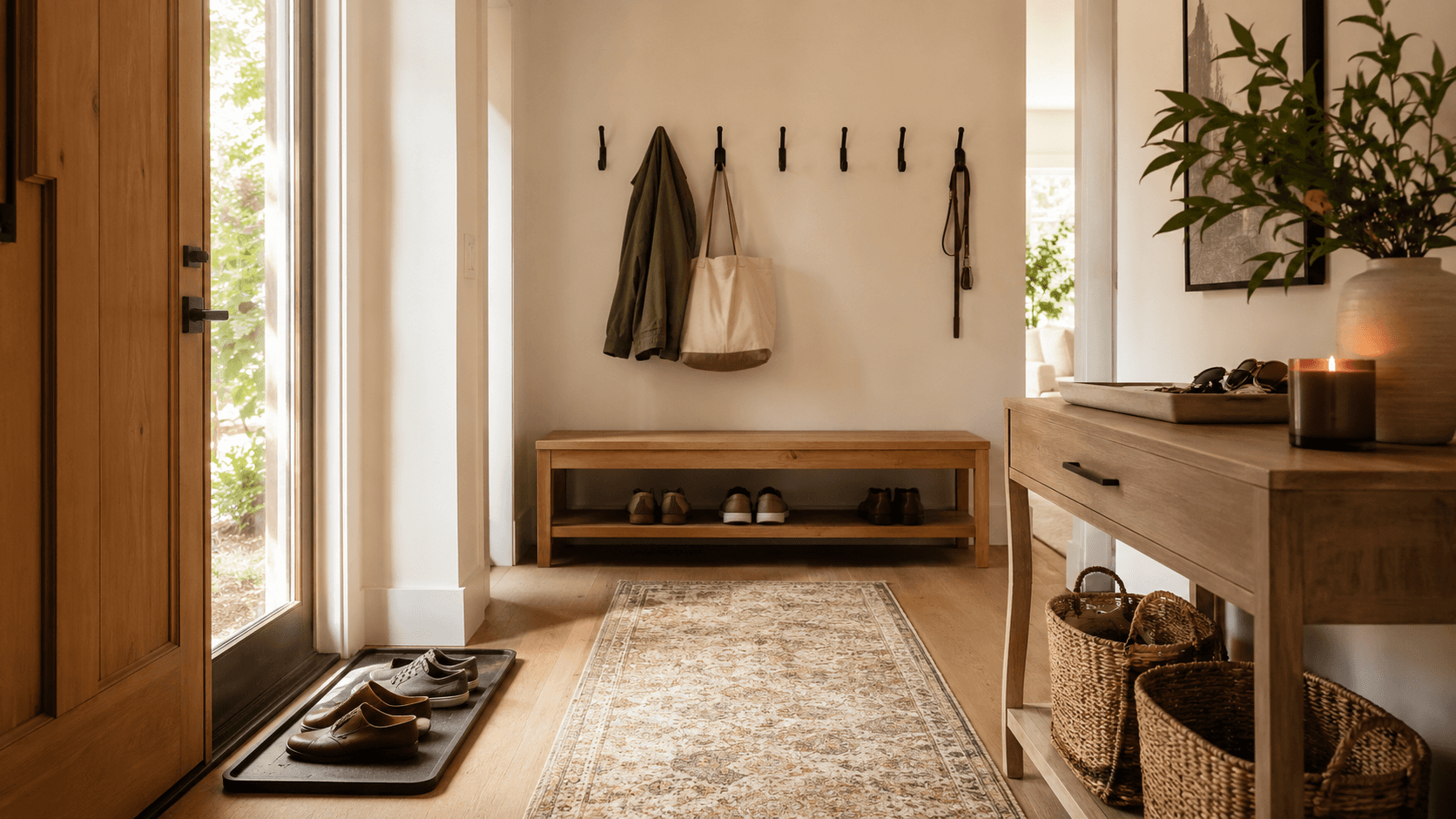
Your foyer does more work than any other room in your house. Here's how to set up a drop zone that actually holds up, with three layouts and a weekly reset routine that takes ten minutes flat.
Your foyer does more work than any other room in your house. Here's how to set up a drop zone that actually holds up, with three layouts and a weekly reset routine that takes ten minutes flat.
Foyer Drop Zone Systems: How to Organize an Entryway for a True 10-Minute Reset
*This blog contains affiliate links.
Sometimes I look on Zillow for homes I cant afford, and my first look is always Montana. I worked as a wrangler for a summer after college and it was magical. Getting to ride horses each day, it was incredible. I digress...
While I love the idea of Montana, I did notice something in those listings. They all have a huge foyer for muddy boots, snowy coats, all the gear. That alone is enough to keep me in North Carolina, thinking about all the dirt and slush.
The reality is all our foyers do the most, even if we aren't in Montana.
Think about what passes through your front door every single day. Shoes. Keys. A bag. Mail that you swear you'll sort later. A jacket. A dog leash, maybe. Your kids backpack hitting the floor like a 14-pound sandbag.
That entry, whether its a proper foyer or just three feet of tile before the living room starts, is doing the hardest job in your house with usually zero infrastructure.
So lets fix that.
---
Shop This Room
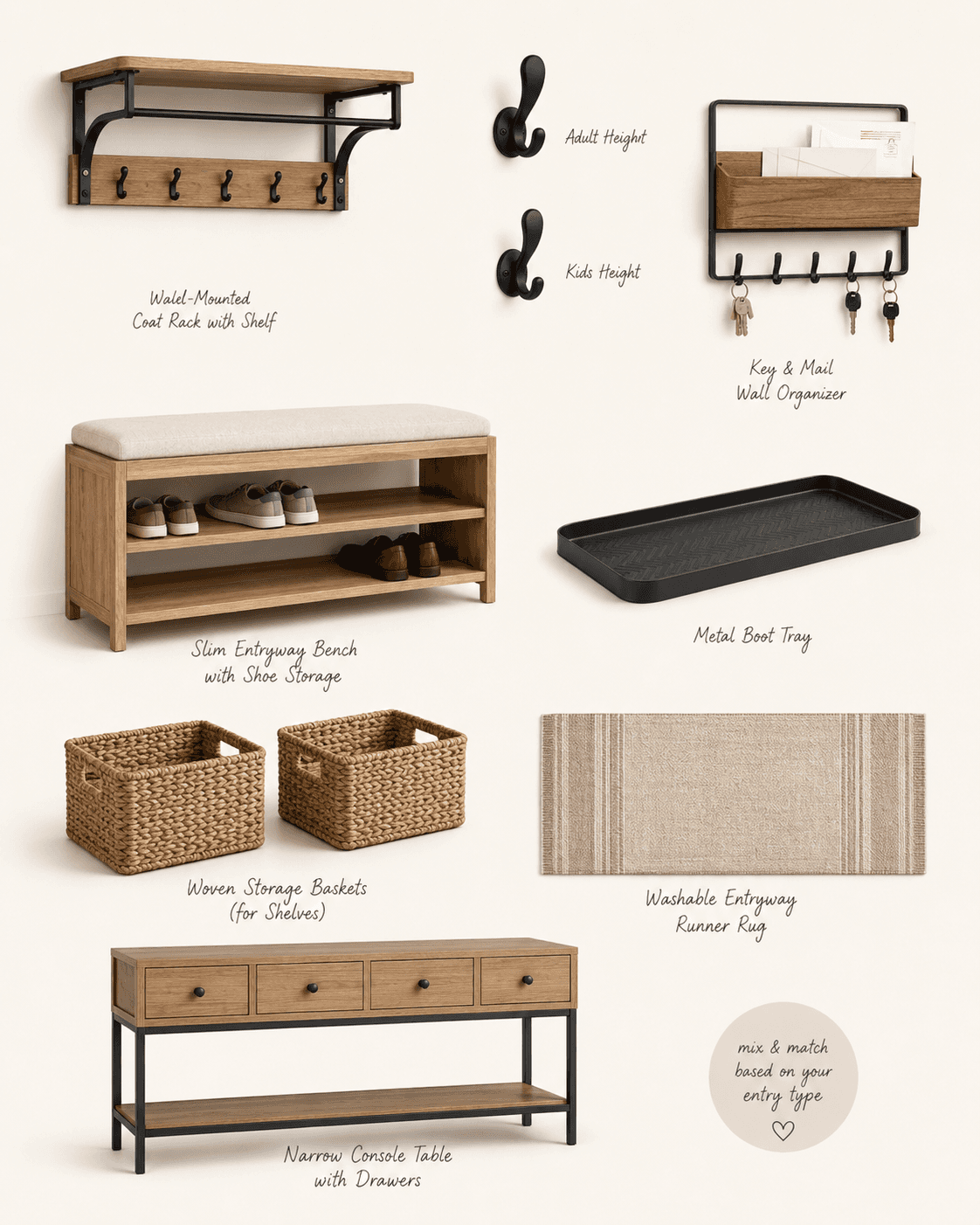
Before we get into layouts, heres what makes most of these setups work. Mix and match based on your entry type.
Wall-mounted coat rack with shelf (the thing that does two jobs at once)
Slim entryway bench with shoe storage (sit, store, done)
Matte black wall hooks (I like these at two heights if you have kids)
Metal boot tray (the unsung hero of a foyer that doesnt look grimy)
Woven storage baskets for shelves (seasonal catch-alls)
Key and mail wall organizer (the thing you need and keep not buying)
Washable entryway runner rug (the rug that hides everything)
Narrow console table with drawers (for open entries that can handle the depth)
---
What You're Actually Solving
I think most foyer frustration gets labeled as "we need to declutter" when the real problem is theres no system. Stuff piles up not because you own too much, but because nothing has a landing spot.
Heres what I ask clients to track for one week before we touch anything:
The Daily Flow Audit
Write down every single item that crosses your threshold. Every day for five days. Not what you think comes in. What actually does.
Most households land somewhere around this:
Daily: shoes (2-4 pairs in rotation), keys, wallet or bag, phone, mail, one jacket or hoodie
Weekly: packages, gym bag, groceries passing through, library books, a random thing from the car you keep meaning to bring inside
Seasonally: heavy coats, rain gear, umbrellas, hats and gloves, boots, sports equipment, holiday stuff passing through
That list is your design brief. Not a Pinterest board. Not a vibe. The actual stuff that needs a home.
And honestly, that tracks. Because once you see the volume written down, you stop blaming yourself for the mess and start blaming the room.
---
Three Layouts That Actually Work
Every entry is different. A 1920s bungalow hallway is not the same animal as a new-build open foyer. So here are three approaches based on what you're working with.
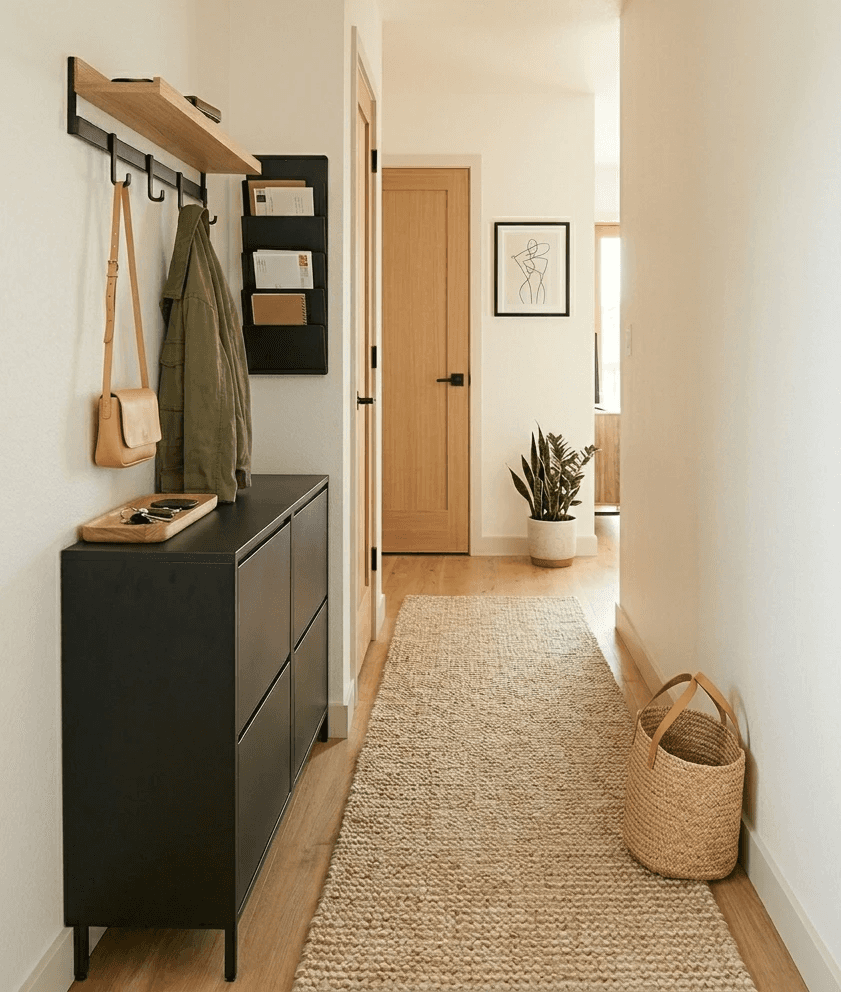
Layout 1: The Narrow Hallway (under 42 inches wide)
This is the one that makes everyone nervous. Theres no room for a bench. Barely room for a person and a grocery bag at the same time.
The move here is vertical.
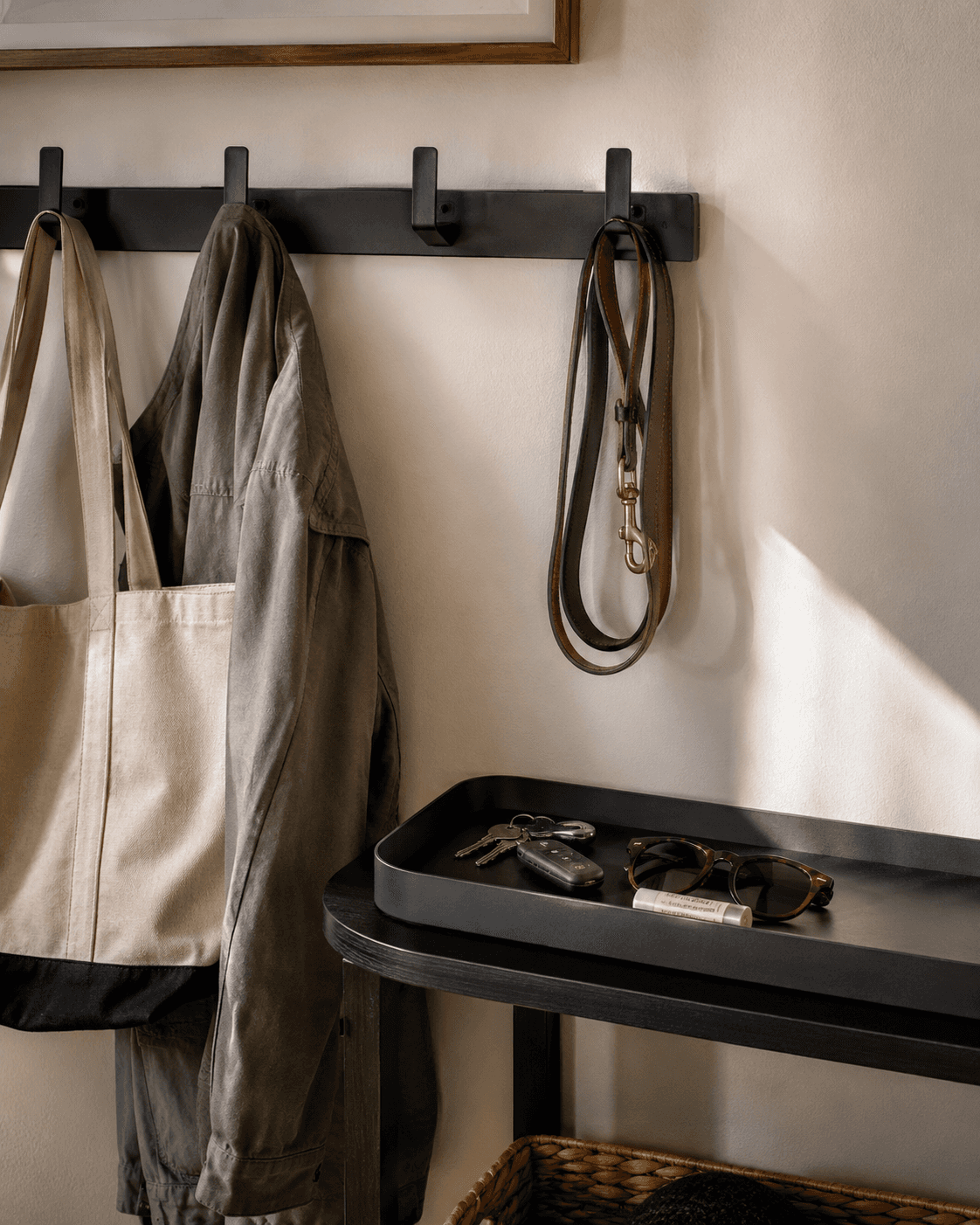
Go up the walls. A wall-mounted coat rack with a shelf at about 60 inches gives you hooks below and a shelf for a small tray for keys and wallets on top. Below that, a slim boot tray on the floor catches two pairs of shoes without blocking the path.
If you have 30 inches of wall to spare, a slim wall-mounted mail sorter next to the coat rack handles the paper flow.
No bench. Don't force it. If theres no room to sit and still walk past, the bench becomes an obstacle, not a feature.
A washable runner down the center protects the floor and gives the hallway a finished feel without eating any width.
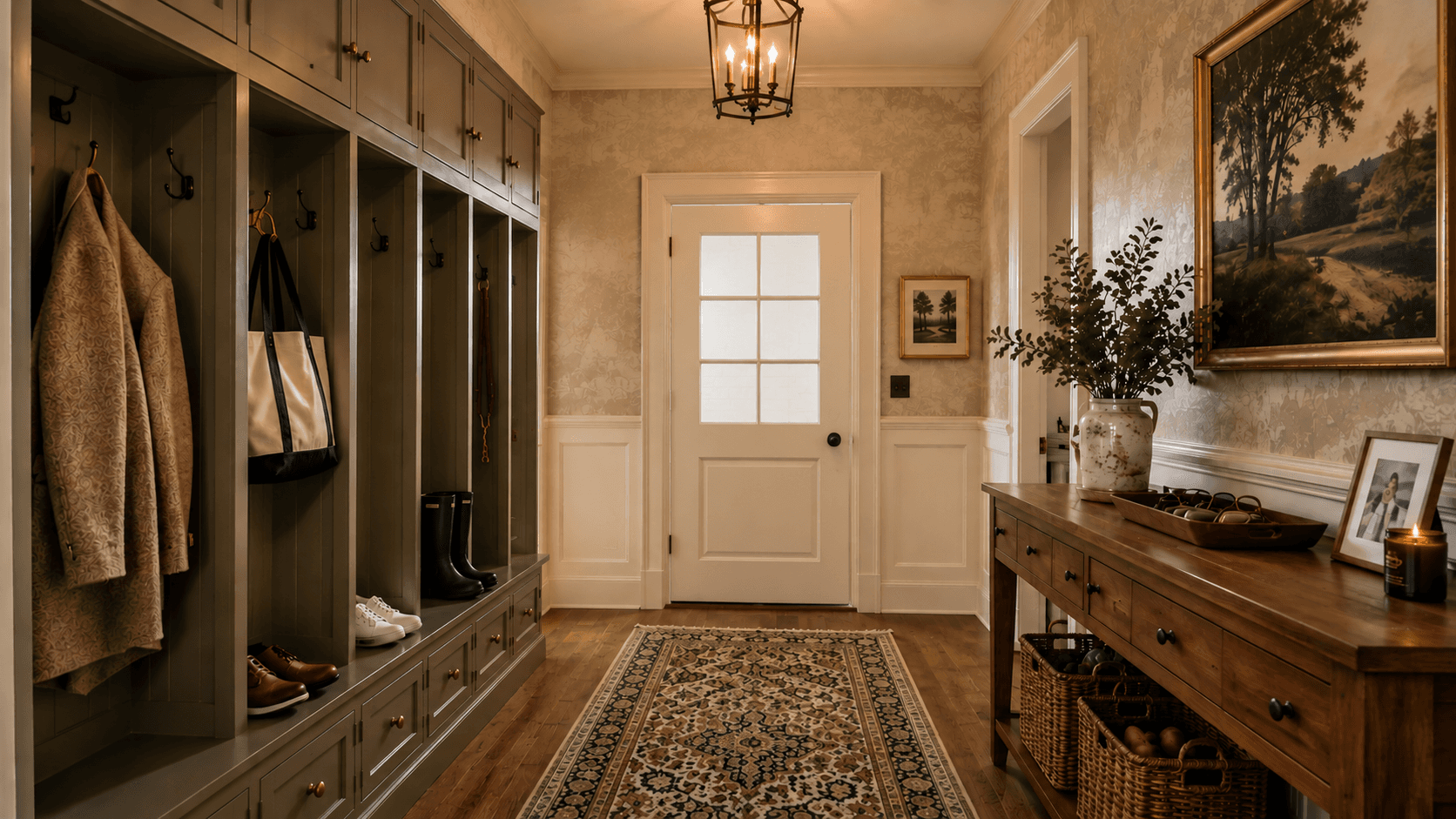
Layout 2: The Open Entry (foyer or wide landing area)
This is the Montana energy. You have room. Use it wisely.
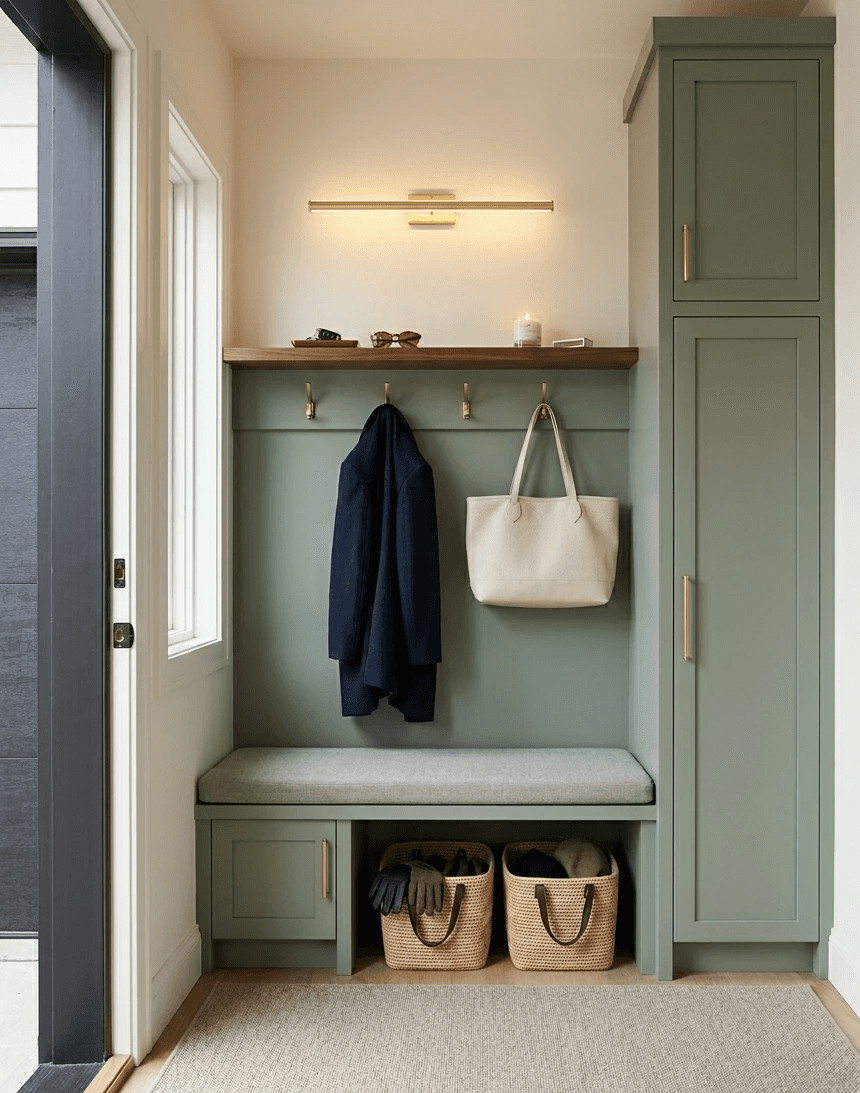
The anchor piece is a bench with shoe storage underneath. Position it against the wall closest to the door, not the wall you see first. I know thats counterintuitive. You want the drop zone near the action, not displayed like art.
Above the bench, hooks. I like individual matte black hooks spaced 8-10 inches apart rather than a single rail. They look more intentional and you can customize spacing for what you actually hang.
On the opposite wall or on a perpendicular surface, a narrow console table with at least one drawer. The drawer is for the junk that doesn't have a category. Sunglasses. Chapstick. The spare car key. The top is for a small tray and maybe one thing that makes you feel something when you walk in. A candle. A photo. One thing.
Under the console, two woven baskets. One for each kid, or one for seasonal stuff and one for the gym bag situation.
Layout 3: The No-Foyer Apartment
You open the front door and you're immediately in the living room. Or the kitchen. Theres no entry to speak of. I once measured a clients "foyer" at 19 inches deep before the couch started. Which always makes me nervous because theres nothing to work with, and yet everything still needs a place to land.
The trick is creating a foyer that doesn't exist architecturally.
A small entryway organizer with hooks and a shelf mounted right next to the door, on the hinge side, catches the essentials. A door-back organizer on the inside of a closet door nearby handles overflow.
Put a small washable rug right at the door. This does something psychological. It defines a zone even when the architecture doesn't. Your brain reads it as "this is the entry" and your habits start to follow.
If you have a closet within arm's reach of the door, thats your foyer. Add a closet shelf organizer and use the inside of the door. That closet is doing triple duty now.
---
The Decision Tree: Hooks vs. Cabinets, Bench vs. No Bench
I get asked these questions constantly. Heres how I think through them.
Hooks or closed cabinets?
If you have kids under 10, hooks. Always hooks. They wont open a cabinet. They barely close a cabinet. Hooks are grab-and-go and the compliance rate is about 400% higher. If its just adults and you hate visual clutter, a closed entryway cabinet works, but only if you commit to opening it every single time. Be honest with yourself.
Bench or no bench?
If anyone in your household sits down to put on shoes, bench. If you have kids, bench. If your hallway is under 42 inches wide, no bench. If you have an open entry with room, bench. Its that simple. The bench isn't about looks. Its about whether someone physically sits there.
Baskets or drawers?
Baskets are better for things that vary in size, like hats, gloves, scarves, seasonal rotation stuff. Drawers are better for small daily items that disappear, like keys and sunglasses. If you can only have one, baskets. Theyre more forgiving.
---
This Is Exactly What I Do for Clients
Heres the thing. The layout advice above works. You can absolutely do this yourself.
Want me to design your room like this? I look at photos of your actual entry, your actual stuff, your actual daily flow, and I put together a plan that accounts for all of it. Not a mood board. A functional layout with specific products.
Let's Chat to see if were a good fit.
---
The Maintenance System: 2-Minute Daily + 10-Minute Weekly
A good drop zone with no maintenance routine becomes a bad drop zone in about nine days. I have seen it happen with alarming consistency.
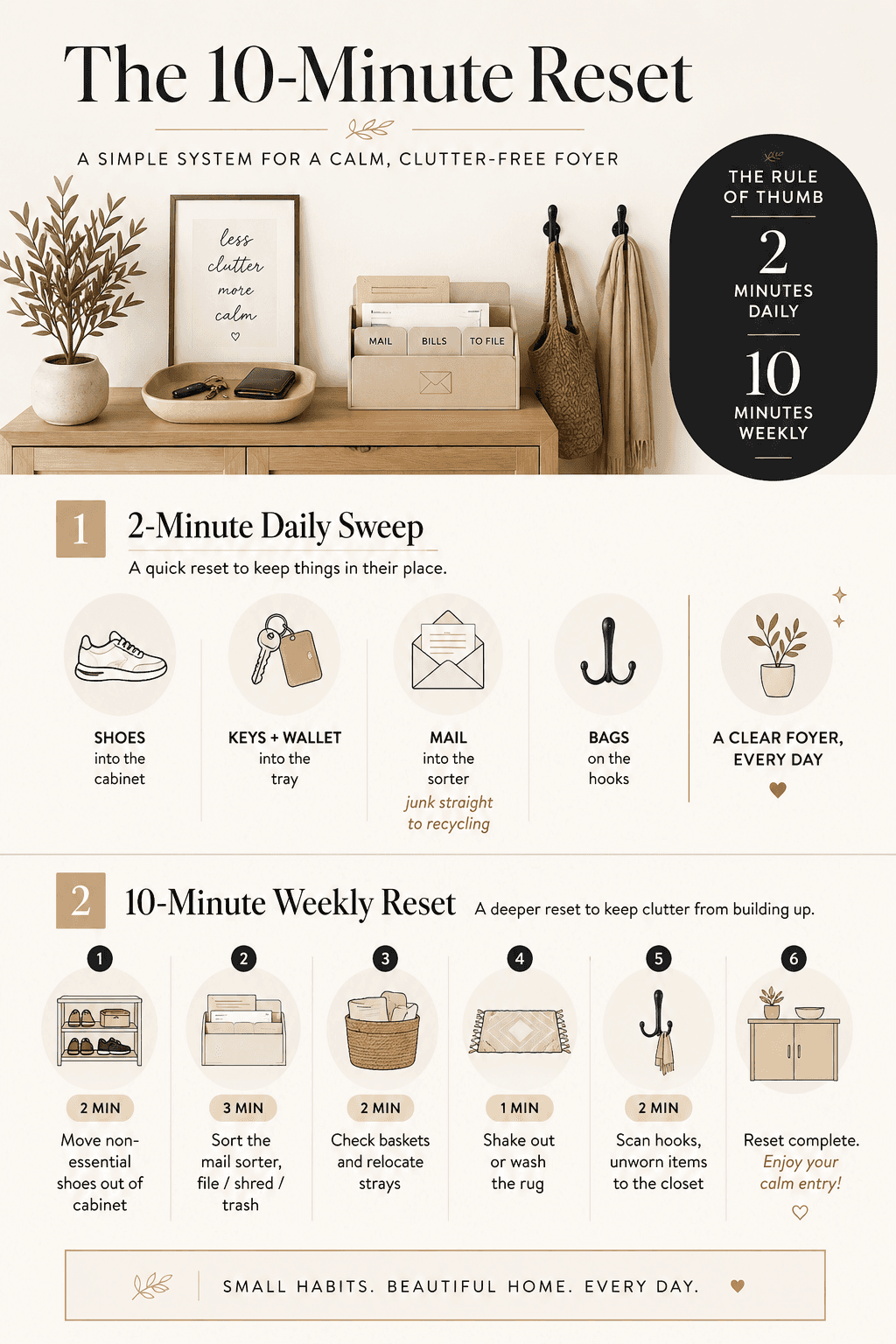
The 2-Minute Daily Sweep (do this when you walk in the last time each night):
Shoes onto the tray or into the bench. Not beside it. On it. In it.
Keys and wallet into the tray.
Mail into the sorter. Junk straight to recycling. Do not set it down anywhere else.
Bags on hooks or into the closet.
Thats it. Two minutes. Maybe ninety seconds once its habit.
The 10-Minute Weekly Reset (pick a day, any day, and protect it):
Empty the boot tray and wipe it down. (2 min)
Go through the mail sorter. File, shred, or trash everything. (3 min)
Check the baskets. Pull out anything that doesn't belong in the entry. Relocate it. (2 min)
Shake out or wash the entry rug. (1 min)
Quick scan of hooks. Anything hanging there that hasn't been worn this week gets moved to the closet. (2 min)
Thats your 10-minute reset. Its not deep cleaning. Its a systems check. Like rebooting a computer. Everything gets put back to zero so the week can start clean.
---
One More Thing
I think the reason foyers feel so hard is that theyre the room you never designed on purpose. You decorated the living room. You organized the kitchen. The bedroom got new sheets.
The entry just... happened. It accumulated.
And every single day, its the first thing you see when you walk in and the last thing you touch when you leave. Thats a lot of emotional weight for a room running on zero infrastructure.
A good set of hooks, a tray that catches the small stuff, a boot tray, and a plan. Thats all it takes to make walking through your front door feel like something other than chaos.
You don't have to have a Montana foyer. You just need the one you have to work a little harder. If you want help making that happen, let's work together. I'd love to see what were working with.
If you are looking for help styling you foyer, this is a great resource.
Foyer Drop Zone Systems: How to Organize an Entryway for a True 10-Minute Reset
*This blog contains affiliate links.
Sometimes I look on Zillow for homes I cant afford, and my first look is always Montana. I worked as a wrangler for a summer after college and it was magical. Getting to ride horses each day, it was incredible. I digress...
While I love the idea of Montana, I did notice something in those listings. They all have a huge foyer for muddy boots, snowy coats, all the gear. That alone is enough to keep me in North Carolina, thinking about all the dirt and slush.
The reality is all our foyers do the most, even if we aren't in Montana.
Think about what passes through your front door every single day. Shoes. Keys. A bag. Mail that you swear you'll sort later. A jacket. A dog leash, maybe. Your kids backpack hitting the floor like a 14-pound sandbag.
That entry, whether its a proper foyer or just three feet of tile before the living room starts, is doing the hardest job in your house with usually zero infrastructure.
So lets fix that.
---
Shop This Room
Before we get into layouts, heres what makes most of these setups work. Mix and match based on your entry type.
Wall-mounted coat rack with shelf (the thing that does two jobs at once)
Slim entryway bench with shoe storage (sit, store, done)
Matte black wall hooks (I like these at two heights if you have kids)
Metal boot tray (the unsung hero of a foyer that doesnt look grimy)
Woven storage baskets for shelves (seasonal catch-alls)
Key and mail wall organizer (the thing you need and keep not buying)
Washable entryway runner rug (the rug that hides everything)
Narrow console table with drawers (for open entries that can handle the depth)
---
What You're Actually Solving
I think most foyer frustration gets labeled as "we need to declutter" when the real problem is theres no system. Stuff piles up not because you own too much, but because nothing has a landing spot.
Heres what I ask clients to track for one week before we touch anything:
The Daily Flow Audit
Write down every single item that crosses your threshold. Every day for five days. Not what you think comes in. What actually does.
Most households land somewhere around this:
Daily: shoes (2-4 pairs in rotation), keys, wallet or bag, phone, mail, one jacket or hoodie
Weekly: packages, gym bag, groceries passing through, library books, a random thing from the car you keep meaning to bring inside
Seasonally: heavy coats, rain gear, umbrellas, hats and gloves, boots, sports equipment, holiday stuff passing through
That list is your design brief. Not a Pinterest board. Not a vibe. The actual stuff that needs a home.
And honestly, that tracks. Because once you see the volume written down, you stop blaming yourself for the mess and start blaming the room.
---
Three Layouts That Actually Work
Every entry is different. A 1920s bungalow hallway is not the same animal as a new-build open foyer. So here are three approaches based on what you're working with.
Layout 1: The Narrow Hallway (under 42 inches wide)
This is the one that makes everyone nervous. Theres no room for a bench. Barely room for a person and a grocery bag at the same time.
The move here is vertical.
Go up the walls. A wall-mounted coat rack with a shelf at about 60 inches gives you hooks below and a shelf for a small tray for keys and wallets on top. Below that, a slim boot tray on the floor catches two pairs of shoes without blocking the path.
If you have 30 inches of wall to spare, a slim wall-mounted mail sorter next to the coat rack handles the paper flow.
No bench. Don't force it. If theres no room to sit and still walk past, the bench becomes an obstacle, not a feature.
A washable runner down the center protects the floor and gives the hallway a finished feel without eating any width.
Layout 2: The Open Entry (foyer or wide landing area)
This is the Montana energy. You have room. Use it wisely.
The anchor piece is a bench with shoe storage underneath. Position it against the wall closest to the door, not the wall you see first. I know thats counterintuitive. You want the drop zone near the action, not displayed like art.
Above the bench, hooks. I like individual matte black hooks spaced 8-10 inches apart rather than a single rail. They look more intentional and you can customize spacing for what you actually hang.
On the opposite wall or on a perpendicular surface, a narrow console table with at least one drawer. The drawer is for the junk that doesn't have a category. Sunglasses. Chapstick. The spare car key. The top is for a small tray and maybe one thing that makes you feel something when you walk in. A candle. A photo. One thing.
Under the console, two woven baskets. One for each kid, or one for seasonal stuff and one for the gym bag situation.
Layout 3: The No-Foyer Apartment
You open the front door and you're immediately in the living room. Or the kitchen. Theres no entry to speak of. I once measured a clients "foyer" at 19 inches deep before the couch started. Which always makes me nervous because theres nothing to work with, and yet everything still needs a place to land.
The trick is creating a foyer that doesn't exist architecturally.
A small entryway organizer with hooks and a shelf mounted right next to the door, on the hinge side, catches the essentials. A door-back organizer on the inside of a closet door nearby handles overflow.
Put a small washable rug right at the door. This does something psychological. It defines a zone even when the architecture doesn't. Your brain reads it as "this is the entry" and your habits start to follow.
If you have a closet within arm's reach of the door, thats your foyer. Add a closet shelf organizer and use the inside of the door. That closet is doing triple duty now.
---
The Decision Tree: Hooks vs. Cabinets, Bench vs. No Bench
I get asked these questions constantly. Heres how I think through them.
Hooks or closed cabinets?
If you have kids under 10, hooks. Always hooks. They wont open a cabinet. They barely close a cabinet. Hooks are grab-and-go and the compliance rate is about 400% higher. If its just adults and you hate visual clutter, a closed entryway cabinet works, but only if you commit to opening it every single time. Be honest with yourself.
Bench or no bench?
If anyone in your household sits down to put on shoes, bench. If you have kids, bench. If your hallway is under 42 inches wide, no bench. If you have an open entry with room, bench. Its that simple. The bench isn't about looks. Its about whether someone physically sits there.
Baskets or drawers?
Baskets are better for things that vary in size, like hats, gloves, scarves, seasonal rotation stuff. Drawers are better for small daily items that disappear, like keys and sunglasses. If you can only have one, baskets. Theyre more forgiving.
---
This Is Exactly What I Do for Clients
Heres the thing. The layout advice above works. You can absolutely do this yourself.
Want me to design your room like this? I look at photos of your actual entry, your actual stuff, your actual daily flow, and I put together a plan that accounts for all of it. Not a mood board. A functional layout with specific products.
Let's Chat to see if were a good fit.
---
The Maintenance System: 2-Minute Daily + 10-Minute Weekly
A good drop zone with no maintenance routine becomes a bad drop zone in about nine days. I have seen it happen with alarming consistency.
The 2-Minute Daily Sweep (do this when you walk in the last time each night):
Shoes onto the tray or into the bench. Not beside it. On it. In it.
Keys and wallet into the tray.
Mail into the sorter. Junk straight to recycling. Do not set it down anywhere else.
Bags on hooks or into the closet.
Thats it. Two minutes. Maybe ninety seconds once its habit.
The 10-Minute Weekly Reset (pick a day, any day, and protect it):
Empty the boot tray and wipe it down. (2 min)
Go through the mail sorter. File, shred, or trash everything. (3 min)
Check the baskets. Pull out anything that doesn't belong in the entry. Relocate it. (2 min)
Shake out or wash the entry rug. (1 min)
Quick scan of hooks. Anything hanging there that hasn't been worn this week gets moved to the closet. (2 min)
Thats your 10-minute reset. Its not deep cleaning. Its a systems check. Like rebooting a computer. Everything gets put back to zero so the week can start clean.
---
One More Thing
I think the reason foyers feel so hard is that theyre the room you never designed on purpose. You decorated the living room. You organized the kitchen. The bedroom got new sheets.
The entry just... happened. It accumulated.
And every single day, its the first thing you see when you walk in and the last thing you touch when you leave. Thats a lot of emotional weight for a room running on zero infrastructure.
A good set of hooks, a tray that catches the small stuff, a boot tray, and a plan. Thats all it takes to make walking through your front door feel like something other than chaos.
You don't have to have a Montana foyer. You just need the one you have to work a little harder. If you want help making that happen, let's work together. I'd love to see what were working with.
If you are looking for help styling you foyer, this is a great resource.
Other Blogs
Other Similar Blogs
Your go-to destination for insightful articles, tips, and inspiration on all things landscaping and outdoor living
Other Blogs
Other Similar Blogs
Your go-to destination for insightful articles, tips, and inspiration on all things landscaping and outdoor living
Other Blogs
Other Similar Blogs
Your go-to destination for insightful articles, tips, and inspiration on all things landscaping and outdoor living


Join our newsletter list
Sign up to get the most recent blog articles in your email every week.