
Author
Suzanne is an Owner/Designer
Author
Suzanne is an Owner/Designer
Modern Mexican bathrooms live or die on restraint: one hero pattern, warm plaster, and a color story that actually agrees with itself. Here is how I plan tile, sinks, and color for small baths and large ones.
Modern Mexican bathrooms live or die on restraint: one hero pattern, warm plaster, and a color story that actually agrees with itself. Here is how I plan tile, sinks, and color for small baths and large ones.
There is a Mexican restaurant in my hometown where I get unreasonably judgey about the bathroom. And that surprises me, because I almost always prefer a room that tried and missed over a room that never tried at all.
But this one tried and landed in a strange place. Two patterned tiles at nearly the same scale, fighting each other across a small room. Colors that were close but not related, so everything read slightly sour. And then the whole thing was grayscale, which for Mexican design is like ordering a taco with no filling.
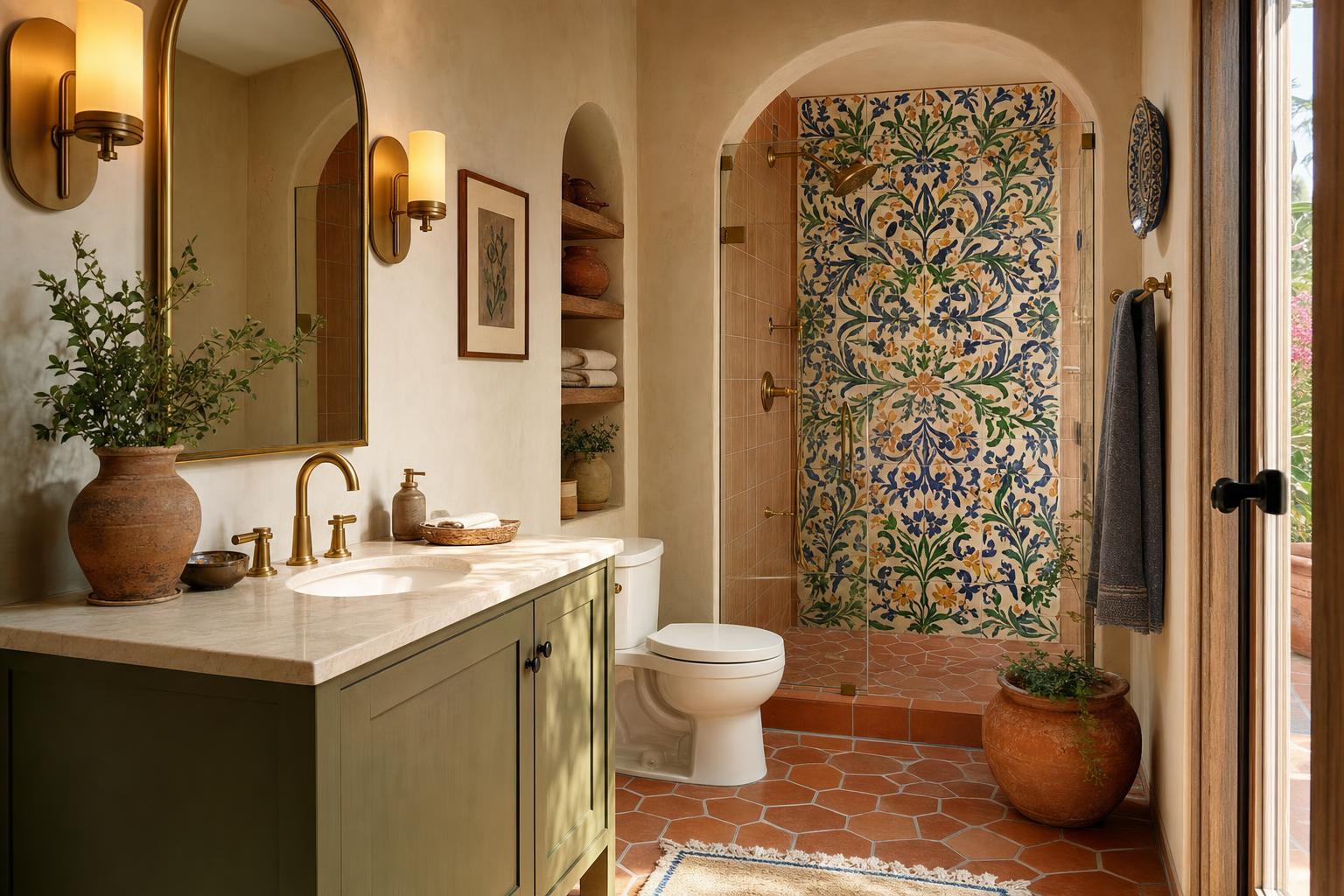
Here is the short answer. A modern Mexican bathroom works when you pick one patterned surface to be the star, keep everything else warm and plain, and build the color story from earth tones like terracotta and ochre with one saturated accent such as cobalt or green. The more pattern and color you add, the more precise your scale and undertones have to be. Two solid tiles are forgiving. Two patterns are not.
What Actually Makes a Bathroom Read as Modern Mexican
It is not a motif. It is a set of material relationships.
Handmade ceramic with visible glaze variation. Lime plaster or a plastered look on the walls. Unglazed terracotta or saltillo-style floors with warm undertones. Solid wood with real grain. Aged brass instead of polished chrome. Woven palm or rush somewhere in the room.
The modern part is restraint and clean fixture lines. Traditional Mexican bathrooms often go pattern-heavy on every surface, and that can be gorgeous. The contemporary version picks one surface to sing and lets the rest hum.
If you want the wider view of how this plays out house-wide, my room-by-room guide to modern Mexican interiors covers the whole home, and the kitchen storage post is useful if you are carrying the same materials into a kitchen.
Shop This Room
As an Amazon Associate, I earn from qualifying purchases. It doesn't change what I recommend.

The tile that carries the whole room goes on one surface only, ideally the shower wall or the floor, never both.
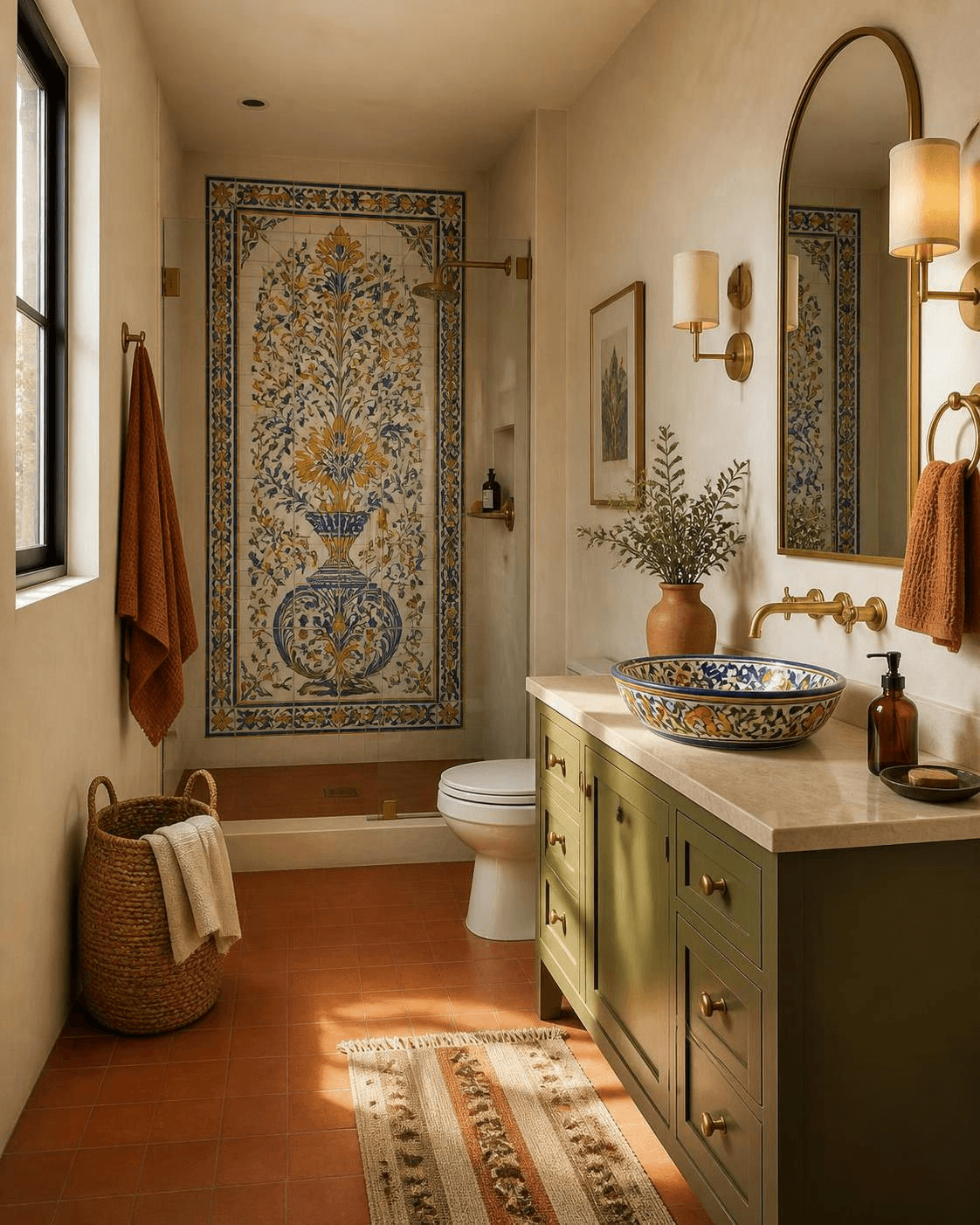
The hand-painted basin worth the counter space sits on a simple wood vanity so the bowl gets to be the interesting part.
The brass faucet that ages nicely mounts tall enough to clear a vessel bowl, which is the number one thing people forget.
The carved mirror that softens all the hard surfaces hangs over the sink and breaks up the rectangles.
The sconces that make skin look human flank the mirror at roughly eye level instead of glaring down from above.
The flatweave rug that reads handmade lands in front of the vanity and adds the stripe so the tile does not have to.
The baskets that hide the ugly part of bathrooms slide under an open vanity for backstock and hair tools.
The clay accessories that warm up a cold counter replace the plastic bottles nobody wants to look at.
Tile Strategy Changes With the Size of the Bath
Small bath: one patterned surface, full stop
In a powder room or a 5 by 8 bath, pattern on more than one plane starts bouncing off itself. Pick the floor or a single wall.
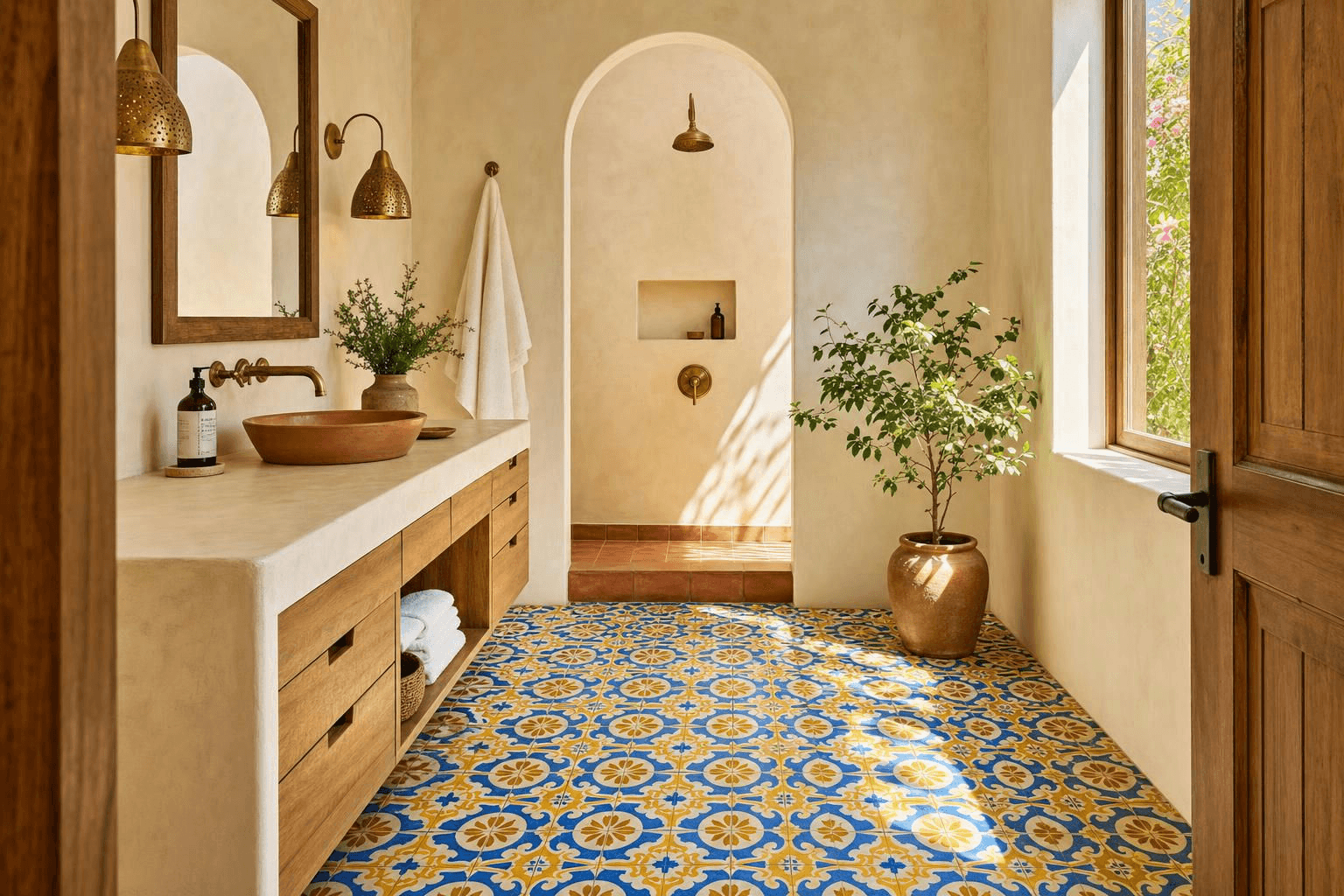
My usual move in a tiny bath is patterned floor, plain walls. The floor is a surface you see in pieces, partly covered by fixtures and a rug, so a busy pattern stays interesting instead of overwhelming.
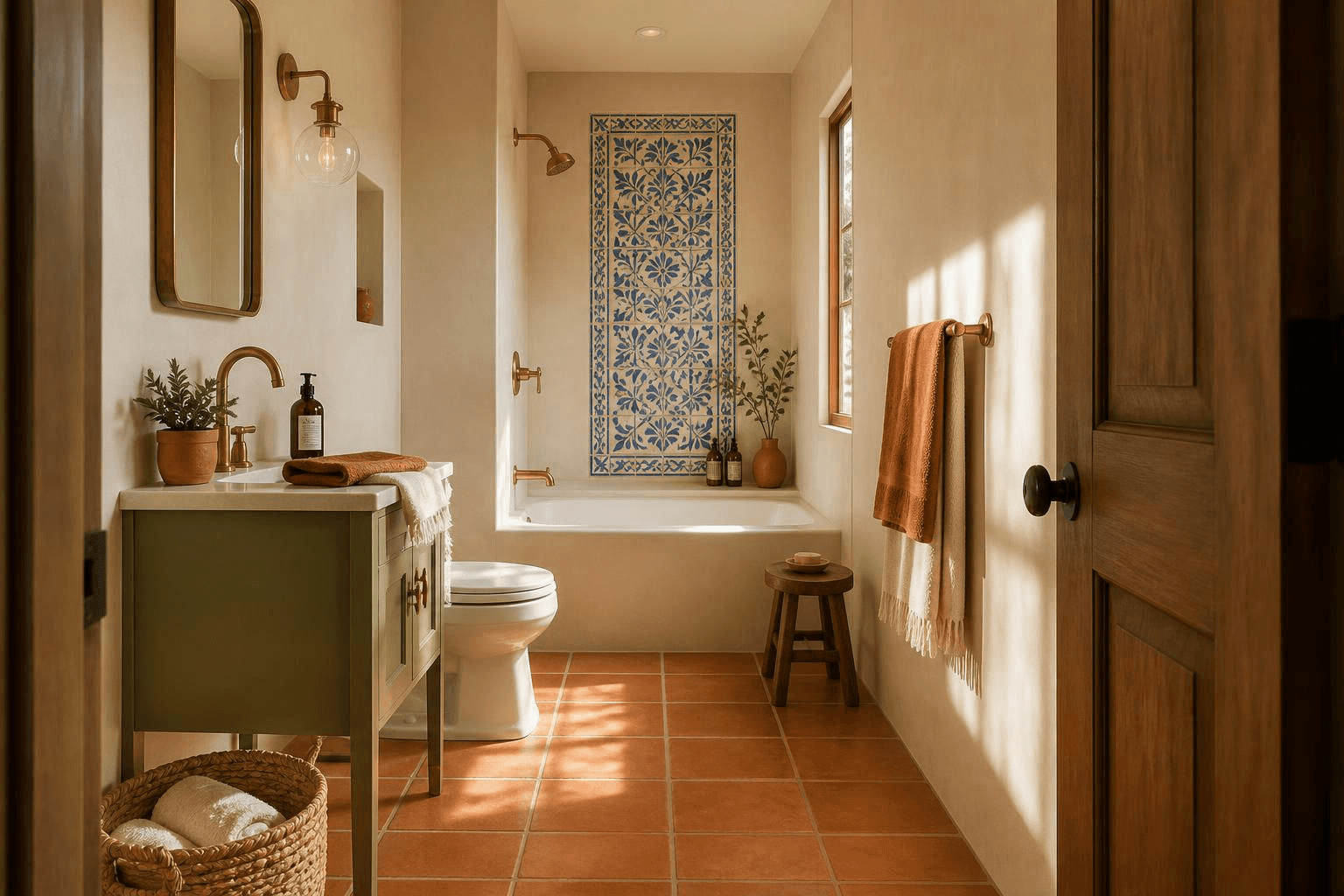
If you want pattern at eye level instead, do the sink wall or a single shower wall, then keep the floor a solid warm terracotta or a small unglazed square.
Primary bath: pattern plus plaster
A larger bath can hold a hero pattern and still breathe, because there is enough plain surface between the busy parts.
Here the combination I reach for is a patterned shower floor or niche, plaster on the surrounding walls, and a solid warm floor tying it together. Three materials, one of them patterned.
If you truly want two patterns, make the scale difference obvious. A large geometric floor with a tiny repeating wall tile can work. Two medium florals will not. That is exactly what went wrong in the restaurant.
The zellige and talavera question
Handmade glazed tiles vary in tone and surface. That variation is the point, and it is also why they photograph better than they sometimes install. Order extra, look at a full sample box rather than one piece, and ask whether the tile is rated for floors or wet areas before you commit.

Sinks: Beautiful Versus Maintainable
Hand-painted vessel sinks are the signature move, and they are genuinely lovely. They are also a little more work.
A vessel sits above the counter, so water pools around the base if your faucet aim is off, and the counter needs sealing if it is stone or concrete. Undermount and drop-in versions of painted ceramic exist and are a lot easier to wipe down.
Sink type | Best for | Daily upkeep | Watch out for |
|---|---|---|---|
Hand-painted vessel | Powder rooms, guest baths | Wipe the base and counter seam | Needs a tall faucet, splashes more |
Painted drop-in | Family and primary baths | Easy, one surface to wipe | Less dramatic, rim collects grime |
Undermount with talavera-tiled counter | Custom look, larger baths | Grout needs sealing | Grout lines at splash height |
Plain white ceramic plus painted backsplash | Renters and tight budgets | Easiest of the group | Pattern must be placed carefully |
For a bathroom used by kids every morning, I would put the painted ceramic somewhere it gets admired rather than blasted with toothpaste.
Plaster and Limewash Versus Tile in Wet Zones
This is where I have to be careful, because the internet is full of confident wrong answers.
Lime plaster finishes like tadelakt, and the chukum plaster used in the Yucatán, can absolutely be used in showers. They are traditional wet-area finishes. But the finish itself is not the waterproofing system. The substrate and membrane behind it do that work, and the plaster has to be applied and sealed by someone who has done it before, on the schedule the material manufacturer specifies.
Limewash is a different animal. It is a paint-like coating, it is beautiful on dry walls, and it does not belong inside a shower or directly behind a sink that gets splashed hard.
Finish | Shower interior | Dry bathroom walls | Upkeep |
|---|---|---|---|
Tile and grout | Yes, with proper membrane | Yes | Grout cleaning, periodic sealing |
Tadelakt or chukum plaster | Yes, installer-applied over a waterproofed substrate | Yes | Re-seal on the maker's schedule |
Limewash | No | Yes | Touch up, recoat over time |
Plaster-look paint | No | Yes | Normal paint upkeep |
My honest recommendation for most homes: tile the wet zone, plaster everything else. You get the soft handmade wall texture where it is easy to maintain and a bulletproof shower.
Color Palettes That Do Not Fight
Start with the warm base. Terracotta floors, chalk white or bone walls, natural wood. That is the bed everything else lies in.
Then pick one saturated accent and commit. Cobalt blue with white is the classic talavera pairing and it reads crisp. Ochre and mustard lean sunbaked and calm. Deep green with terracotta is the combination I use most, because green cools the orange without arguing with it.
The dissonance problem is almost always undertone. A cool gray-blue tile next to a warm orange floor will feel off even if you cannot name why. Hold samples together in the actual bathroom light before you buy, and if the colors make you squint, they are not related.
If you have no idea which direction is actually yours, my Style Discovery quiz sorts that out fast. Readers can take it free with the code FRIENDS, a $49 value.
Mirrors, Lighting, and Textiles
Lighting is where a lot of these rooms fall apart. Overhead-only light flattens plaster texture and makes glazed tile look cheap.
Put light at the sides of the mirror at roughly eye level, add a warm overhead for general light, and use bulbs in the warm range so terracotta stays terracotta. My guide to lighting spacing and placement covers the measuring part.
Mirrors are your softening tool. A carved or arched wood frame does more for a tiled bathroom than any accessory you could put on a counter.
Textiles carry pattern when the tile stays quiet. Striped cotton towels, a flatweave rug, a rush stool in the corner. That is also your cheapest way to change the room in three years.
A Small Bath Layout, Roughly Speaking
Commonly cited guidance runs around 30 inches of total width for the toilet with about 15 inches from its centerline to the nearest wall or fixture, and roughly 21 to 24 inches of clear floor in front of fixtures. A door that swings into that lane will make a small bath feel worse than any tile choice ever could.
If your room needs a plan like this rather than a shopping list, that is the part I do. Tell me about your bathroom and we can figure out where the walls and fixtures should actually land.

It Depends on Your Space
Small bath, no natural light. Skip the dark patterned floor. Go light plaster walls, warm white fixtures, and put your pattern on a single small surface like a shower niche or a backsplash strip.
Large primary bath. You have room for a hero pattern and real plaster. Use the extra square footage to keep the patterned tile in one zone instead of spreading it thin.
Renting. No demo required. Swap the mirror, change the cabinet hardware to brass, add a striped cotton shower curtain, roll out a flatweave rug, and hang two pieces of framed art. Peel-and-stick tile works as a backsplash if your landlord is fine with it and your walls are smooth.
Kids or a shared family bath. Put the personality in textiles and hardware. Keep counters and floors easy to wipe, and choose grout in a mid warm tone rather than bright white.
Tight budget. One good thing beats five mediocre things. A single hand-painted sink or one wall of real glazed tile does more than a room full of look-alike accessories.
Hard water. Aged brass and unlacquered finishes show spots less dramatically than polished chrome, which is a quiet practical win.

The No-Renovation Version
Start with the mirror, because it changes the room's whole silhouette. Then hardware, then light bulbs and warm fixtures, then textiles, then art and one clay object.
Add a wood rush-seat stool if you have a corner, and put a small trailing plant in a clay pot somewhere near the light. That is five purchases and a Saturday.
FAQ
How do I make a bathroom look Mexican without renovating?
Change the mirror, the hardware, the light bulbs, and the textiles, in that order. A carved wood mirror, aged brass knobs, warm-toned bulbs, and striped cotton towels shift the whole feel without touching a single tile. Add one handmade clay object and a piece of folk-style art and you are most of the way there.
Is talavera tile good for a shower floor?
Sometimes, but you have to check. Many decorative glazed tiles are rated for walls only, and glaze can be slick underfoot. Ask the manufacturer for the floor and wet-area rating before you order, and let your installer confirm it works with your waterproofing.
Can you use tadelakt or lime plaster in a shower?
Yes, when it is installed correctly by someone experienced with it and over a properly waterproofed substrate. The plaster is a finish, not the waterproofing layer. It also needs re-sealing on the schedule the material maker specifies, so ask about upkeep before you commit.
What colors work best in a modern Mexican bathroom?
Build on a warm neutral base of terracotta, bone, and natural wood, then add one saturated accent. Cobalt blue, ochre, and deep green all work beautifully. The trick is keeping undertones related, so hold your samples together in the actual bathroom light.
How much pattern is too much in a small bathroom?
One patterned surface is the safe limit in a bath under about 40 square feet. If you want two, make the scales dramatically different, like a large geometric floor with a tiny repeating wall tile. Matching scales at close range is what creates that jittery, unresolved feeling.
Where to Start
Pick the hero surface first. Everything else is supporting cast, and supporting cast should be warm, plain, and slightly boring on purpose.
If you would rather not guess at tile scale and undertones, that is exactly the kind of decision I plan for people. Take a look at how I work, then get in touch and let's get your bathroom right the first time.
More Inspiration


There is a Mexican restaurant in my hometown where I get unreasonably judgey about the bathroom. And that surprises me, because I almost always prefer a room that tried and missed over a room that never tried at all.
But this one tried and landed in a strange place. Two patterned tiles at nearly the same scale, fighting each other across a small room. Colors that were close but not related, so everything read slightly sour. And then the whole thing was grayscale, which for Mexican design is like ordering a taco with no filling.
Here is the short answer. A modern Mexican bathroom works when you pick one patterned surface to be the star, keep everything else warm and plain, and build the color story from earth tones like terracotta and ochre with one saturated accent such as cobalt or green. The more pattern and color you add, the more precise your scale and undertones have to be. Two solid tiles are forgiving. Two patterns are not.
What Actually Makes a Bathroom Read as Modern Mexican
It is not a motif. It is a set of material relationships.
Handmade ceramic with visible glaze variation. Lime plaster or a plastered look on the walls. Unglazed terracotta or saltillo-style floors with warm undertones. Solid wood with real grain. Aged brass instead of polished chrome. Woven palm or rush somewhere in the room.
The modern part is restraint and clean fixture lines. Traditional Mexican bathrooms often go pattern-heavy on every surface, and that can be gorgeous. The contemporary version picks one surface to sing and lets the rest hum.
If you want the wider view of how this plays out house-wide, my room-by-room guide to modern Mexican interiors covers the whole home, and the kitchen storage post is useful if you are carrying the same materials into a kitchen.
Shop This Room
As an Amazon Associate, I earn from qualifying purchases. It doesn't change what I recommend.
The tile that carries the whole room goes on one surface only, ideally the shower wall or the floor, never both.
The hand-painted basin worth the counter space sits on a simple wood vanity so the bowl gets to be the interesting part.
The brass faucet that ages nicely mounts tall enough to clear a vessel bowl, which is the number one thing people forget.
The carved mirror that softens all the hard surfaces hangs over the sink and breaks up the rectangles.
The sconces that make skin look human flank the mirror at roughly eye level instead of glaring down from above.
The flatweave rug that reads handmade lands in front of the vanity and adds the stripe so the tile does not have to.
The baskets that hide the ugly part of bathrooms slide under an open vanity for backstock and hair tools.
The clay accessories that warm up a cold counter replace the plastic bottles nobody wants to look at.
Tile Strategy Changes With the Size of the Bath
Small bath: one patterned surface, full stop
In a powder room or a 5 by 8 bath, pattern on more than one plane starts bouncing off itself. Pick the floor or a single wall.
My usual move in a tiny bath is patterned floor, plain walls. The floor is a surface you see in pieces, partly covered by fixtures and a rug, so a busy pattern stays interesting instead of overwhelming.
If you want pattern at eye level instead, do the sink wall or a single shower wall, then keep the floor a solid warm terracotta or a small unglazed square.
Primary bath: pattern plus plaster
A larger bath can hold a hero pattern and still breathe, because there is enough plain surface between the busy parts.
Here the combination I reach for is a patterned shower floor or niche, plaster on the surrounding walls, and a solid warm floor tying it together. Three materials, one of them patterned.
If you truly want two patterns, make the scale difference obvious. A large geometric floor with a tiny repeating wall tile can work. Two medium florals will not. That is exactly what went wrong in the restaurant.
The zellige and talavera question
Handmade glazed tiles vary in tone and surface. That variation is the point, and it is also why they photograph better than they sometimes install. Order extra, look at a full sample box rather than one piece, and ask whether the tile is rated for floors or wet areas before you commit.
Sinks: Beautiful Versus Maintainable
Hand-painted vessel sinks are the signature move, and they are genuinely lovely. They are also a little more work.
A vessel sits above the counter, so water pools around the base if your faucet aim is off, and the counter needs sealing if it is stone or concrete. Undermount and drop-in versions of painted ceramic exist and are a lot easier to wipe down.
Sink type | Best for | Daily upkeep | Watch out for |
|---|---|---|---|
Hand-painted vessel | Powder rooms, guest baths | Wipe the base and counter seam | Needs a tall faucet, splashes more |
Painted drop-in | Family and primary baths | Easy, one surface to wipe | Less dramatic, rim collects grime |
Undermount with talavera-tiled counter | Custom look, larger baths | Grout needs sealing | Grout lines at splash height |
Plain white ceramic plus painted backsplash | Renters and tight budgets | Easiest of the group | Pattern must be placed carefully |
For a bathroom used by kids every morning, I would put the painted ceramic somewhere it gets admired rather than blasted with toothpaste.
Plaster and Limewash Versus Tile in Wet Zones
This is where I have to be careful, because the internet is full of confident wrong answers.
Lime plaster finishes like tadelakt, and the chukum plaster used in the Yucatán, can absolutely be used in showers. They are traditional wet-area finishes. But the finish itself is not the waterproofing system. The substrate and membrane behind it do that work, and the plaster has to be applied and sealed by someone who has done it before, on the schedule the material manufacturer specifies.
Limewash is a different animal. It is a paint-like coating, it is beautiful on dry walls, and it does not belong inside a shower or directly behind a sink that gets splashed hard.
Finish | Shower interior | Dry bathroom walls | Upkeep |
|---|---|---|---|
Tile and grout | Yes, with proper membrane | Yes | Grout cleaning, periodic sealing |
Tadelakt or chukum plaster | Yes, installer-applied over a waterproofed substrate | Yes | Re-seal on the maker's schedule |
Limewash | No | Yes | Touch up, recoat over time |
Plaster-look paint | No | Yes | Normal paint upkeep |
My honest recommendation for most homes: tile the wet zone, plaster everything else. You get the soft handmade wall texture where it is easy to maintain and a bulletproof shower.
Color Palettes That Do Not Fight
Start with the warm base. Terracotta floors, chalk white or bone walls, natural wood. That is the bed everything else lies in.
Then pick one saturated accent and commit. Cobalt blue with white is the classic talavera pairing and it reads crisp. Ochre and mustard lean sunbaked and calm. Deep green with terracotta is the combination I use most, because green cools the orange without arguing with it.
The dissonance problem is almost always undertone. A cool gray-blue tile next to a warm orange floor will feel off even if you cannot name why. Hold samples together in the actual bathroom light before you buy, and if the colors make you squint, they are not related.
If you have no idea which direction is actually yours, my Style Discovery quiz sorts that out fast. Readers can take it free with the code FRIENDS, a $49 value.
Mirrors, Lighting, and Textiles
Lighting is where a lot of these rooms fall apart. Overhead-only light flattens plaster texture and makes glazed tile look cheap.
Put light at the sides of the mirror at roughly eye level, add a warm overhead for general light, and use bulbs in the warm range so terracotta stays terracotta. My guide to lighting spacing and placement covers the measuring part.
Mirrors are your softening tool. A carved or arched wood frame does more for a tiled bathroom than any accessory you could put on a counter.
Textiles carry pattern when the tile stays quiet. Striped cotton towels, a flatweave rug, a rush stool in the corner. That is also your cheapest way to change the room in three years.
A Small Bath Layout, Roughly Speaking
Commonly cited guidance runs around 30 inches of total width for the toilet with about 15 inches from its centerline to the nearest wall or fixture, and roughly 21 to 24 inches of clear floor in front of fixtures. A door that swings into that lane will make a small bath feel worse than any tile choice ever could.
If your room needs a plan like this rather than a shopping list, that is the part I do. Tell me about your bathroom and we can figure out where the walls and fixtures should actually land.
It Depends on Your Space
Small bath, no natural light. Skip the dark patterned floor. Go light plaster walls, warm white fixtures, and put your pattern on a single small surface like a shower niche or a backsplash strip.
Large primary bath. You have room for a hero pattern and real plaster. Use the extra square footage to keep the patterned tile in one zone instead of spreading it thin.
Renting. No demo required. Swap the mirror, change the cabinet hardware to brass, add a striped cotton shower curtain, roll out a flatweave rug, and hang two pieces of framed art. Peel-and-stick tile works as a backsplash if your landlord is fine with it and your walls are smooth.
Kids or a shared family bath. Put the personality in textiles and hardware. Keep counters and floors easy to wipe, and choose grout in a mid warm tone rather than bright white.
Tight budget. One good thing beats five mediocre things. A single hand-painted sink or one wall of real glazed tile does more than a room full of look-alike accessories.
Hard water. Aged brass and unlacquered finishes show spots less dramatically than polished chrome, which is a quiet practical win.
The No-Renovation Version
Start with the mirror, because it changes the room's whole silhouette. Then hardware, then light bulbs and warm fixtures, then textiles, then art and one clay object.
Add a wood rush-seat stool if you have a corner, and put a small trailing plant in a clay pot somewhere near the light. That is five purchases and a Saturday.
FAQ
How do I make a bathroom look Mexican without renovating?
Change the mirror, the hardware, the light bulbs, and the textiles, in that order. A carved wood mirror, aged brass knobs, warm-toned bulbs, and striped cotton towels shift the whole feel without touching a single tile. Add one handmade clay object and a piece of folk-style art and you are most of the way there.
Is talavera tile good for a shower floor?
Sometimes, but you have to check. Many decorative glazed tiles are rated for walls only, and glaze can be slick underfoot. Ask the manufacturer for the floor and wet-area rating before you order, and let your installer confirm it works with your waterproofing.
Can you use tadelakt or lime plaster in a shower?
Yes, when it is installed correctly by someone experienced with it and over a properly waterproofed substrate. The plaster is a finish, not the waterproofing layer. It also needs re-sealing on the schedule the material maker specifies, so ask about upkeep before you commit.
What colors work best in a modern Mexican bathroom?
Build on a warm neutral base of terracotta, bone, and natural wood, then add one saturated accent. Cobalt blue, ochre, and deep green all work beautifully. The trick is keeping undertones related, so hold your samples together in the actual bathroom light.
How much pattern is too much in a small bathroom?
One patterned surface is the safe limit in a bath under about 40 square feet. If you want two, make the scales dramatically different, like a large geometric floor with a tiny repeating wall tile. Matching scales at close range is what creates that jittery, unresolved feeling.
Where to Start
Pick the hero surface first. Everything else is supporting cast, and supporting cast should be warm, plain, and slightly boring on purpose.
If you would rather not guess at tile scale and undertones, that is exactly the kind of decision I plan for people. Take a look at how I work, then get in touch and let's get your bathroom right the first time.
More Inspiration
Other Blogs
Other Similar Blogs
Your go-to destination for insightful articles, tips, and inspiration on all things landscaping and outdoor living
Other Blogs
Other Similar Blogs
Your go-to destination for insightful articles, tips, and inspiration on all things landscaping and outdoor living
Other Blogs
Other Similar Blogs
Your go-to destination for insightful articles, tips, and inspiration on all things landscaping and outdoor living



Join our newsletter list
Sign up to get the most recent blog articles in your email every week.