
Author
Suzanne is an Owner/Designer
Author
Suzanne is an Owner/Designer
Modern Appalachian is what happens when clean, contemporary rooms make space for real handmade work: pottery, quilts, and solid wood from North Carolina makers. Here's how I plan a room around heirlooms without it turning into a cabin.
Modern Appalachian is what happens when clean, contemporary rooms make space for real handmade work: pottery, quilts, and solid wood from North Carolina makers. Here's how I plan a room around heirlooms without it turning into a cabin.

There's a bull horn in my living room. Not a cheerleading megaphone, not a gym teacher's prop, an actual horn from an actual bull, sitting on a stack of coffee table books like it pays rent. I love it. It's the kind of object that makes people pick it up and ask a question, which is more than I can say for most decor.
Most of us have something like that. A handmade quilt folded in a closet. A trunk that belonged to somebody's grandmother. A piece of pottery you can't part with even though it doesn't match anything.
So here's the short answer. Modern Appalachian, at least the way I define it, is a contemporary room with a restrained palette and clean architecture, where handmade regional craft carries all the visual weight. It isn't a recognized historic style with a rulebook. It's an emerging direction I've been building on purpose, and the whole idea is that the handmade things get to be the loudest objects in the room.
The Roots: Why North Carolina Has an Unfair Advantage
We live in one of the strongest craft regions in the country, and a lot of Triangle homeowners don't fully clock it because the makers are three to five hours west.
Pottery is the obvious one. Seagrove, about an hour and a half from Raleigh, has one of the densest concentrations of working potters in the United States, with the North Carolina Pottery Center there and long-running shops like Jugtown Pottery and Ben Owen Pottery. Nearby in Star, STARworks runs a clay and glass facility that supplies potters across the region.
Then there's the mountain craft infrastructure. Penland School of Craft in Bakersville and the John C. Campbell Folk School in Brasstown have been teaching wood, clay, fiber, iron, and glass for roughly a century between them. The Southern Highland Craft Guild runs the Folk Art Center on the Blue Ridge Parkway outside Asheville. Grovewood Village sits next to the Omni Grove Park Inn. Qualla Arts and Crafts Mutual in Cherokee represents Eastern Band of Cherokee Indians artists and is one of the oldest Native American craft cooperatives in the country.
Quilting and woodworking never left either. They just got quieter than pottery because they're harder to sell in a gift shop.
The 2024 flooding hit a lot of these communities hard, including Asheville's River Arts District. If you've been meaning to buy from a western North Carolina maker, this is a good year to actually do it.
Shop This Room
As an Amazon Associate, I earn from qualifying purchases. It doesn't change what I recommend.
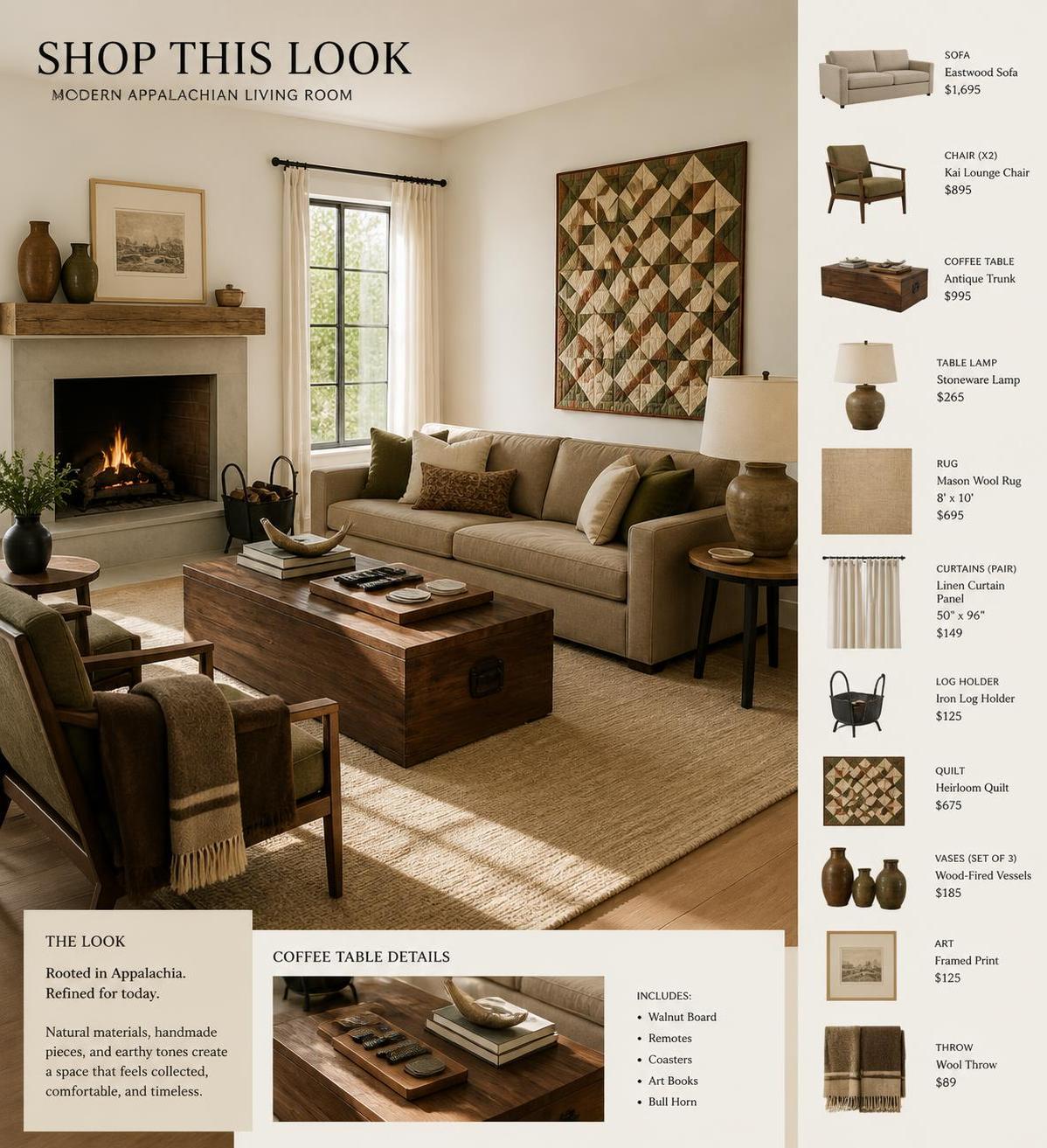
These are the supporting pieces. The handmade work comes from makers, and this is the quiet framework that lets it stand out.
the rug that makes everything look intentional goes under the full seating group, with at least the front legs of every piece on it.
a lamp with actual weight to it sits on the end table and does the warm-light job a ceiling fixture can't.
the quilt hanger that won't wreck the quilt turns a folded heirloom into the second focal point of the room.
iron curtain rods that disappear mount high and wide so the windows read taller.
linen panels in the right off-white soften the corners without adding pattern.
a wool throw you'll actually use lives over the arm of the chair nearest the fireplace.
the firewood holder that looks like sculpture sits on the hearth and earns its spot even in July.
a walnut board for the coffee table corrals remotes, coasters, and the horn.
picture lights that flatter handmade work go above the quilt or a framed print.
The Modern Edit
The move that keeps this from sliding into cabin territory is contrast. Clean shell, handmade contents.
That means straight-lined upholstery instead of rolled arms. Flat-panel or simple shaker cabinetry instead of carved anything. Painted drywall or plaster-look walls instead of shiplap. Then you bring in one wood-fired pitcher, one quilt, one turned bowl, and they read as art rather than as theme.
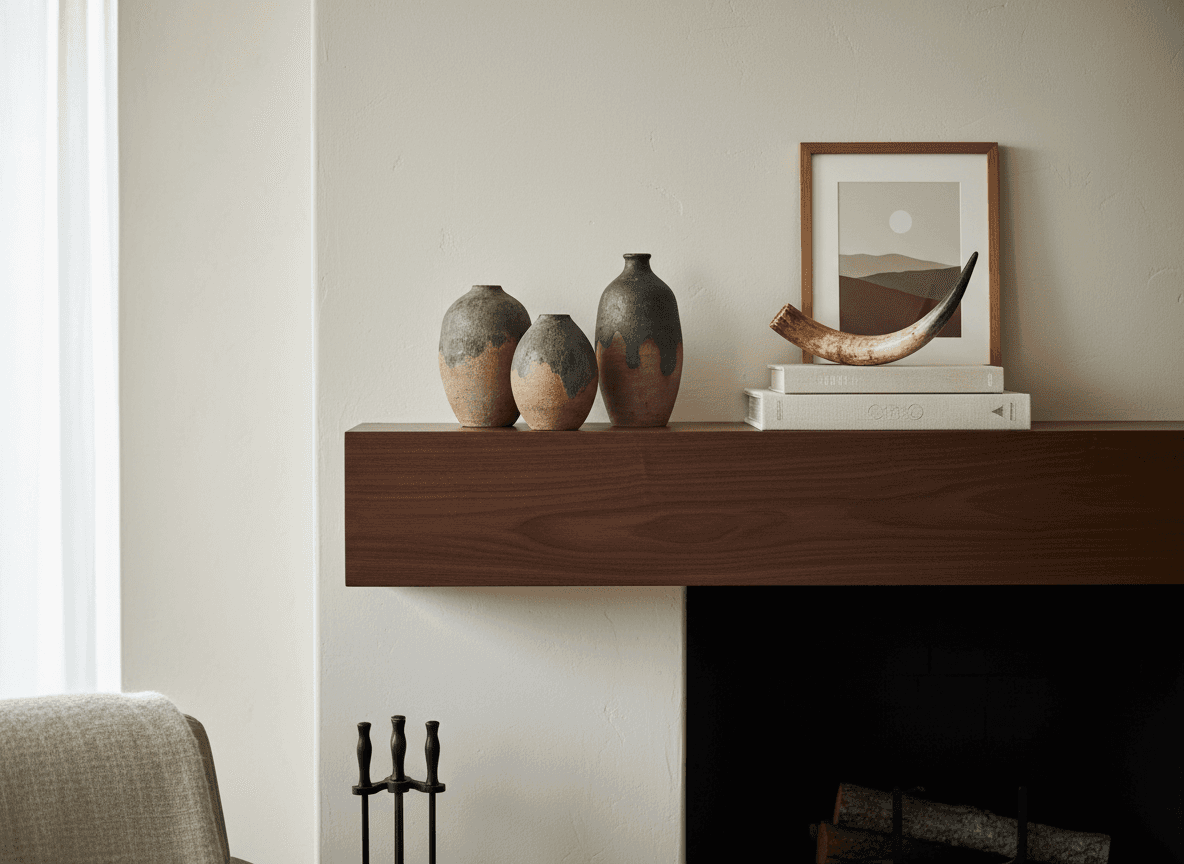
Restraint is the whole trick. Three exceptional handmade objects on a clean mantel look like a collection. Fifteen look like a booth.
Materials That Do the Work
Walnut and cherry for wood, because both age into something richer instead of just getting scratched. Cherry in particular darkens over years, which is part of the appeal.
Stoneware for anything you can put on a surface. Undyed or naturally dyed wool for rugs and throws. Blackened iron for hardware, rods, and fireplace tools. Linen for windows and upholstery.
Notice what's missing. No reclaimed barnwood accent wall. No live-edge slab on every horizontal surface. One slab in a room is a statement, three is a lumberyard.
Mixing Heirlooms With New Furniture
The reason inherited pieces often look off is scale and spacing, not style. A small dark trunk shoved against a wall of big modern upholstery reads like it got left behind by the movers.
Give old pieces room and give them a job. That trunk becomes the coffee table, floating in the center of the rug with 14 to 18 inches of clearance to the sofa as a general starting range. Your legs decide the final number.
If you're not sure where your taste actually sits between modern and traditional, the Style Discovery quiz sorts that out fast, and you can take it free with the code FRIENDS, a $49 value.
Here's how I usually split a room between handmade and retail.
Element | Handmade or heirloom | New and simple | Why |
|---|---|---|---|
Sofa and sectional | Rarely | Yes | Comfort, cleanable fabric, and warranties matter more than provenance |
Coffee table | Yes | Optional | A trunk or a solid wood piece with visible joinery anchors the room |
Dining table | Yes | Optional | The piece you touch most is worth commissioning |
Storage and case goods | Either | Either | Inherited chests work if the scale fits the wall |
Table lamps | Yes | Base only | Ceramic bases from potters, shades from anywhere |
Rug | Either | Yes | Natural wool retail rugs perform well and cost less |
Wall art and quilts | Yes | No | This is where the personality lives |
Dinnerware | Yes | Yes | Mix a handmade serving set with plain everyday plates |
If your room has good pieces and still feels unresolved, that's usually a plan problem rather than a shopping problem, and figuring out the plan is the part I actually do.
Color Palette
Moss green, clay, slate, and cream. Warm neutrals on the big surfaces, muted color on the medium ones, saturated color only in the handmade objects.
Walls in a warm off-white or soft cream. Upholstery in oatmeal, clay, or moss. Slate blue-gray on a built-in or an accent chair if you want depth without going dark. The glaze on a good piece of pottery will out-color anything you paint.
If you want to push contrast further, the same logic drives a white oak and black warm minimalist room, just with a cooler hand.
What to Avoid
Antler chandeliers. Buffalo check on more than one item. Barn doors on rooms that need actual sound privacy. Anything sold as pre-distressed, because real wear happens in specific places and factory wear happens everywhere at once.
Also skip the word art. If a sign has to tell people the room is cozy, the room isn't.
A Living Room Layout That Works
Take a typical Triangle living room around 16 by 20 feet with a fireplace on one long wall and cased openings on two sides.
Float the sofa opposite the fireplace instead of pushing it flat against the wall. Put two lower chairs at slight angles at the ends. Trunk in the middle on a rug large enough that all front legs land on it, usually 8 by 10 or 9 by 12 in a room that size.
Keep main walkways in the 30 to 36 inch range where you can. That's general guidance, not gospel, and your traffic patterns win.
Hang the quilt on the long blank wall opposite the fireplace so the room has two anchors instead of one. Use a hanging sleeve or a clamp system rated for the weight, and follow the hardware instructions for your wall type. My guide to hanging artwork and getting the measurements right covers heights in more detail.
For balance and scale across a layered room like this, the thinking in my warm transitional living room breakdown applies almost directly.

It Depends on Your Space
Small room. One hero craft piece, not six. A single quilt or one large framed textile, plus two pieces of pottery. Keep furniture legs visible so the floor reads continuous.
Large or open-plan room. Repeat one material across zones. Walnut on the coffee table, walnut on the dining table, walnut on a floating shelf. That thread holds a big room together better than matching colors.
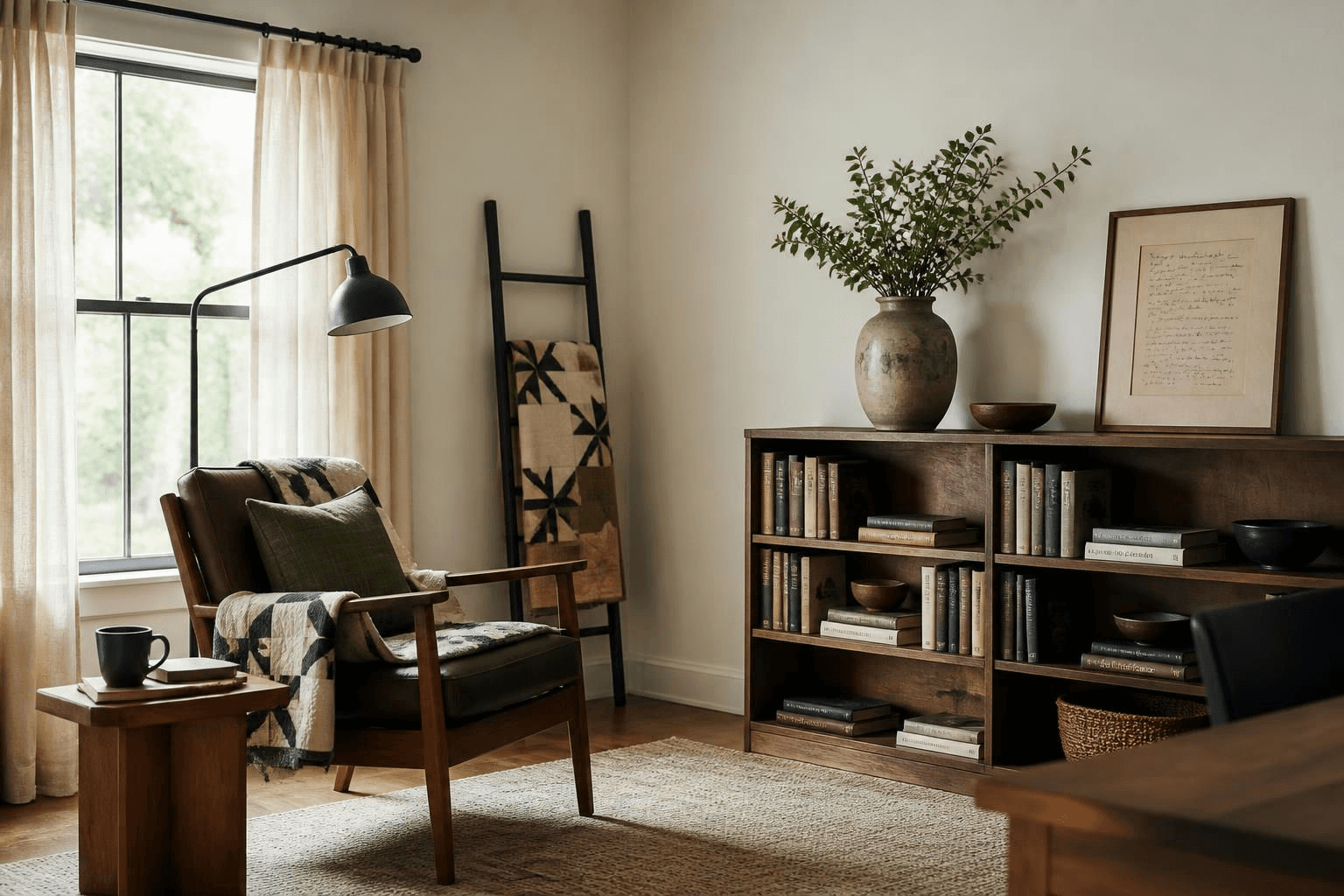
Renting. Tension rods, leaning art, and freestanding shelves. A quilt draped over an open ladder or a sofa back gives you the same warmth with zero holes in the drywall.
Owning. This is where a built-in or a plaster-look wall finish pays off, since the shell is doing half the styling work.
Low light. Skip heavy dark wood on every surface. Go cherry over walnut, cream walls, and add lamps at three heights.
Bright light. Watch textile fade. Rotate quilts seasonally and keep the most delicate one out of direct sun.
Kids and pets. Performance fabric on seating, wool on the floor because it hides more than you'd think, and put the fragile pottery above 48 inches.
Tight budget. Start with one commissioned mug set and one good lamp. Craft collections are supposed to accumulate slowly.
Where to Buy From North Carolina Makers
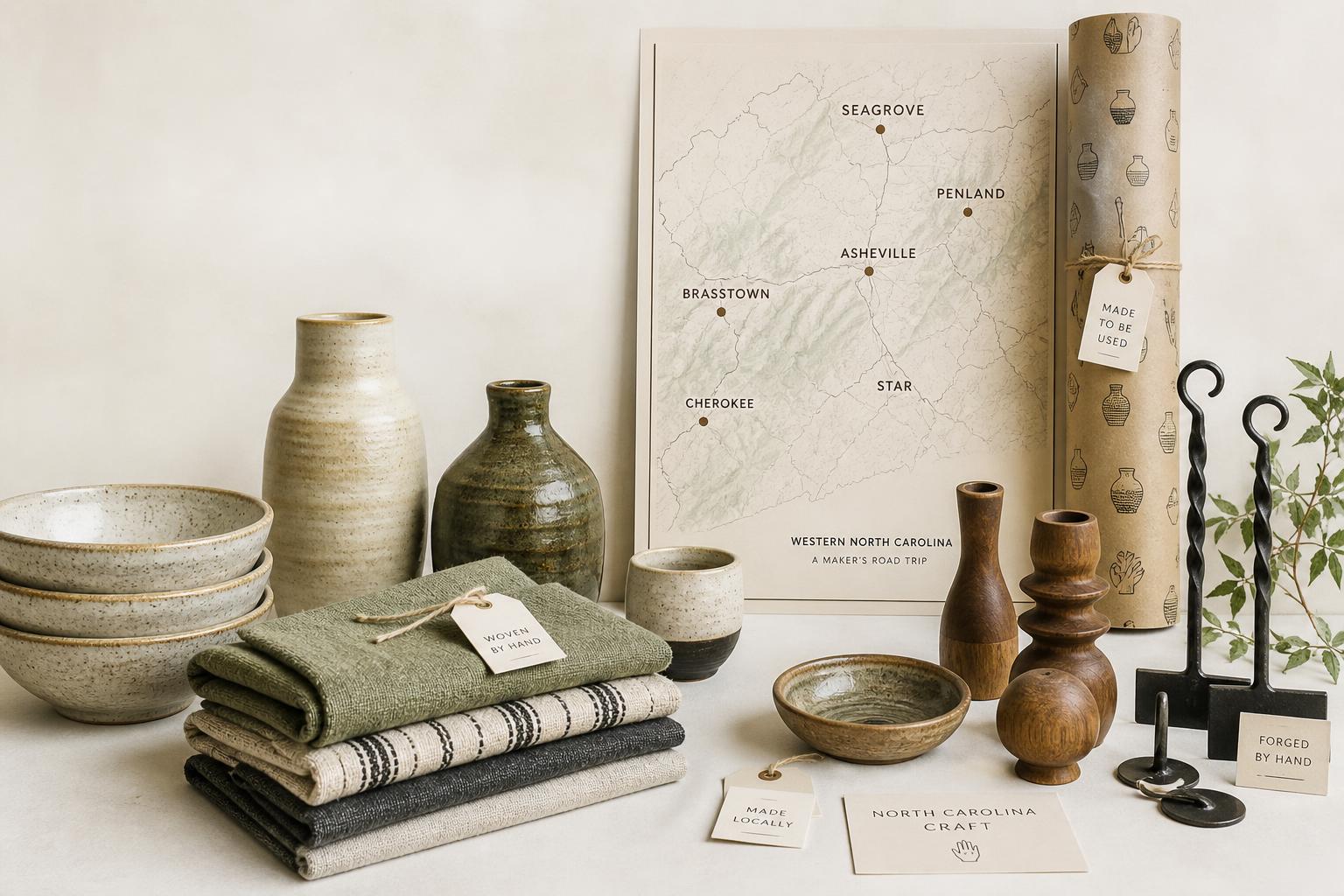
Seagrove. Roughly 90 minutes from Raleigh. Jugtown Pottery, Ben Owen Pottery, and dozens of other working studios, plus the North Carolina Pottery Center.
STARworks, Star NC. Clay and glass studios with open events and a shop.
Folk Art Center, Blue Ridge Parkway near Asheville. Southern Highland Craft Guild members, juried work across every medium.
Penland School of Craft, Bakersville. Gallery and visitors center representing instructors and resident artists.
John C. Campbell Folk School, Brasstown. Craft Shop plus classes if you want to make the thing yourself.
Grovewood Village, Asheville. Working studios and a gallery next to the Grove Park Inn.
Qualla Arts and Crafts Mutual, Cherokee. Eastern Band of Cherokee Indians artists, including basketry and carving.
River Arts District, Asheville. Open studios, still rebuilding after the 2024 flooding.
Closer to home. Claymakers in Durham and the Pullen Arts Center in Raleigh both host classes and sales, and the Triangle has regular craft markets worth checking seasonally.
Always confirm current hours before you drive. Several western studios are still operating on adjusted schedules.
FAQ
What is modern Appalachian interior design?
It's a contemporary room with clean lines and a limited palette where handmade regional craft provides the ornament. I use it as a working definition rather than a historic style, because the look is still forming.
How do I decorate with a quilt without it looking country?
Hang it flat like art on a plain wall, give it space, and keep the rest of the room quiet. One quilt against cream walls reads as a textile piece, while a quilt plus plaid plus a rooster reads as a theme.
What woods work best for this look?
Walnut and cherry, both of which are grown and worked in the Southeast. They have enough color depth to carry a room without any staining or distressing, and cherry keeps deepening for years.
Is handmade pottery practical for everyday use?
Most functional stoneware from working potters is food safe, dishwasher safe, and microwave safe, but ask the maker since glazes and clay bodies vary. Pieces with metallic glazes usually stay out of the microwave.
How much should I budget for a room like this?
It depends entirely on whether you're commissioning furniture or shopping retail with a few handmade accents. My services page lays out how I structure projects and what's involved.
If you've got good pieces with real history and a room that isn't doing them justice, let's put a plan around them. That's the part that makes the difference.
More Inspiration


There's a bull horn in my living room. Not a cheerleading megaphone, not a gym teacher's prop, an actual horn from an actual bull, sitting on a stack of coffee table books like it pays rent. I love it. It's the kind of object that makes people pick it up and ask a question, which is more than I can say for most decor.
Most of us have something like that. A handmade quilt folded in a closet. A trunk that belonged to somebody's grandmother. A piece of pottery you can't part with even though it doesn't match anything.
So here's the short answer. Modern Appalachian, at least the way I define it, is a contemporary room with a restrained palette and clean architecture, where handmade regional craft carries all the visual weight. It isn't a recognized historic style with a rulebook. It's an emerging direction I've been building on purpose, and the whole idea is that the handmade things get to be the loudest objects in the room.
The Roots: Why North Carolina Has an Unfair Advantage
We live in one of the strongest craft regions in the country, and a lot of Triangle homeowners don't fully clock it because the makers are three to five hours west.
Pottery is the obvious one. Seagrove, about an hour and a half from Raleigh, has one of the densest concentrations of working potters in the United States, with the North Carolina Pottery Center there and long-running shops like Jugtown Pottery and Ben Owen Pottery. Nearby in Star, STARworks runs a clay and glass facility that supplies potters across the region.
Then there's the mountain craft infrastructure. Penland School of Craft in Bakersville and the John C. Campbell Folk School in Brasstown have been teaching wood, clay, fiber, iron, and glass for roughly a century between them. The Southern Highland Craft Guild runs the Folk Art Center on the Blue Ridge Parkway outside Asheville. Grovewood Village sits next to the Omni Grove Park Inn. Qualla Arts and Crafts Mutual in Cherokee represents Eastern Band of Cherokee Indians artists and is one of the oldest Native American craft cooperatives in the country.
Quilting and woodworking never left either. They just got quieter than pottery because they're harder to sell in a gift shop.
The 2024 flooding hit a lot of these communities hard, including Asheville's River Arts District. If you've been meaning to buy from a western North Carolina maker, this is a good year to actually do it.
Shop This Room
As an Amazon Associate, I earn from qualifying purchases. It doesn't change what I recommend.
These are the supporting pieces. The handmade work comes from makers, and this is the quiet framework that lets it stand out.
the rug that makes everything look intentional goes under the full seating group, with at least the front legs of every piece on it.
a lamp with actual weight to it sits on the end table and does the warm-light job a ceiling fixture can't.
the quilt hanger that won't wreck the quilt turns a folded heirloom into the second focal point of the room.
iron curtain rods that disappear mount high and wide so the windows read taller.
linen panels in the right off-white soften the corners without adding pattern.
a wool throw you'll actually use lives over the arm of the chair nearest the fireplace.
the firewood holder that looks like sculpture sits on the hearth and earns its spot even in July.
a walnut board for the coffee table corrals remotes, coasters, and the horn.
picture lights that flatter handmade work go above the quilt or a framed print.
The Modern Edit
The move that keeps this from sliding into cabin territory is contrast. Clean shell, handmade contents.
That means straight-lined upholstery instead of rolled arms. Flat-panel or simple shaker cabinetry instead of carved anything. Painted drywall or plaster-look walls instead of shiplap. Then you bring in one wood-fired pitcher, one quilt, one turned bowl, and they read as art rather than as theme.
Restraint is the whole trick. Three exceptional handmade objects on a clean mantel look like a collection. Fifteen look like a booth.
Materials That Do the Work
Walnut and cherry for wood, because both age into something richer instead of just getting scratched. Cherry in particular darkens over years, which is part of the appeal.
Stoneware for anything you can put on a surface. Undyed or naturally dyed wool for rugs and throws. Blackened iron for hardware, rods, and fireplace tools. Linen for windows and upholstery.
Notice what's missing. No reclaimed barnwood accent wall. No live-edge slab on every horizontal surface. One slab in a room is a statement, three is a lumberyard.
Mixing Heirlooms With New Furniture
The reason inherited pieces often look off is scale and spacing, not style. A small dark trunk shoved against a wall of big modern upholstery reads like it got left behind by the movers.
Give old pieces room and give them a job. That trunk becomes the coffee table, floating in the center of the rug with 14 to 18 inches of clearance to the sofa as a general starting range. Your legs decide the final number.
If you're not sure where your taste actually sits between modern and traditional, the Style Discovery quiz sorts that out fast, and you can take it free with the code FRIENDS, a $49 value.
Here's how I usually split a room between handmade and retail.
Element | Handmade or heirloom | New and simple | Why |
|---|---|---|---|
Sofa and sectional | Rarely | Yes | Comfort, cleanable fabric, and warranties matter more than provenance |
Coffee table | Yes | Optional | A trunk or a solid wood piece with visible joinery anchors the room |
Dining table | Yes | Optional | The piece you touch most is worth commissioning |
Storage and case goods | Either | Either | Inherited chests work if the scale fits the wall |
Table lamps | Yes | Base only | Ceramic bases from potters, shades from anywhere |
Rug | Either | Yes | Natural wool retail rugs perform well and cost less |
Wall art and quilts | Yes | No | This is where the personality lives |
Dinnerware | Yes | Yes | Mix a handmade serving set with plain everyday plates |
If your room has good pieces and still feels unresolved, that's usually a plan problem rather than a shopping problem, and figuring out the plan is the part I actually do.
Color Palette
Moss green, clay, slate, and cream. Warm neutrals on the big surfaces, muted color on the medium ones, saturated color only in the handmade objects.
Walls in a warm off-white or soft cream. Upholstery in oatmeal, clay, or moss. Slate blue-gray on a built-in or an accent chair if you want depth without going dark. The glaze on a good piece of pottery will out-color anything you paint.
If you want to push contrast further, the same logic drives a white oak and black warm minimalist room, just with a cooler hand.
What to Avoid
Antler chandeliers. Buffalo check on more than one item. Barn doors on rooms that need actual sound privacy. Anything sold as pre-distressed, because real wear happens in specific places and factory wear happens everywhere at once.
Also skip the word art. If a sign has to tell people the room is cozy, the room isn't.
A Living Room Layout That Works
Take a typical Triangle living room around 16 by 20 feet with a fireplace on one long wall and cased openings on two sides.
Float the sofa opposite the fireplace instead of pushing it flat against the wall. Put two lower chairs at slight angles at the ends. Trunk in the middle on a rug large enough that all front legs land on it, usually 8 by 10 or 9 by 12 in a room that size.
Keep main walkways in the 30 to 36 inch range where you can. That's general guidance, not gospel, and your traffic patterns win.
Hang the quilt on the long blank wall opposite the fireplace so the room has two anchors instead of one. Use a hanging sleeve or a clamp system rated for the weight, and follow the hardware instructions for your wall type. My guide to hanging artwork and getting the measurements right covers heights in more detail.
For balance and scale across a layered room like this, the thinking in my warm transitional living room breakdown applies almost directly.
It Depends on Your Space
Small room. One hero craft piece, not six. A single quilt or one large framed textile, plus two pieces of pottery. Keep furniture legs visible so the floor reads continuous.
Large or open-plan room. Repeat one material across zones. Walnut on the coffee table, walnut on the dining table, walnut on a floating shelf. That thread holds a big room together better than matching colors.
Renting. Tension rods, leaning art, and freestanding shelves. A quilt draped over an open ladder or a sofa back gives you the same warmth with zero holes in the drywall.
Owning. This is where a built-in or a plaster-look wall finish pays off, since the shell is doing half the styling work.
Low light. Skip heavy dark wood on every surface. Go cherry over walnut, cream walls, and add lamps at three heights.
Bright light. Watch textile fade. Rotate quilts seasonally and keep the most delicate one out of direct sun.
Kids and pets. Performance fabric on seating, wool on the floor because it hides more than you'd think, and put the fragile pottery above 48 inches.
Tight budget. Start with one commissioned mug set and one good lamp. Craft collections are supposed to accumulate slowly.
Where to Buy From North Carolina Makers
Seagrove. Roughly 90 minutes from Raleigh. Jugtown Pottery, Ben Owen Pottery, and dozens of other working studios, plus the North Carolina Pottery Center.
STARworks, Star NC. Clay and glass studios with open events and a shop.
Folk Art Center, Blue Ridge Parkway near Asheville. Southern Highland Craft Guild members, juried work across every medium.
Penland School of Craft, Bakersville. Gallery and visitors center representing instructors and resident artists.
John C. Campbell Folk School, Brasstown. Craft Shop plus classes if you want to make the thing yourself.
Grovewood Village, Asheville. Working studios and a gallery next to the Grove Park Inn.
Qualla Arts and Crafts Mutual, Cherokee. Eastern Band of Cherokee Indians artists, including basketry and carving.
River Arts District, Asheville. Open studios, still rebuilding after the 2024 flooding.
Closer to home. Claymakers in Durham and the Pullen Arts Center in Raleigh both host classes and sales, and the Triangle has regular craft markets worth checking seasonally.
Always confirm current hours before you drive. Several western studios are still operating on adjusted schedules.
FAQ
What is modern Appalachian interior design?
It's a contemporary room with clean lines and a limited palette where handmade regional craft provides the ornament. I use it as a working definition rather than a historic style, because the look is still forming.
How do I decorate with a quilt without it looking country?
Hang it flat like art on a plain wall, give it space, and keep the rest of the room quiet. One quilt against cream walls reads as a textile piece, while a quilt plus plaid plus a rooster reads as a theme.
What woods work best for this look?
Walnut and cherry, both of which are grown and worked in the Southeast. They have enough color depth to carry a room without any staining or distressing, and cherry keeps deepening for years.
Is handmade pottery practical for everyday use?
Most functional stoneware from working potters is food safe, dishwasher safe, and microwave safe, but ask the maker since glazes and clay bodies vary. Pieces with metallic glazes usually stay out of the microwave.
How much should I budget for a room like this?
It depends entirely on whether you're commissioning furniture or shopping retail with a few handmade accents. My services page lays out how I structure projects and what's involved.
If you've got good pieces with real history and a room that isn't doing them justice, let's put a plan around them. That's the part that makes the difference.
More Inspiration
Other Blogs
Other Similar Blogs
Your go-to destination for insightful articles, tips, and inspiration on all things landscaping and outdoor living
Other Blogs
Other Similar Blogs
Your go-to destination for insightful articles, tips, and inspiration on all things landscaping and outdoor living
Other Blogs
Other Similar Blogs
Your go-to destination for insightful articles, tips, and inspiration on all things landscaping and outdoor living



Join our newsletter list
Sign up to get the most recent blog articles in your email every week.