Author
Suzanne is an Owner/Designer
Author
Suzanne is an Owner/Designer
FunHaus style brings circus-inspired warmth into grown-up rooms through restrained palettes, bold stripes, and sculptural forms. Here's how to get the look without it feeling like a birthday party.
FunHaus style brings circus-inspired warmth into grown-up rooms through restrained palettes, bold stripes, and sculptural forms. Here's how to get the look without it feeling like a birthday party.
FunHaus Style: An Elevated Circuscore Home That's Playful, Not Kitschy
*This blog contains affiliate links.
I remember the first time I saw it. I think Sarah Sherman Samuel made it popular with her iconic modern eye. She had created a bunkbed for her boys' room with an arch and curtains that would close, then she painted stripes on the ceiling. All with just a couple grounded tones, olive and cream with a pop of chartreuse, to not feel over the top. It was incredible and the design world was changed. We all had to have it.
And then, like most good things on the internet, it got a little out of hand.
Suddenly everyone was painting circus stripes on every wall, hanging star garlands from the ceiling, and calling it "whimsical." Rooms started looking like a party supply aisle had a baby with a Pinterest board. Which always makes me nervous, because the original idea was so good. So restrained.
So let's talk about what I'm calling FunHaus style. And more importantly, how to keep it feeling like you and not like a five-year-old's birthday.
Shop This Room
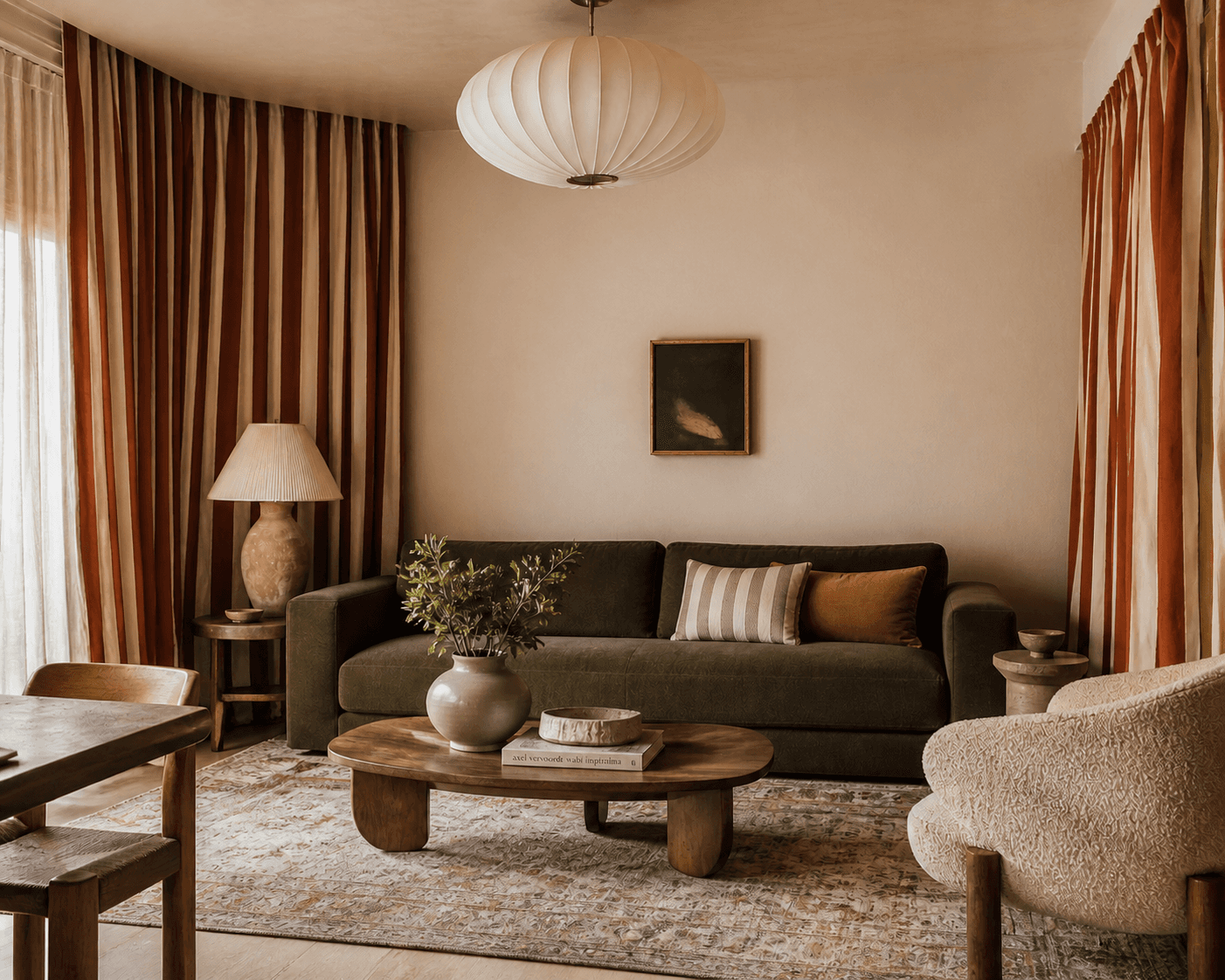
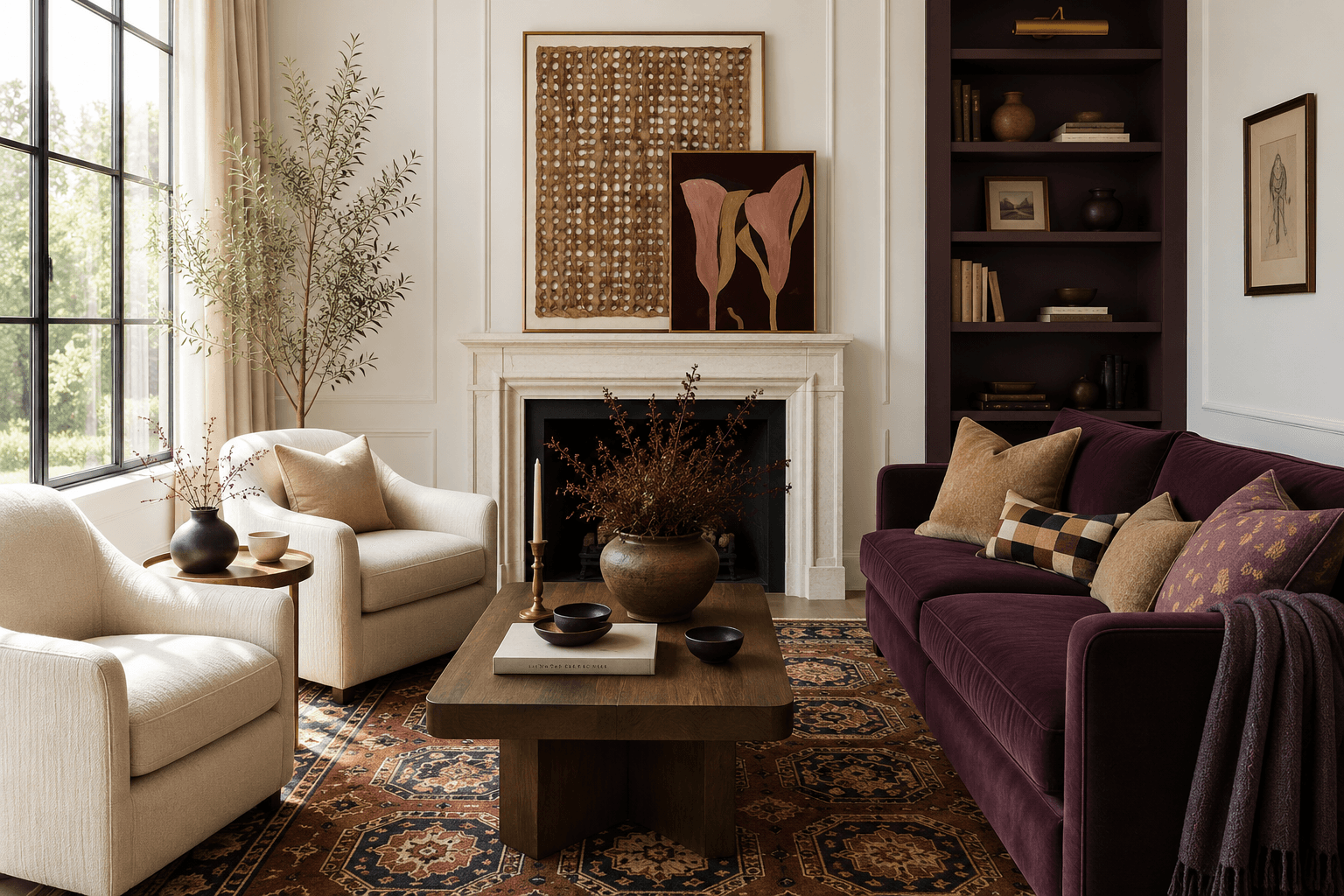
Here are the pieces that get you 80% of the way there. The trick is that none of them scream circus on their own. Together, they hum.
Wait, What Even Is FunHaus
I made the name up. Or maybe I didn't. It doesn't matter.
FunHaus is what happens when you take the visual language of old European circuses and traveling theaters, the stripes, the arches, the warm amber lighting, the slight drama of it all, and you filter it through a modern, restrained lens.
Think Wes Anderson if he designed a hotel with Jeremiah Brent. Think a Parisian cabaret that got a renovation from someone who actually understands drywall.
It's not about literal circus decor. No elephants. No trapeze artists printed on your wallpaper. It's about borrowing the geometry, the warmth, and the sense of performance from that world. And then grounding it so hard in natural materials and a tight color palette that it reads as sophisticated.
The bones of FunHaus are simple:
A restrained palette. Three tones max, plus one bold accent.
One confident stripe or bold pattern, not five.
Sculptural, curved forms in the furniture.
Warm, layered lighting. Always.
High-quality textures doing all the heavy lifting.
That's it. Five things. And honestly, that tracks with most good design. The restraint is the whole game.
The Elevation Checklist
Here's where I see rooms go sideways. Someone gets excited about the stripes and forgets that the thing making Sarah Sherman Samuel's room work wasn't the stripes themselves. It was everything around the stripes.
The stripes had permission to be bold because the rest of the room was calm, grounded, and full of really well-chosen finishing details.
So here's what I call the elevation checklist. These are the pieces that take a FunHaus room from "fun idea" to "wait, who designed this."
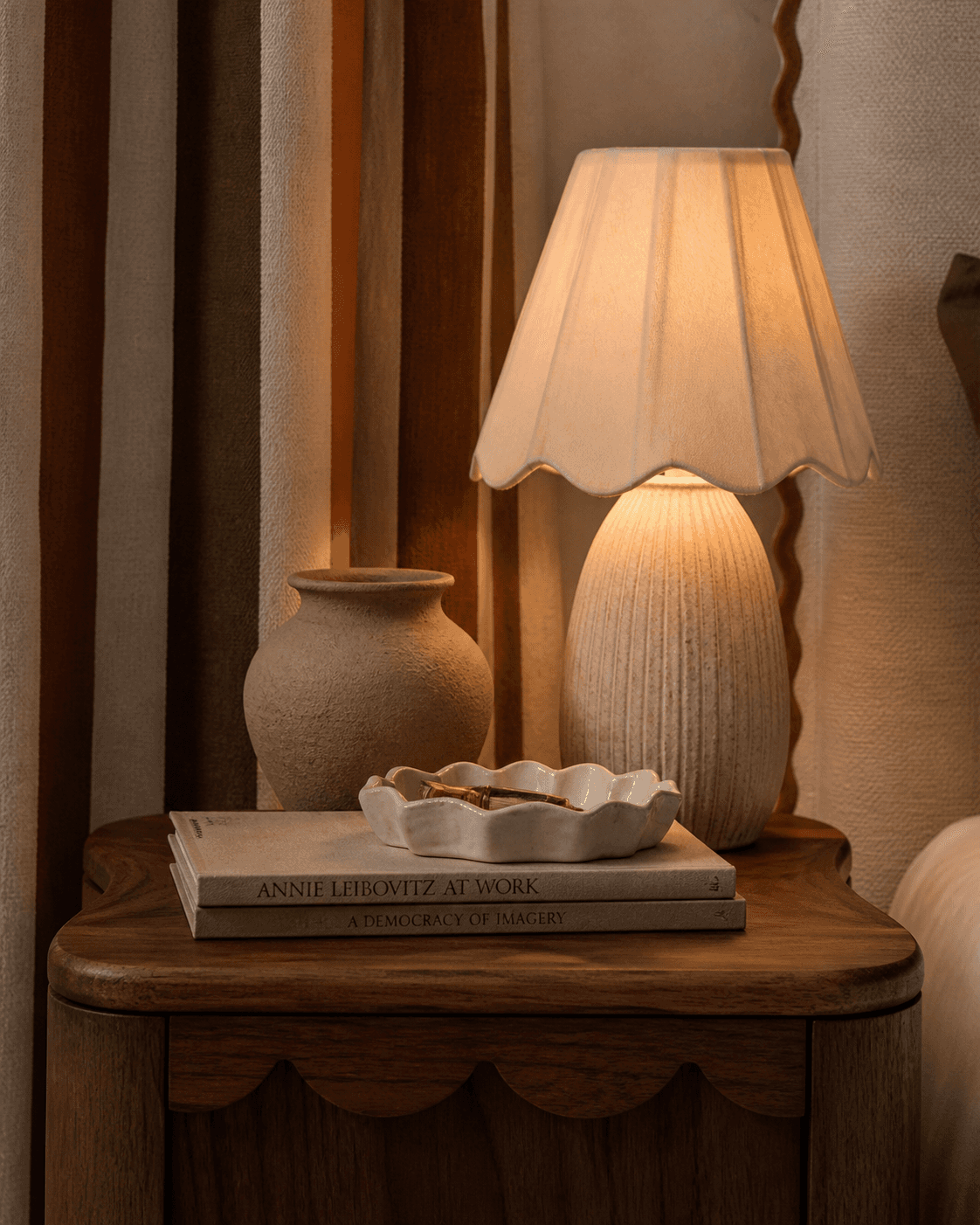
Tailored drapery. Not just any curtains. Floor-to-ceiling panels that puddle just slightly. Hung high. The fabric should have weight to it. This is the single fastest way to make any room feel finished and a little bit theatrical without trying.
Artisan lighting. One sculptural lamp or a globe pendant with brass detail changes the whole temperature of the room. Literally and visually. Skip anything with a paper shade from your college apartment.
Curved furniture. A chair with a rounded back. A round side table. An arched mirror. Curves are doing double duty here. They reference the arches and tent shapes of circus architecture, and they soften the graphic punch of your stripes. You need both.
Texture, not pattern. Once you've committed to your one bold pattern (the stripe, the arch, whatever it is), let everything else be about texture. A nubby wool throw. A linen duvet with visible weave. A woven basket for storage. These quiet layers are what keep the room from feeling flat or costume-y.
The Guest Room That Started It All
I had a client last year with a guest room that was, and I say this with love, aggressively beige. It was 11 by 13 feet. A queen bed centered on the long wall. Two mismatched nightstands. A ceiling fan from 2004 that made a clicking noise at any speed above "1." The kind of room where you put your suitcase on the bed and immediately check your phone.
She wanted it to feel like a boutique hotel. Something guests would actually be excited to sleep in. And she kept sending me photos of rooms with bold stripes and arches but then saying "but not too much."
Which is exactly the right instinct.
Here's what we did, and this is where layout comes first.
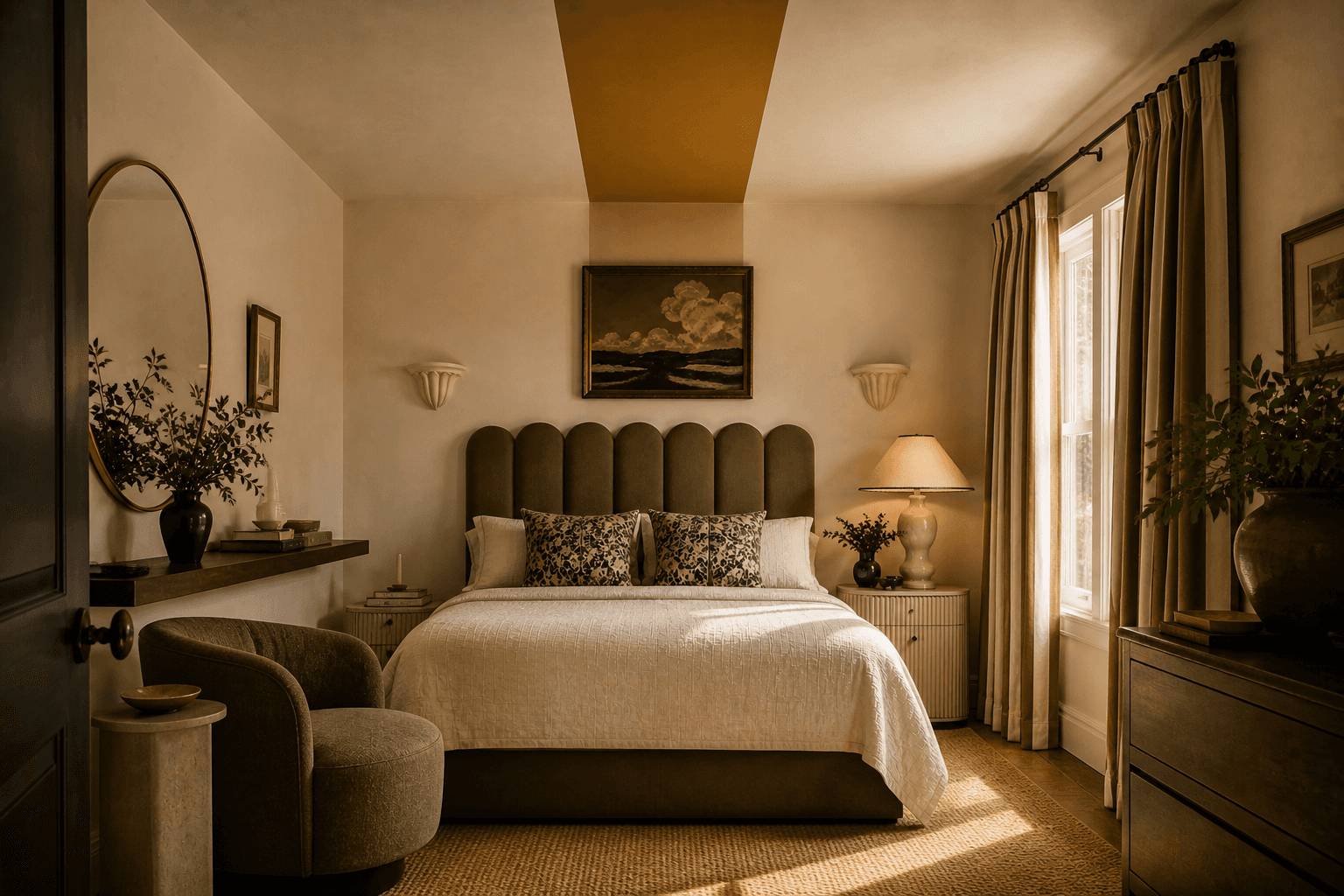
We moved the bed to the short wall. This felt wrong to her at first because the headboard wall was now only 11 feet wide and the bed looked bigger in proportion. But it opened up the entry path and gave us a full 13-foot wall for a long low dresser and a reading corner with that curved bouclé chair. The room went from "walk in, see bed" to "walk in, see a whole room."
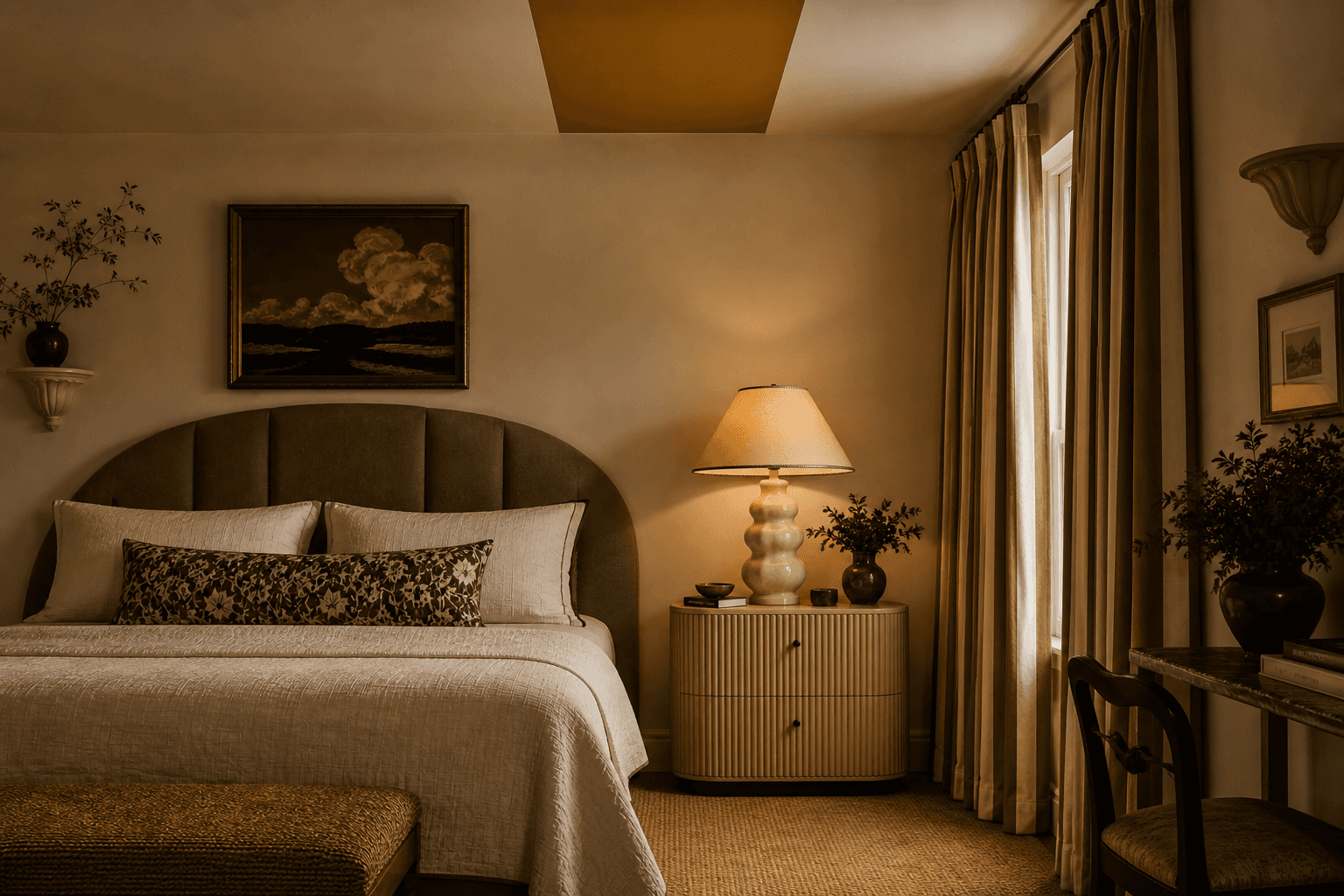
One stripe on the ceiling. Not the whole ceiling. One wide stripe, about 14 inches, in a muted ochre, running the length of the room directly over the bed. It draws your eye up and gives the room height without overwhelming anything.
Striped drapery on the window wall. Cream and olive panels, hung from a brass rod with ball finials, 8 inches above the window frame. They echo the ceiling stripe but in a softer, fabric form. The conversation between the two is what makes it feel intentional instead of random.
Everything else: quiet. Cream linen bedding. Warm white ceramic lamps on matching fluted nightstands. An oversized round mirror on the wall opposite the window to bounce light around. The high-pile rug under the bed, pulled out about 24 inches on each side so your feet hit something soft in the morning.
She texted me a photo after the first guest stayed. The guest had taken a picture of the room and posted it. Which, for a guest room, is basically a standing ovation.
This is exactly what I do for clients. Want me to design your room like this? Let's make it happen
A Quick Word About Nurseries
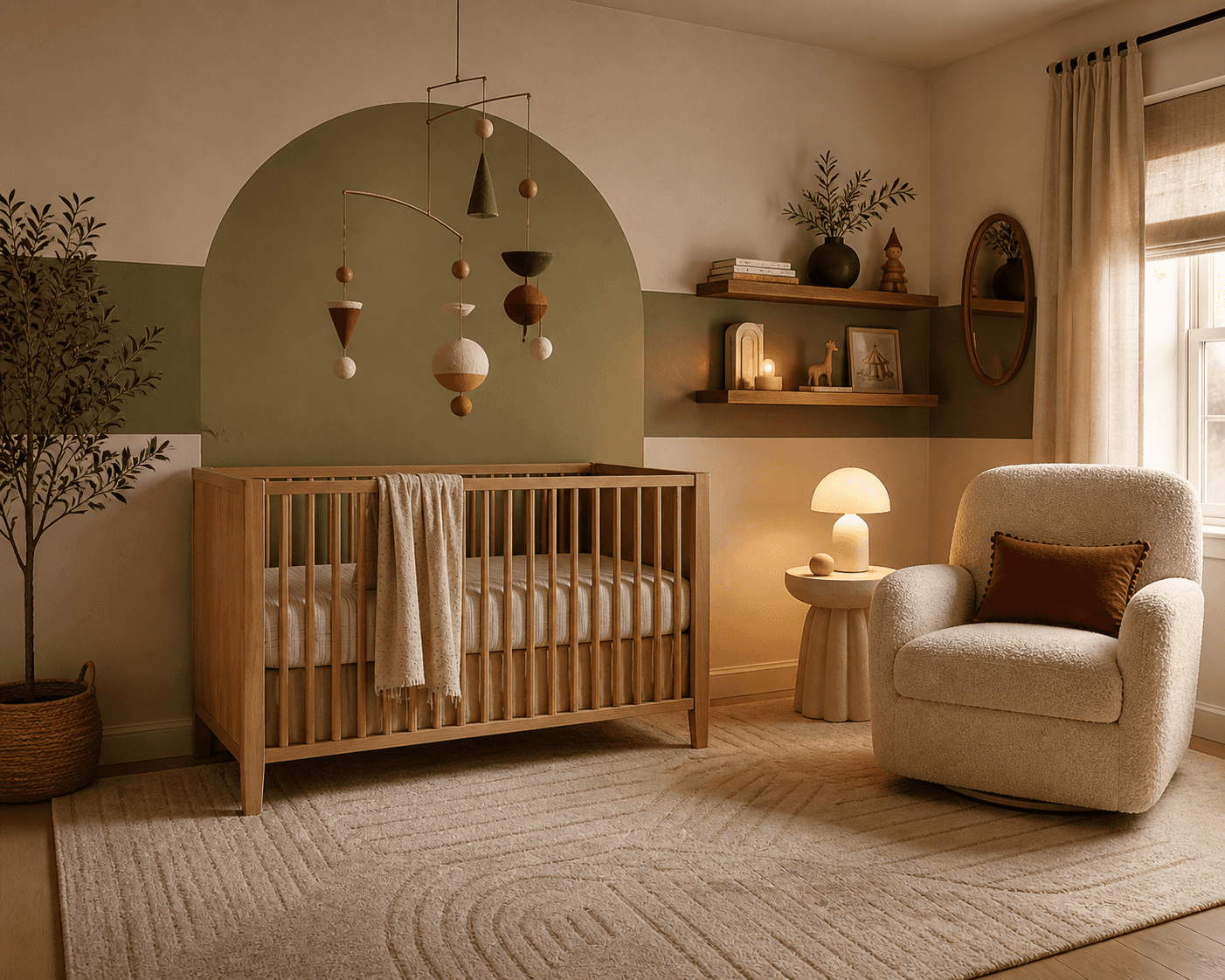
I get asked about this a lot. Can you do FunHaus in a nursery?
Yes. And honestly, nurseries might be where this style makes the most sense. Because here's the thing about nursery design that nobody warns you about: you're going to be staring at this room at 3 AM for months. Maybe years. Whatever you put on those walls, you need to still like it when you're sleep-deprived and slightly delirious.
Bold primary-color circus themes don't age well. Not on the walls, and not on you at 3 AM.
Here's what does age well:
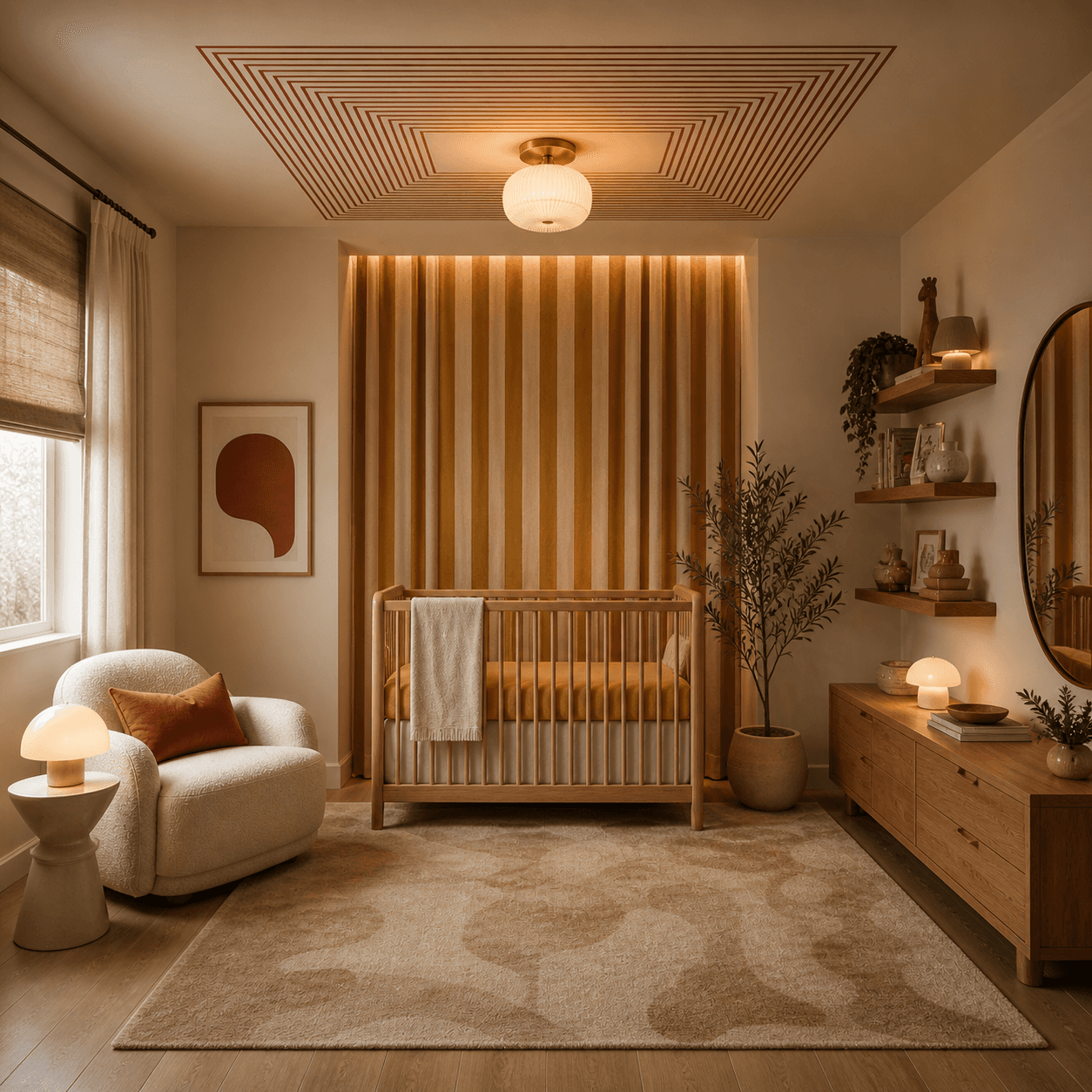
A warm neutral base. One muted stripe, maybe on the wall behind the crib, in olive or dusty rose or ochre. A sculptural mobile instead of a plastic one that plays "Twinkle Twinkle" in a key that haunts your dreams. A quality wool rug that can handle the inevitable. A rattan or curved bookshelf instead of a primary-colored cube organizer.
The goal is the same as every FunHaus room. Let the geometry and the forms carry the playfulness. Let the palette stay grown-up. When your kid is four and wants dinosaur everything, you can layer that in with bedding and art. The bones of the room stay.
The One-Bold-Thing Rule
If you take nothing else from this post, take this.
One bold thing per room.
One stripe. One arch. One saturated accent color. One piece of furniture with a dramatic curve.
Not one of each. One total.
Everything around it should be supporting, not competing. Quiet textures, grounded tones, clean lines. The bold thing only works because it has room to breathe.
This is the difference between a room that feels curated (sorry, I know, but it's the right word here) and a room that feels like a mood board exploded.
Why Layout Comes First (Even Here)
It's tempting to start with the fun stuff. The stripes. The color. The lamp you saw on Instagram.
I get it. Truly.
But FunHaus falls apart fast if the room doesn't flow. If your bold stripe is competing with a TV on the same wall. If your beautiful arched headboard is crammed into a corner because the bed placement was an afterthought. If you bought the curved chair but there's nowhere to put it that doesn't block the closet door.
The playfulness only reads as intentional when the layout is solid underneath it. Otherwise it just reads as stuff.
That's the quiet part. The part that doesn't make it into the Instagram carousel. The measuring, the furniture templates on graph paper, the "what if we shift this 6 inches to the left" conversations. It's not glamorous. But it's the difference between a room that photographs well and a room that actually lives well.
If you're not sure where to start, Style Discovery is a good first step. It helps me understand how you actually use your room before we pick a single paint color.
Bringing It Home
I think about that Sarah Sherman Samuel room sometimes. How it launched a thousand stripe tutorials and arch DIYs. How most of them missed the point.
The point wasn't the stripes.
The point was that someone had built a room with real intention, where every single choice was in conversation with every other choice, and the result felt like joy without feeling like chaos.
That's what FunHaus is, when it's done right. A room that makes you smile when you walk in. Not because it's loud, but because it's confident.
And confidence, in a room, comes from the layout. From the proportions. From knowing what to leave out.
I keep coming back to that.
If you are looking for bolder color check out:
FunHaus Style: An Elevated Circuscore Home That's Playful, Not Kitschy
*This blog contains affiliate links.
I remember the first time I saw it. I think Sarah Sherman Samuel made it popular with her iconic modern eye. She had created a bunkbed for her boys' room with an arch and curtains that would close, then she painted stripes on the ceiling. All with just a couple grounded tones, olive and cream with a pop of chartreuse, to not feel over the top. It was incredible and the design world was changed. We all had to have it.
And then, like most good things on the internet, it got a little out of hand.
Suddenly everyone was painting circus stripes on every wall, hanging star garlands from the ceiling, and calling it "whimsical." Rooms started looking like a party supply aisle had a baby with a Pinterest board. Which always makes me nervous, because the original idea was so good. So restrained.
So let's talk about what I'm calling FunHaus style. And more importantly, how to keep it feeling like you and not like a five-year-old's birthday.
Shop This Room
Here are the pieces that get you 80% of the way there. The trick is that none of them scream circus on their own. Together, they hum.
Wait, What Even Is FunHaus
I made the name up. Or maybe I didn't. It doesn't matter.
FunHaus is what happens when you take the visual language of old European circuses and traveling theaters, the stripes, the arches, the warm amber lighting, the slight drama of it all, and you filter it through a modern, restrained lens.
Think Wes Anderson if he designed a hotel with Jeremiah Brent. Think a Parisian cabaret that got a renovation from someone who actually understands drywall.
It's not about literal circus decor. No elephants. No trapeze artists printed on your wallpaper. It's about borrowing the geometry, the warmth, and the sense of performance from that world. And then grounding it so hard in natural materials and a tight color palette that it reads as sophisticated.
The bones of FunHaus are simple:
A restrained palette. Three tones max, plus one bold accent.
One confident stripe or bold pattern, not five.
Sculptural, curved forms in the furniture.
Warm, layered lighting. Always.
High-quality textures doing all the heavy lifting.
That's it. Five things. And honestly, that tracks with most good design. The restraint is the whole game.
The Elevation Checklist
Here's where I see rooms go sideways. Someone gets excited about the stripes and forgets that the thing making Sarah Sherman Samuel's room work wasn't the stripes themselves. It was everything around the stripes.
The stripes had permission to be bold because the rest of the room was calm, grounded, and full of really well-chosen finishing details.
So here's what I call the elevation checklist. These are the pieces that take a FunHaus room from "fun idea" to "wait, who designed this."
Tailored drapery. Not just any curtains. Floor-to-ceiling panels that puddle just slightly. Hung high. The fabric should have weight to it. This is the single fastest way to make any room feel finished and a little bit theatrical without trying.
Artisan lighting. One sculptural lamp or a globe pendant with brass detail changes the whole temperature of the room. Literally and visually. Skip anything with a paper shade from your college apartment.
Curved furniture. A chair with a rounded back. A round side table. An arched mirror. Curves are doing double duty here. They reference the arches and tent shapes of circus architecture, and they soften the graphic punch of your stripes. You need both.
Texture, not pattern. Once you've committed to your one bold pattern (the stripe, the arch, whatever it is), let everything else be about texture. A nubby wool throw. A linen duvet with visible weave. A woven basket for storage. These quiet layers are what keep the room from feeling flat or costume-y.
The Guest Room That Started It All
I had a client last year with a guest room that was, and I say this with love, aggressively beige. It was 11 by 13 feet. A queen bed centered on the long wall. Two mismatched nightstands. A ceiling fan from 2004 that made a clicking noise at any speed above "1." The kind of room where you put your suitcase on the bed and immediately check your phone.
She wanted it to feel like a boutique hotel. Something guests would actually be excited to sleep in. And she kept sending me photos of rooms with bold stripes and arches but then saying "but not too much."
Which is exactly the right instinct.
Here's what we did, and this is where layout comes first.
We moved the bed to the short wall. This felt wrong to her at first because the headboard wall was now only 11 feet wide and the bed looked bigger in proportion. But it opened up the entry path and gave us a full 13-foot wall for a long low dresser and a reading corner with that curved bouclé chair. The room went from "walk in, see bed" to "walk in, see a whole room."
One stripe on the ceiling. Not the whole ceiling. One wide stripe, about 14 inches, in a muted ochre, running the length of the room directly over the bed. It draws your eye up and gives the room height without overwhelming anything.
Striped drapery on the window wall. Cream and olive panels, hung from a brass rod with ball finials, 8 inches above the window frame. They echo the ceiling stripe but in a softer, fabric form. The conversation between the two is what makes it feel intentional instead of random.
Everything else: quiet. Cream linen bedding. Warm white ceramic lamps on matching fluted nightstands. An oversized round mirror on the wall opposite the window to bounce light around. The high-pile rug under the bed, pulled out about 24 inches on each side so your feet hit something soft in the morning.
She texted me a photo after the first guest stayed. The guest had taken a picture of the room and posted it. Which, for a guest room, is basically a standing ovation.
This is exactly what I do for clients. Want me to design your room like this? Let's make it happen
A Quick Word About Nurseries
I get asked about this a lot. Can you do FunHaus in a nursery?
Yes. And honestly, nurseries might be where this style makes the most sense. Because here's the thing about nursery design that nobody warns you about: you're going to be staring at this room at 3 AM for months. Maybe years. Whatever you put on those walls, you need to still like it when you're sleep-deprived and slightly delirious.
Bold primary-color circus themes don't age well. Not on the walls, and not on you at 3 AM.
Here's what does age well:
A warm neutral base. One muted stripe, maybe on the wall behind the crib, in olive or dusty rose or ochre. A sculptural mobile instead of a plastic one that plays "Twinkle Twinkle" in a key that haunts your dreams. A quality wool rug that can handle the inevitable. A rattan or curved bookshelf instead of a primary-colored cube organizer.
The goal is the same as every FunHaus room. Let the geometry and the forms carry the playfulness. Let the palette stay grown-up. When your kid is four and wants dinosaur everything, you can layer that in with bedding and art. The bones of the room stay.
The One-Bold-Thing Rule
If you take nothing else from this post, take this.
One bold thing per room.
One stripe. One arch. One saturated accent color. One piece of furniture with a dramatic curve.
Not one of each. One total.
Everything around it should be supporting, not competing. Quiet textures, grounded tones, clean lines. The bold thing only works because it has room to breathe.
This is the difference between a room that feels curated (sorry, I know, but it's the right word here) and a room that feels like a mood board exploded.
Why Layout Comes First (Even Here)
It's tempting to start with the fun stuff. The stripes. The color. The lamp you saw on Instagram.
I get it. Truly.
But FunHaus falls apart fast if the room doesn't flow. If your bold stripe is competing with a TV on the same wall. If your beautiful arched headboard is crammed into a corner because the bed placement was an afterthought. If you bought the curved chair but there's nowhere to put it that doesn't block the closet door.
The playfulness only reads as intentional when the layout is solid underneath it. Otherwise it just reads as stuff.
That's the quiet part. The part that doesn't make it into the Instagram carousel. The measuring, the furniture templates on graph paper, the "what if we shift this 6 inches to the left" conversations. It's not glamorous. But it's the difference between a room that photographs well and a room that actually lives well.
If you're not sure where to start, Style Discovery is a good first step. It helps me understand how you actually use your room before we pick a single paint color.
Bringing It Home
I think about that Sarah Sherman Samuel room sometimes. How it launched a thousand stripe tutorials and arch DIYs. How most of them missed the point.
The point wasn't the stripes.
The point was that someone had built a room with real intention, where every single choice was in conversation with every other choice, and the result felt like joy without feeling like chaos.
That's what FunHaus is, when it's done right. A room that makes you smile when you walk in. Not because it's loud, but because it's confident.
And confidence, in a room, comes from the layout. From the proportions. From knowing what to leave out.
I keep coming back to that.
If you are looking for bolder color check out:
Other Blogs
Other Similar Blogs
Your go-to destination for insightful articles, tips, and inspiration on all things landscaping and outdoor living
Other Blogs
Other Similar Blogs
Your go-to destination for insightful articles, tips, and inspiration on all things landscaping and outdoor living
Other Blogs
Other Similar Blogs
Your go-to destination for insightful articles, tips, and inspiration on all things landscaping and outdoor living
Join our newsletter list
Sign up to get the most recent blog articles in your email every week.