Author
Suzanne is an Owner/Designer
Author
Suzanne is an Owner/Designer
A room-by-room guide to Afrohemian decor that actually feels like yours. Bold textiles, warm woods, and handcrafted pieces, layered with intention so your home tells the story of where you've been and who you are.
A room-by-room guide to Afrohemian decor that actually feels like yours. Bold textiles, warm woods, and handcrafted pieces, layered with intention so your home tells the story of where you've been and who you are.
Afrohemian Decor: The Virmae Guide to a Collected Home That Feels Global and Grounded
Where is the color. More and more our society has moved away to become less overt and more agreeable, which is wonderful in relationship, but so sad in design. The age of staging has brought us wonderfully beautiful homes that are devoid of personality. And I am on a mission to bring it back.
Let's travel and show where we've been, show off our precious novelties that have been handed down, buy the local art that you like and build a room around it.
So we are going to work through styles and how to attain them without your place looking like a mishmosh. We can tie your personality in beautifully with some rules.
Today we start with Afrohemian decor. Let's dive in.
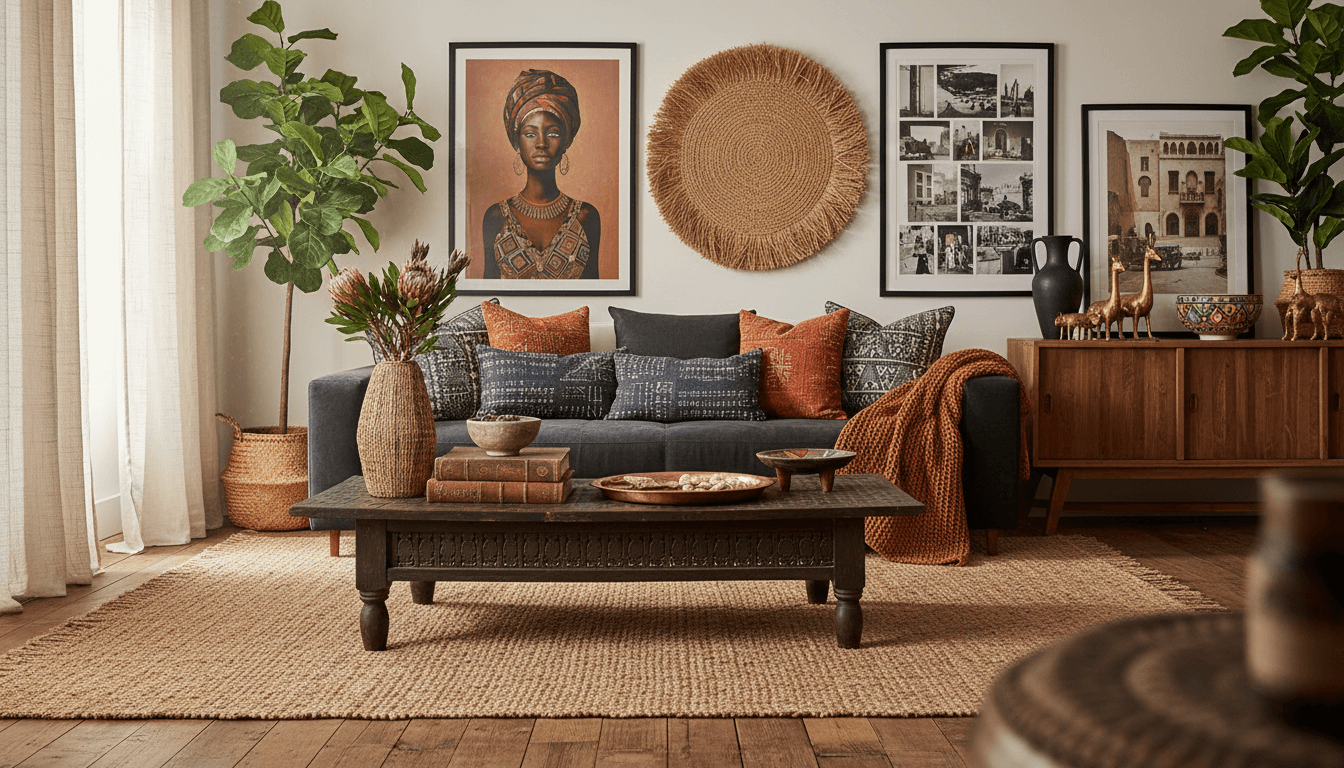
[IMAGE 1: A warm, layered living room with mudcloth pillows, a large jute rug, carved wood accents, and a gallery wall mixing African textiles with personal art. Afternoon light. Lived-in but intentional.]
What Afrohemian Decor Actually Is
Afrohemian decor draws from the richness of African diaspora design traditions and layers them with the free-spirited, collected-over-time feel of bohemian living. It's what happens when heritage, travel, and personal story become the actual design plan instead of an afterthought.
This isn't about buying a "collection" off a shelf. It's about building a room that could only belong to you.
The Signature Elements
These are the threads that run through every good Afrohemian room I've seen or designed:
Bold textiles. Mudcloth, kente, Ankara prints, hand-dyed indigo. These aren't accents. They're the backbone.
Handcrafted art. Carved masks, woven wall hangings, pottery made by someone whose name you could learn.
Natural fibers. Jute, sisal, seagrass, raffia. Everywhere. On the floor, on the walls, holding your stuff.
Warm woods. Mango wood, acacia, reclaimed teak. Nothing shiny. Nothing that looks like it came from a boardroom.
Shop This Room
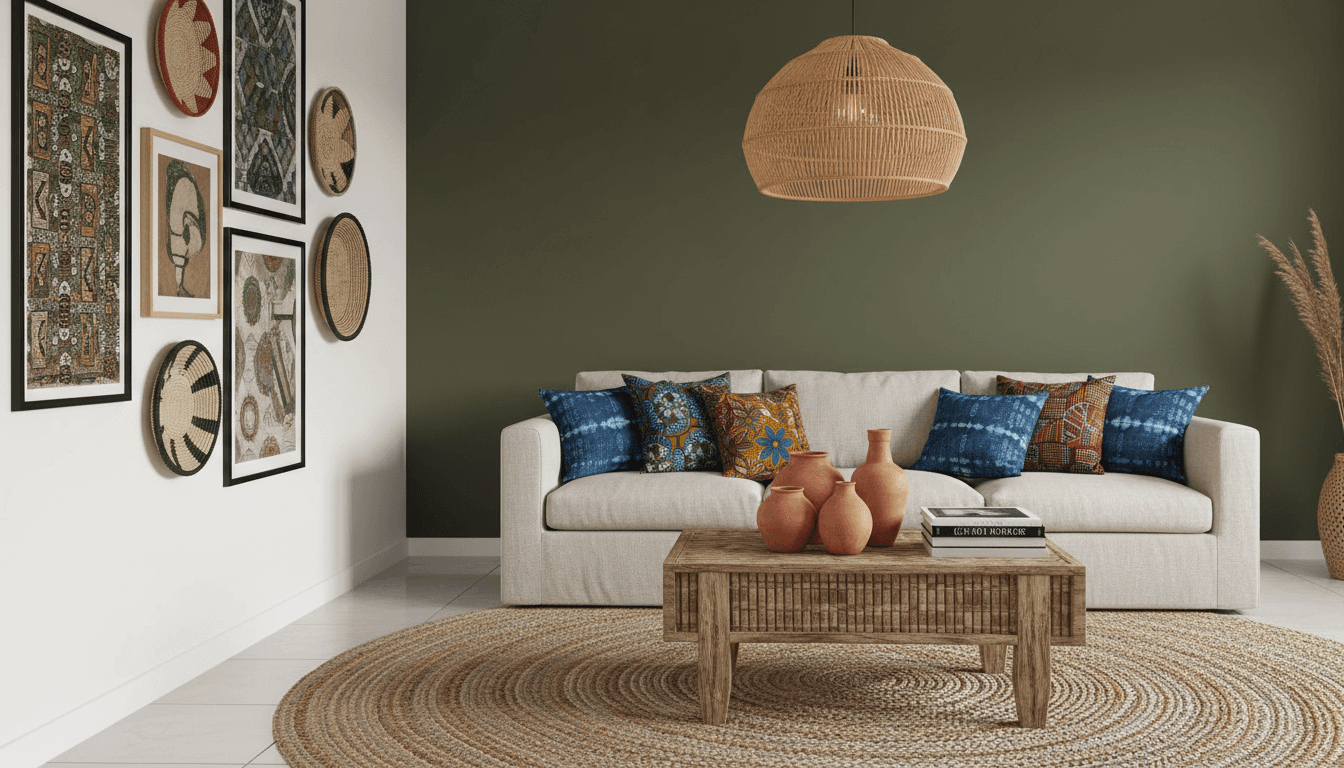
Here's where I'd start if I were building this from scratch today. Every one of these pieces earns its spot by doing something in the layout, not just looking pretty on a shelf.
The rug that grounds everything. A large-scale jute or sisal. Go bigger than you think. 8x10 minimum in a living room.
Mudcloth throw pillows. The real ones. Look for hand-sewn, fair-trade sourcing.
A carved wood stool. Use it as a side table, a plant stand, or just let it sit there being beautiful.
Woven seagrass baskets. Storage that looks like art. Stack them. Hang them on the wall.
A rattan pendant light. The single fastest way to change the mood of a room.
Terracotta ceramic vases. Cluster three different heights on a shelf or console.
Block print curtains in indigo. Soft, not stiff. These should move when someone walks by.
A warm linen throw blanket. Draped over the arm of the sofa. Not folded into a perfect rectangle.
---
The Build: Step by Step
Here's how I walk clients through this. It's the same order every time, because order matters more than the stuff.
Step 1: The Base Palette
Start with your walls and your biggest pieces. You want warmth, not noise.
I go with a warm cream or soft clay on the walls. Not white. White fights everything we're about to layer in. If you're renting and stuck with white walls, a warm-toned peel and stick wallpaper on one accent wall changes the whole temperature of the room. I had a client in a 14x16 rental living room in Charlotte, and a single wallpapered wall behind the sofa made it feel like a completely different apartment.
Your sofa, your rug, your curtains. These are the big swaths of color or neutral. Pick two warm neutrals and one rich tone. My go-to: cream sofa, jute rug, indigo curtains.
Step 2: Key Patterns and Textiles
This is where it gets fun. And honestly, this is where most rooms stall out because the fear kicks in.
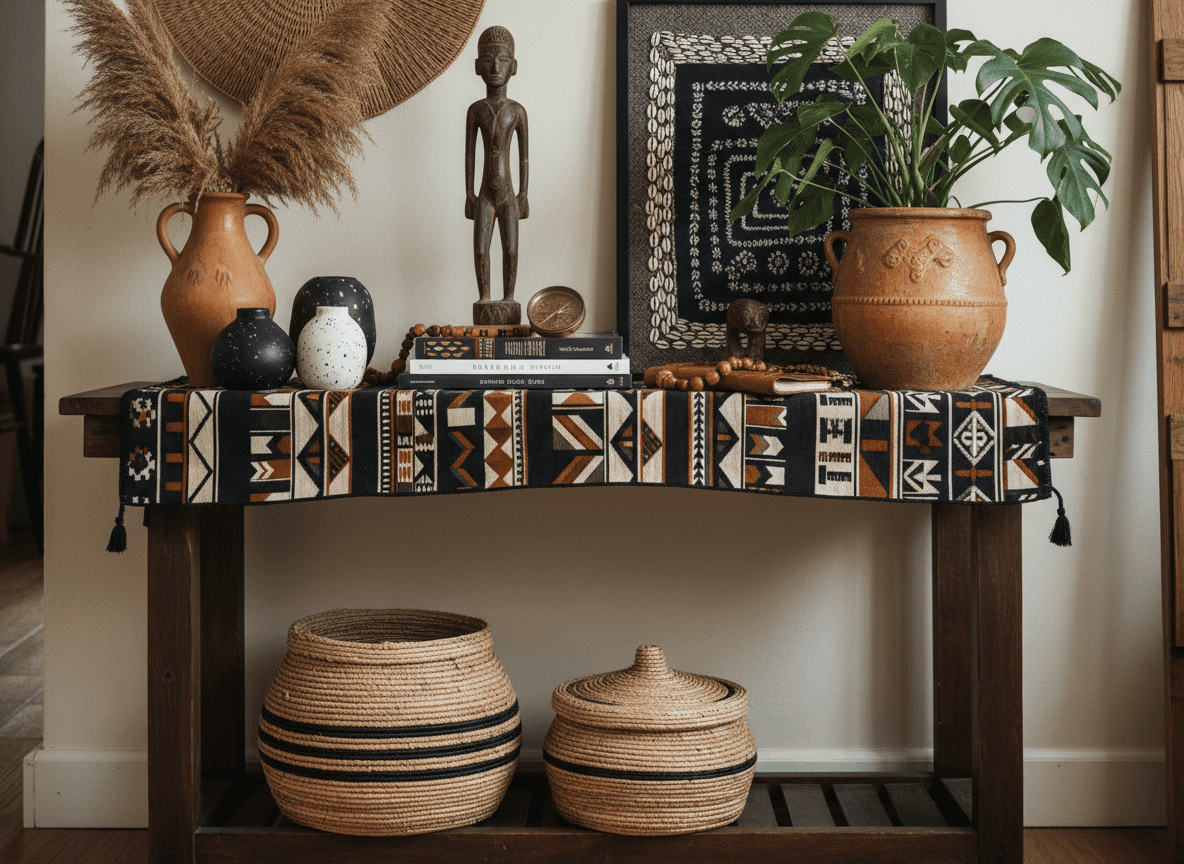
Here's the rule: vary the scale of your patterns. One large-scale print (a big Ankara pillow, a patterned throw). One medium-scale (mudcloth with its smaller geometric lines). One micro or textural pattern (a woven basket, a chunky knit blanket).
When the scales are different, your eye reads it as "collected" instead of "competing."
Textiles I reach for over and over:
Hand-dyed indigo fabric for wrapping a pillow or framing as art
Ankara print pillow covers in bold geometrics
Mix them. Don't match them.
Step 3: Furniture Silhouettes
Keep the lines simple and low. Afrohemian rooms breathe when the furniture doesn't fight for attention. The textiles and art are the stars. The furniture is the stage.
A low-profile sofa in a warm neutral is your anchor. I like straight arms, not rolled. It reads modern without being cold.
For accent seating, a rattan lounge chair or a leather butterfly chair. Something with visible texture and a relaxed posture.
Side tables and coffee tables. This is where wood does its work. A mango wood coffee table with visible grain. Something that looks like it existed before your room did.
Step 4: Lighting
Most rooms I walk into have one overhead light and zero warmth. That's not a room. That's a waiting area.
Layer it. A woven rattan pendant over the seating area throws beautiful patterned shadows at night. A brass floor lamp beside the reading corner. A couple of amber glass table lamps on surfaces around the room.
You want the room to glow, not glare. Warm bulbs, 2700K, always. I will not budge on this.
Step 5: Styling Rules That Keep It From Looking Like a Mishmosh
Here's where the engineering part of my brain earns its keep.
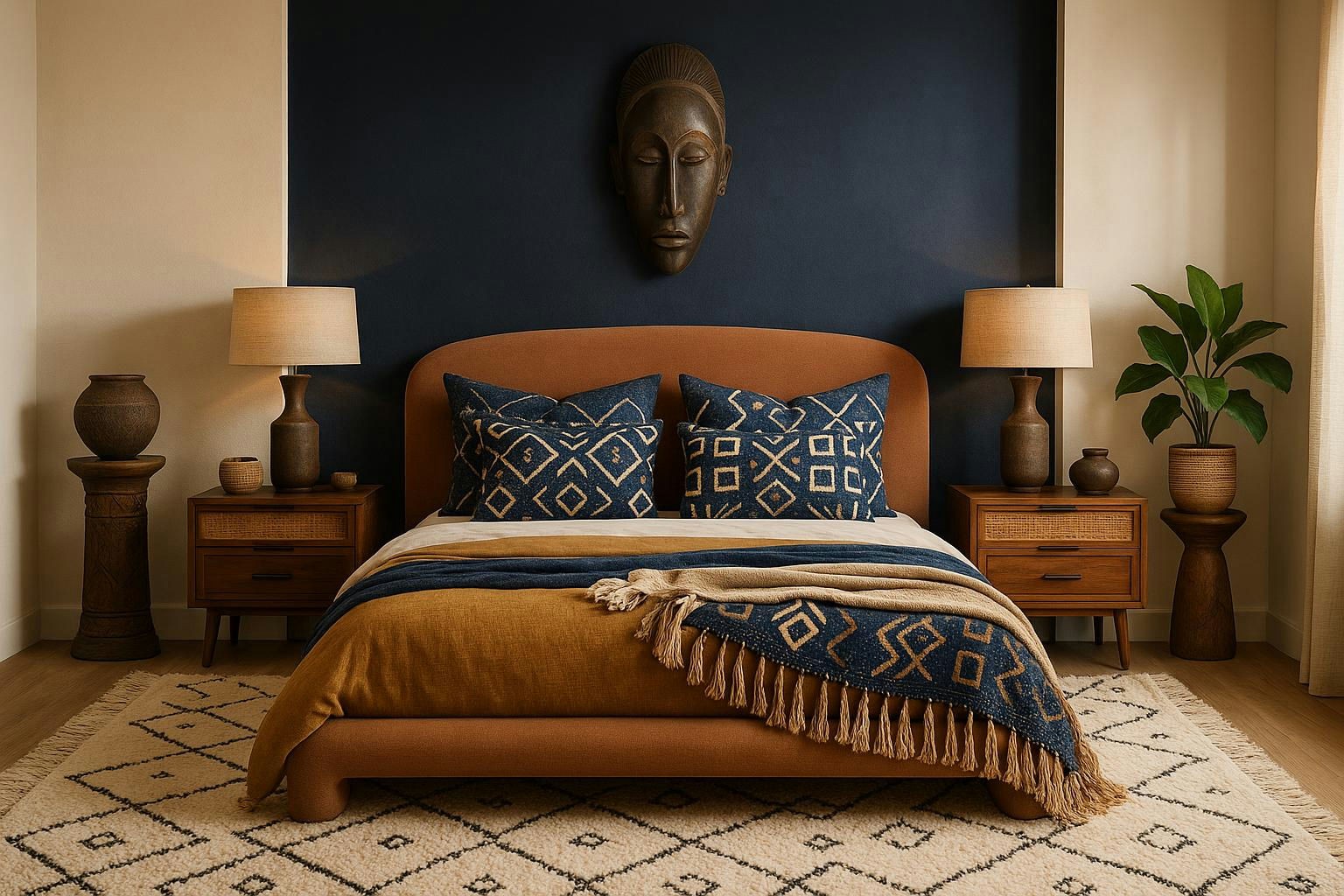
The triangle rule. Every color should appear in at least three spots in the room, forming a visual triangle. If your indigo is in the curtains, it needs to show up in a pillow across the room and maybe in a piece of art on the adjacent wall. Your eye follows that triangle and the room feels cohesive even when the pieces are wildly different.
The odd-number cluster. When grouping objects on a shelf or console, use three or five. Three baskets. Five vases. It feels organic instead of arranged.
One empty surface. For every surface you fill, leave one empty or nearly empty. A clear nightstand next to a full bookshelf. This is the breathing room.
Hang art lower than you think. Center it at 57 inches from the floor, which is average eye height. I've measured this in probably forty rooms now and it never stops being right.
---
This Is Exactly What I Do for Clients
Want me to design your room like this? I'll build you a layout plan, a sourcing list, and styling direction tailored to your actual room, your actual life.
---
Respect and Sourcing: Getting This Right
I need to say this part plainly.
Afrohemian decor done well is rooted in appreciation, not appropriation. There's a difference between buying a mass-produced "tribal" pillow from a fast-fashion home store and seeking out a mudcloth made by Malian artisans using a centuries-old process.
The difference matters. And honestly, you can feel it in the room. Real handcraft has weight, irregularity, presence. It changes the energy of what you're building.
Where to source with intention:
Maker markets and artisan cooperatives. Look for fair-trade certification or direct-trade relationships.
Black-owned home decor shops. Many specialize in connecting buyers with African artisan communities.
When buying on Amazon, look for sellers that specify handmade, fair-trade, or artisan-made. Read the descriptions. Look at the photos closely.
Local artists. Wherever you live, there are artists making work that speaks to diaspora experiences. Buy directly when you can.
Thrift and estate sales. Some of the most meaningful pieces I've placed in client rooms came from someone else's collection first. A hand-carved bookend from a Goodwill in Durham, NC, 4.5 inches tall, shaped like a seated figure. Twelve dollars. It anchored an entire shelf.
Don't costume a room. Collect for it. There's a wide line between the two, and staying on the right side starts with caring enough to ask where something came from.
---
The Start Small Plan (For Renters and the Budget-Conscious)
You don't need to redo everything. You need three moves.
Move 1: Pillows. Swap out whatever's on your sofa right now for three mudcloth or Ankara pillow covers. Different patterns, different scales. Keep the inserts you already have.
Move 2: Art. One piece. Something that makes you stop. Lean it on a shelf if you can't drill into the wall. A framed African print or a textile you found somewhere and had framed yourself.
Move 3: Baskets. Two or three woven wall baskets hung in a cluster. They replace whatever generic thing is on that wall right now and they cost almost nothing.
Total investment: under $150. Total impact: someone walks in and says, "this feels like you."
That's the whole point.
The Go Big Plan (For Homeowners Ready to Commit)
When you own the walls and the floors and the light fixtures, the room can become something really specific.
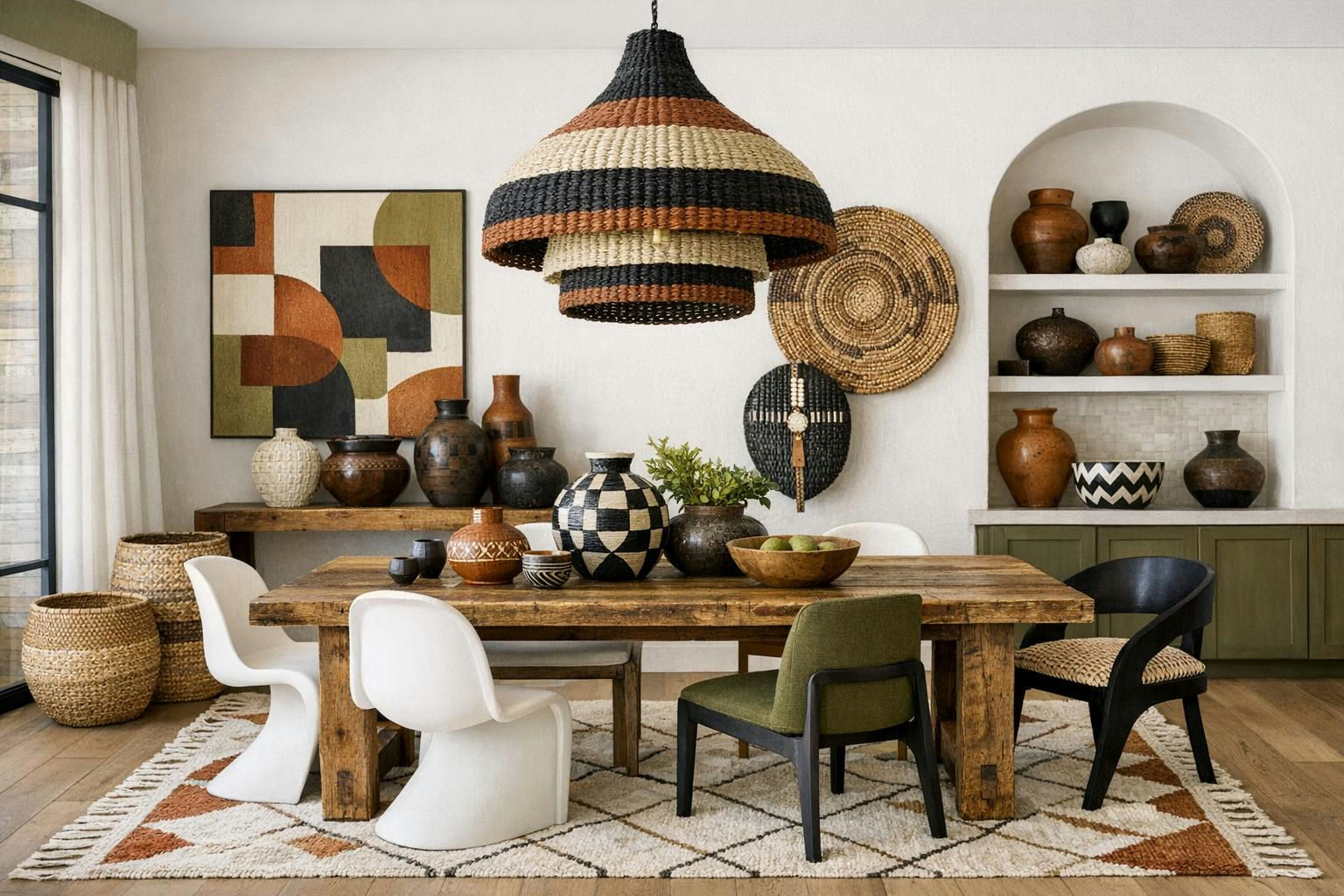
The feature wall. Not an accent wall in a loud paint color. A textured wall. A peel and stick grasscloth wallpaper in warm sisal. Or a gallery wall that takes up 60% of the surface, mixing textiles, framed art, baskets, and personal photographs. Treat the wall like a composition, not a grid.
The statement rug. Go handwoven. Go large. A hand-knotted wool rug with African-inspired geometric patterns in indigo and cream. This becomes the floor plan. Furniture arranges around it. Everything else in the room responds to it.
The lighting overhaul. Replace the builder-grade flush mount with the woven pendant. Add the floor lamp. Add the table lamps. When the sun goes down, this room should feel like it was lit on purpose.
The furniture anchor. One real piece of furniture that carries heritage. A hand-carved wooden console or a vintage credenza you find at a local shop. Something with a past.
---
Bringing It Home
I think what makes Afrohemian decor so compelling to me is that it demands honesty. You can't fake a collected room. You can't buy a "look" in one cart and have it mean something.
The rooms I love most are the ones where someone can point to a piece and tell me a story. Where they got it. Who gave it to them. What it reminded them of.
The layout holds it together. The function makes it livable. The personality makes it yours.
If you're not sure where to start, or you've got a room full of things you love but can't figure out how to make them work together, that's literally what I do.
I'd love to help you build a room worth telling stories about.
Afrohemian Decor: The Virmae Guide to a Collected Home That Feels Global and Grounded
Where is the color. More and more our society has moved away to become less overt and more agreeable, which is wonderful in relationship, but so sad in design. The age of staging has brought us wonderfully beautiful homes that are devoid of personality. And I am on a mission to bring it back.
Let's travel and show where we've been, show off our precious novelties that have been handed down, buy the local art that you like and build a room around it.
So we are going to work through styles and how to attain them without your place looking like a mishmosh. We can tie your personality in beautifully with some rules.
Today we start with Afrohemian decor. Let's dive in.
[IMAGE 1: A warm, layered living room with mudcloth pillows, a large jute rug, carved wood accents, and a gallery wall mixing African textiles with personal art. Afternoon light. Lived-in but intentional.]
What Afrohemian Decor Actually Is
Afrohemian decor draws from the richness of African diaspora design traditions and layers them with the free-spirited, collected-over-time feel of bohemian living. It's what happens when heritage, travel, and personal story become the actual design plan instead of an afterthought.
This isn't about buying a "collection" off a shelf. It's about building a room that could only belong to you.
The Signature Elements
These are the threads that run through every good Afrohemian room I've seen or designed:
Bold textiles. Mudcloth, kente, Ankara prints, hand-dyed indigo. These aren't accents. They're the backbone.
Handcrafted art. Carved masks, woven wall hangings, pottery made by someone whose name you could learn.
Natural fibers. Jute, sisal, seagrass, raffia. Everywhere. On the floor, on the walls, holding your stuff.
Warm woods. Mango wood, acacia, reclaimed teak. Nothing shiny. Nothing that looks like it came from a boardroom.
Shop This Room
Here's where I'd start if I were building this from scratch today. Every one of these pieces earns its spot by doing something in the layout, not just looking pretty on a shelf.
The rug that grounds everything. A large-scale jute or sisal. Go bigger than you think. 8x10 minimum in a living room.
Mudcloth throw pillows. The real ones. Look for hand-sewn, fair-trade sourcing.
A carved wood stool. Use it as a side table, a plant stand, or just let it sit there being beautiful.
Woven seagrass baskets. Storage that looks like art. Stack them. Hang them on the wall.
A rattan pendant light. The single fastest way to change the mood of a room.
Terracotta ceramic vases. Cluster three different heights on a shelf or console.
Block print curtains in indigo. Soft, not stiff. These should move when someone walks by.
A warm linen throw blanket. Draped over the arm of the sofa. Not folded into a perfect rectangle.
---
The Build: Step by Step
Here's how I walk clients through this. It's the same order every time, because order matters more than the stuff.
Step 1: The Base Palette
Start with your walls and your biggest pieces. You want warmth, not noise.
I go with a warm cream or soft clay on the walls. Not white. White fights everything we're about to layer in. If you're renting and stuck with white walls, a warm-toned peel and stick wallpaper on one accent wall changes the whole temperature of the room. I had a client in a 14x16 rental living room in Charlotte, and a single wallpapered wall behind the sofa made it feel like a completely different apartment.
Your sofa, your rug, your curtains. These are the big swaths of color or neutral. Pick two warm neutrals and one rich tone. My go-to: cream sofa, jute rug, indigo curtains.
Step 2: Key Patterns and Textiles
This is where it gets fun. And honestly, this is where most rooms stall out because the fear kicks in.
Here's the rule: vary the scale of your patterns. One large-scale print (a big Ankara pillow, a patterned throw). One medium-scale (mudcloth with its smaller geometric lines). One micro or textural pattern (a woven basket, a chunky knit blanket).
When the scales are different, your eye reads it as "collected" instead of "competing."
Textiles I reach for over and over:
Hand-dyed indigo fabric for wrapping a pillow or framing as art
Ankara print pillow covers in bold geometrics
Mix them. Don't match them.
Step 3: Furniture Silhouettes
Keep the lines simple and low. Afrohemian rooms breathe when the furniture doesn't fight for attention. The textiles and art are the stars. The furniture is the stage.
A low-profile sofa in a warm neutral is your anchor. I like straight arms, not rolled. It reads modern without being cold.
For accent seating, a rattan lounge chair or a leather butterfly chair. Something with visible texture and a relaxed posture.
Side tables and coffee tables. This is where wood does its work. A mango wood coffee table with visible grain. Something that looks like it existed before your room did.
Step 4: Lighting
Most rooms I walk into have one overhead light and zero warmth. That's not a room. That's a waiting area.
Layer it. A woven rattan pendant over the seating area throws beautiful patterned shadows at night. A brass floor lamp beside the reading corner. A couple of amber glass table lamps on surfaces around the room.
You want the room to glow, not glare. Warm bulbs, 2700K, always. I will not budge on this.
Step 5: Styling Rules That Keep It From Looking Like a Mishmosh
Here's where the engineering part of my brain earns its keep.
The triangle rule. Every color should appear in at least three spots in the room, forming a visual triangle. If your indigo is in the curtains, it needs to show up in a pillow across the room and maybe in a piece of art on the adjacent wall. Your eye follows that triangle and the room feels cohesive even when the pieces are wildly different.
The odd-number cluster. When grouping objects on a shelf or console, use three or five. Three baskets. Five vases. It feels organic instead of arranged.
One empty surface. For every surface you fill, leave one empty or nearly empty. A clear nightstand next to a full bookshelf. This is the breathing room.
Hang art lower than you think. Center it at 57 inches from the floor, which is average eye height. I've measured this in probably forty rooms now and it never stops being right.
---
This Is Exactly What I Do for Clients
Want me to design your room like this? I'll build you a layout plan, a sourcing list, and styling direction tailored to your actual room, your actual life.
---
Respect and Sourcing: Getting This Right
I need to say this part plainly.
Afrohemian decor done well is rooted in appreciation, not appropriation. There's a difference between buying a mass-produced "tribal" pillow from a fast-fashion home store and seeking out a mudcloth made by Malian artisans using a centuries-old process.
The difference matters. And honestly, you can feel it in the room. Real handcraft has weight, irregularity, presence. It changes the energy of what you're building.
Where to source with intention:
Maker markets and artisan cooperatives. Look for fair-trade certification or direct-trade relationships.
Black-owned home decor shops. Many specialize in connecting buyers with African artisan communities.
When buying on Amazon, look for sellers that specify handmade, fair-trade, or artisan-made. Read the descriptions. Look at the photos closely.
Local artists. Wherever you live, there are artists making work that speaks to diaspora experiences. Buy directly when you can.
Thrift and estate sales. Some of the most meaningful pieces I've placed in client rooms came from someone else's collection first. A hand-carved bookend from a Goodwill in Durham, NC, 4.5 inches tall, shaped like a seated figure. Twelve dollars. It anchored an entire shelf.
Don't costume a room. Collect for it. There's a wide line between the two, and staying on the right side starts with caring enough to ask where something came from.
---
The Start Small Plan (For Renters and the Budget-Conscious)
You don't need to redo everything. You need three moves.
Move 1: Pillows. Swap out whatever's on your sofa right now for three mudcloth or Ankara pillow covers. Different patterns, different scales. Keep the inserts you already have.
Move 2: Art. One piece. Something that makes you stop. Lean it on a shelf if you can't drill into the wall. A framed African print or a textile you found somewhere and had framed yourself.
Move 3: Baskets. Two or three woven wall baskets hung in a cluster. They replace whatever generic thing is on that wall right now and they cost almost nothing.
Total investment: under $150. Total impact: someone walks in and says, "this feels like you."
That's the whole point.
The Go Big Plan (For Homeowners Ready to Commit)
When you own the walls and the floors and the light fixtures, the room can become something really specific.
The feature wall. Not an accent wall in a loud paint color. A textured wall. A peel and stick grasscloth wallpaper in warm sisal. Or a gallery wall that takes up 60% of the surface, mixing textiles, framed art, baskets, and personal photographs. Treat the wall like a composition, not a grid.
The statement rug. Go handwoven. Go large. A hand-knotted wool rug with African-inspired geometric patterns in indigo and cream. This becomes the floor plan. Furniture arranges around it. Everything else in the room responds to it.
The lighting overhaul. Replace the builder-grade flush mount with the woven pendant. Add the floor lamp. Add the table lamps. When the sun goes down, this room should feel like it was lit on purpose.
The furniture anchor. One real piece of furniture that carries heritage. A hand-carved wooden console or a vintage credenza you find at a local shop. Something with a past.
---
Bringing It Home
I think what makes Afrohemian decor so compelling to me is that it demands honesty. You can't fake a collected room. You can't buy a "look" in one cart and have it mean something.
The rooms I love most are the ones where someone can point to a piece and tell me a story. Where they got it. Who gave it to them. What it reminded them of.
The layout holds it together. The function makes it livable. The personality makes it yours.
If you're not sure where to start, or you've got a room full of things you love but can't figure out how to make them work together, that's literally what I do.
I'd love to help you build a room worth telling stories about.
Other Blogs
Other Similar Blogs
Your go-to destination for insightful articles, tips, and inspiration on all things landscaping and outdoor living
Other Blogs
Other Similar Blogs
Your go-to destination for insightful articles, tips, and inspiration on all things landscaping and outdoor living
Other Blogs
Other Similar Blogs
Your go-to destination for insightful articles, tips, and inspiration on all things landscaping and outdoor living